
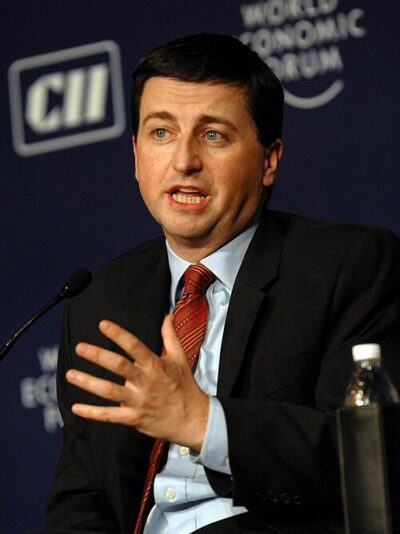
Douglas Alexander
Douglas Alexander is a British politician. Born October 26, 1967, in Glasgow. Positions held include Shadow Foreign Secretary (2011–2015), Shadow Secretary of State for Work and Pensions (2010–2011) and Shadow Secretary of State for International Development (2010). Educated at University of Edinburgh and Park Mains High School.
Facts
29 facts · 1 confirmed by two sources · 8 cited · 20 from one source
Where this comes from
Papalocal keeps its own record. It started from these sources; what each one said is kept here as it was copied, so a change on their side never changes this page by itself. Tap one to read its version.
What Wikidata says · copied November 18, 2026 · revision 2562967996
- Described as
- British politician (born 1967)
- Other names
- Douglas Garven Alexander
- Born
- October 26, 1967 · 1 reference
- Born in
- Glasgow · 1 reference
- Name at birth
- Douglas Garven Alexander
- Citizen of
- United Kingdom
- Occupation
- politician · 2 references
- Positions held
- Shadow Foreign Secretary (2011–2015); Shadow Secretary of State for Work and Pensions (2010–2011); Shadow Secretary of State for International Development (2010); Secretary of State for International Development (2007–2010); Secretary of State for Scotland (2 times) (2006–); Secretary of State for Transport (2006–2007); Minister of State for Europe (2005–2006); Minister of State for Trade (2004–2005); Minister for the Cabinet Office (2003–2004); Member of the Privy Council of the United Kingdom (2005–) · 1 reference; member of the 55th Parliament of the United Kingdom (2010–2015) · 1 reference; member of the 54th Parliament of the United Kingdom (2005–2010) · 1 reference; member of the 53rd Parliament of the United Kingdom (2001–2005) · 1 reference; member of the 52nd Parliament of the United Kingdom (1997–2001) · 1 reference; Chancellor of the Duchy of Lancaster (2003–2004) · 1 reference
- Political party
- Scottish Labour Party; Labour Party · 1 reference
- Education
- University of Edinburgh; Park Mains High School; Pearson College UWC; University of Edinburgh School of Law
- Siblings
- Wendy Alexander
- Religion
- Church of Scotland
- Website
- http://www.douglasalexander.labour.co.uk/
- Wikipedias with a page
- 24
Wikidata item Q259106 (wikidata.org/wiki/Q259106), public domain (CC0). Copied November 18, 2026.
What Wikipedia says · copied November 18, 2026 · revision 1382795478
Douglas Garven Alexander (born 26 October 1967) is a Scottish politician who has served as Secretary of State for Scotland since 2025, having previously held the position from 2006 to 2007. A member of the Labour Party, he has been Member of Parliament (MP) for Lothian East since 2024. He was previously MP for Paisley and Renfrewshire South, formerly Paisley South, from 1997 to 2015 and served in the cabinets of Tony Blair and Gordon Brown, lastly as International Development Secretary from 2007 to 2010.
Born in Glasgow, Alexander attended Park Mains High School and then won a scholarship for Lester B. Pearson United World College of the Pacific in Canada. He studied at the University of Edinburgh and spent a year at the University of Pennsylvania where he worked for Michael Dukakis on his 1988 presidential campaign. He returned to the University of Edinburgh to study for an LLB, before working shadow trade secretary Gordon Brown in 1990. Alexander then qualified and worked as a solicitor. He was first elected to Parliament at the 1997 Paisley South by-election. In 2001, he was appointed by Tony Blair as Minister of State for e-Commerce and Competitiveness in the Department of Trade and Industry. He was Minister of State for the Cabinet Office from 2002 to 2003. In 2003, he was promoted to Minister for the Cabinet Office and Chancellor of the Duchy of Lancaster. In 2004, he was appointed Minister of State for Trade. Following the 2005 general election, he was appointed Minister of State for Europe and made a member of the Privy Council. During this period, he started attending cabinet. In 2006, he was appointed to serve jointly as both Secretary of State for Scotland and Secretary of State for Transport. In 2007, when Gordon Brown became Prime Minister, he appointed Alexander as Secretary of State for International Development.
After Labour lost the 2010 general election Alexander co-chaired David Miliband's leadership campaign. When Ed Miliband became the party's leader, Alexander was elected to the Shadow cabinet and was made the Shadow Secretary of State for Work and Pensions. He held this position until a 2011 reshuffle, when he was appointed Shadow Foreign Secretary. In October 2013, he was appointed by Miliband as the party's chair of general election strategy. In 2015, he lost his seat to 20 year-old Mhairi Black of the Scottish National Party, in what was one of the worst results for Labour; with forty seats lost to the SNP nationwide. After leaving Parliament, Alexander worked as a professor for various universities, as a Council Member on the European Council on Foreign Relations, in broadcasting, and as chair of the board of trustees for UNICEF UK from 2018 to 2020.
In December 2022, Alexander sought out a return to Parliament by applying to be Labour's parliamentary candidate for East Lothian, held by the Alba Party's Kenny MacAskill. He won the selection to stand for the Labour and Co-operative parties in the constituency in February 2023 and was elected as the MP for the redrawn Lothian East constituency in July 2024. He returned to government as minister of state for trade policy and was additionally appointed Minister of State at the Cabinet Office in February 2025. He was promoted to Scotland Secretary in the 2025 cabinet reshuffle and reappointed by Andy Burnham in July 2026.
- Born, in its opening lines
- October 26, 1967
From the Wikipedia article “Douglas Alexander” (en.wikipedia.org/wiki/Douglas_Alexander), by its contributors, under CC BY-SA 4.0 (creativecommons.org/licenses/by-sa/4.0/). Copied November 18, 2026; not changed.
Confirmed Two sources agree. Cited One source, and it names where it got it. One source One source, without a reference of its own. Sources disagree The sources disagree. We show the best-supported value and keep theirs below.
