
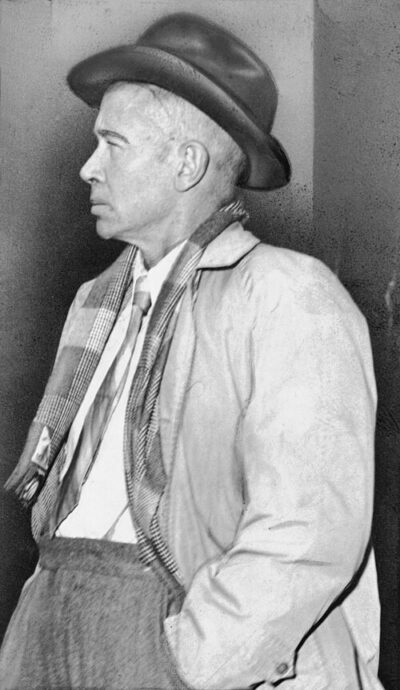
E. E. Cummings
E. E. Cummings was an American author. Born October 14, 1894, in Cambridge. Died September 3, 1962, in Joy Farm. Known for The Enormous Room, Tulips and Chimneys and is 5. Educated at Harvard University and Cambridge Rindge and Latin School. Awards include Guggenheim Fellowship, Bollingen Prize and Shelley Memorial Award.
Facts
36 facts · 2 confirmed by two sources · 20 cited · 14 from one source
Where this comes from
Papalocal keeps its own record. It started from these sources; what each one said is kept here as it was copied, so a change on their side never changes this page by itself. Tap one to read its version.
What Wikidata says · copied November 13, 2026 · revision 2568216289
- Described as
- American author (1894–1962)
- Other names
- Edward Estlin Cummings, e e cummings, Edward Eatlin Cummings, e. e. cummings, EE cummings, E. Estlin Cummings
- Born
- October 14, 1894 · 19 references
- Died
- September 3, 1962 · 18 references
- Born in
- Cambridge · 2 references
- Died in
- Joy Farm
- Buried in
- Forest Hills Cemetery
- Name at birth
- Edward Estlin Cummings
- Citizen of
- United States
- Occupation
- poet · 3 references; painter · 2 references; playwright · 2 references; writer · 2 references; novelist; artist · 1 reference
- Political party
- Republican Party
- Education
- Harvard University · 1 reference; Cambridge Rindge and Latin School · 1 reference
- Member of
- Academy of American Poets; American Academy of Arts and Letters
- Genre
- modernist literature
- Known for
- The Enormous Room · 1 reference; Tulips and Chimneys · 1 reference; is 5 · 1 reference; CIOPW · 1 reference; EIMI · 1 reference; No Thanks · 1 reference; Santa Claus: A Morality · 1 reference; Fairy Tales · 1 reference; pity this busy monster, manunkind
- Awards
- Guggenheim Fellowship (1933) · 1 reference; Bollingen Prize (1957) · 1 reference; Shelley Memorial Award (1945) · 1 reference; Fellowship of the Academy of American Poets (1950) · 1 reference
- Father
- Edward Cummings
- Religion
- Unitarianism
- Lived in
- Irving Street · 1 reference; E.E. Cummings House (1894–1917) · 1 reference
- Wikipedias with a page
- 62
Wikidata item Q298703 (wikidata.org/wiki/Q298703), public domain (CC0). Copied November 13, 2026.
What Wikipedia says · copied November 13, 2026 · revision 1383199914
Edward Estlin Cummings (October 14, 1894 – September 3, 1962), commonly known as e e cummings or E. E. Cummings, was an American poet, painter, essayist, author, and playwright. During World War I, he worked as an ambulance driver and was imprisoned in an internment camp, which provided the basis for his novel The Enormous Room (1922). The following year he published his first collection of poetry, Tulips and Chimneys, which showed his early experiments with grammar and typography. He wrote four plays, the most successful of which were HIM (1927) and Santa Claus: A Morality (1946). He wrote EIMI (1933), a travelog of the Soviet Union, and delivered the Charles Eliot Norton Lectures in poetry, published as i—six nonlectures (1953). Fairy Tales (1965), a collection of short stories, was published posthumously.
Cummings wrote approximately 2,900 poems. He is often regarded as one of the most important American poets of the 20th century. He is associated with modernist free-form poetry, and much of his work uses idiosyncratic syntax and lower-case spellings for poetic expression. M. L. Rosenthal wrote:The chief effect of Cummings' jugglery with syntax, grammar, and diction was to blow open otherwise trite and bathetic motifs through a dynamic rediscovery of the energies sealed up in conventional usage ... He succeeded masterfully in splitting the atom of the cute commonplace.
For Norman Friedman, Cummings's inventions "are best understood as various ways of stripping the film of familiarity from language to strip the film of familiarity from the world. Transform the word, he seems to have felt, and you are on the way to transforming the world."
The poet Randall Jarrell said of Cummings, "No one else has ever made avant-garde, experimental poems so attractive to the general and the special reader." James Dickey wrote, "I think that Cummings is a daringly original poet, with more vitality and more sheer, uncompromising talent than any other living American writer." Dickey described himself as "ashamed and even a little guilty in picking out flaws" in Cummings's poetry, which he compared to noting "the aesthetic defects in a rose. It is better to say what must finally be said about Cummings: that he has helped to give life to the language."
- Born, in its opening lines
- October 14, 1894
- Died, in its opening lines
- September 3, 1962
From the Wikipedia article “E. E. Cummings” (en.wikipedia.org/wiki/E._E._Cummings), by its contributors, under CC BY-SA 4.0 (creativecommons.org/licenses/by-sa/4.0/). Copied November 13, 2026; not changed.
Confirmed Two sources agree. Cited One source, and it names where it got it. One source One source, without a reference of its own. Sources disagree The sources disagree. We show the best-supported value and keep theirs below.
