
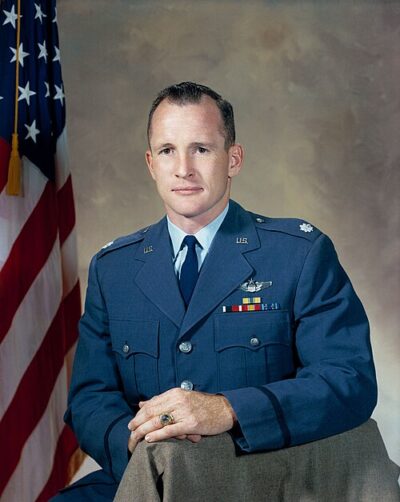
Ed White
Ed White was an American astronaut. Born November 14, 1930, in San Antonio. Died January 27, 1967, in Cape Canaveral Launch Complex 34. Educated at University of Michigan and U.S. Air Force Test Pilot School. Awards include Harmon Trophy, Congressional Space Medal of Honor and National Aviation Hall of Fame.
Facts
29 facts · 2 confirmed by two sources · 10 cited · 17 from one source
Where this comes from
Papalocal keeps its own record. It started from these sources; what each one said is kept here as it was copied, so a change on their side never changes this page by itself. Tap one to read its version.
What Wikidata says · copied November 13, 2026 · revision 2566920238
- Described as
- American astronaut (1930-1967)
- Other names
- Edward Higgins White, Edward Higgins White II, Edward H. White II, Edward White
- Born
- November 14, 1930 · 4 references
- Died
- January 27, 1967 · 4 references
- Born in
- San Antonio
- Died in
- Cape Canaveral Launch Complex 34 · 1 reference
- Buried in
- West Point Cemetery
- Cause of death
- smoke inhalation injury · 1 reference
- Citizen of
- United States
- Occupation
- military officer; test pilot; astronaut (1962–) · 1 reference; military flight engineer; athletics competitor
- Worked for
- National Aeronautics and Space Administration
- Education
- University of Michigan (1959); U.S. Air Force Test Pilot School (–1959); United States Military Academy (1952) · 1 reference
- Member of
- NASA Astronaut Group 2 · 1 reference
- Sport
- athletics
- Awards
- Harmon Trophy; Congressional Space Medal of Honor (1997) · 1 reference; National Aviation Hall of Fame (2009) · 1 reference; United States Astronaut Hall of Fame; NASA Distinguished Service Medal (1969) · 1 reference; International Space Hall of Fame (1982) · 2 references; Golden Plate Award (1965) · 1 reference
- Father
- Edward Higgins White, Sr. · 1 reference
- Military branch
- United States Air Force
- Military rank
- Lieutenant Colonel
- Nickname
- Ed
- Wikipedias with a page
- 51
Wikidata item Q216726 (wikidata.org/wiki/Q216726), public domain (CC0). Copied November 13, 2026.
What Wikipedia says · copied November 13, 2026 · revision 1383630927
Edward Higgins White II (November 14, 1930 – January 27, 1967) was an American aeronautical engineer, United States Air Force officer, test pilot, and NASA astronaut. He was a member of the crews of Gemini 4 and Apollo 1.
After graduating from West Point in 1952 with a Bachelor of Science degree, White was sent to flight training, and assigned to the 22nd Fighter Day Squadron at Bitburg Air Base, West Germany, where he flew the F-86 Sabre and F-100 Super Sabre fighters. In 1958, he enrolled in the University of Michigan to study aeronautical engineering, receiving his Master of Science degree in 1959. White then received test pilot training at Edwards Air Force Base, California, before being assigned as a test pilot for the Aeronautical Systems Division at Wright-Patterson Air Force Base, Ohio.
White was selected as one of the second group of astronauts, the so-called "Next Nine", who were chosen to take part in the Gemini and Apollo missions. He was assigned as pilot of Gemini 4 alongside command pilot James McDivitt. On June 3, 1965, White became the first American to walk in space. He was then assigned as senior pilot of the first crewed Apollo mission, Apollo 1. White died on January 27, 1967, alongside astronauts Virgil "Gus" Grissom and Roger B. Chaffee in a fire during pre-launch testing for Apollo 1 at Cape Canaveral, Florida. He was awarded the NASA Distinguished Service Medal for his flight in Gemini 4 and was then awarded the Congressional Space Medal of Honor posthumously.
- Born, in its opening lines
- November 14, 1930
- Died, in its opening lines
- January 27, 1967
From the Wikipedia article “Ed White (astronaut)” (en.wikipedia.org/wiki/Ed_White_(astronaut)), by its contributors, under CC BY-SA 4.0 (creativecommons.org/licenses/by-sa/4.0/). Copied November 13, 2026; not changed.
Confirmed Two sources agree. Cited One source, and it names where it got it. One source One source, without a reference of its own. Sources disagree The sources disagree. We show the best-supported value and keep theirs below.
