
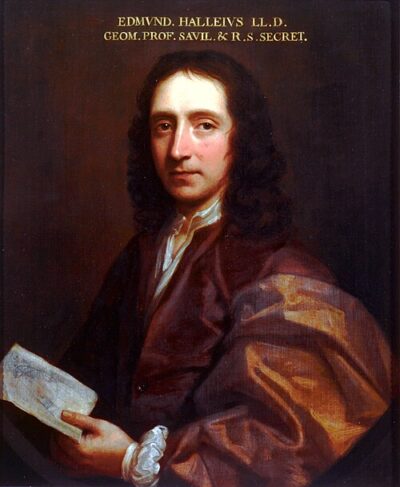
Edmond Halley
Edmond Halley was an English astronomer, mathematician, geophysicist, meteorologist and physicist. Born November 8, 1656, in Haggerston. Died January 25, 1742, in Greenwich. Positions held include Astronomer Royal (1720–1742) and Savilian Professor of Geometry (1704–1742). Known for Astronomiae cometicae synopsis and Halley's method. Educated at St Paul's School and The Queen's College. Awards include Fellow of the Royal Society.
Facts
35 facts · 2 confirmed by two sources · 16 cited · 17 from one source
Where this comes from
Papalocal keeps its own record. It started from these sources; what each one said is kept here as it was copied, so a change on their side never changes this page by itself. Tap one to read its version.
What Wikidata says · copied November 16, 2026 · revision 2569213333
- Described as
- English astronomer, mathematician, geophysicist, meteorologist and physicist (1656–1742)
- Other names
- Edmund Halley
- Born
- November 8, 1656 · 11 references
- Died
- January 25, 1742 · 1 reference
- Born in
- Haggerston
- Died in
- Greenwich · 1 reference
- Buried in
- St Margaret's, Lee · 1 reference
- Citizen of
- Kingdom of England; Kingdom of Great Britain
- Occupation
- mathematician · 1 reference; geophysicist · 1 reference; astronomer · 1 reference; meteorologist · 1 reference; cartographer · 1 reference; philosopher; physicist · 1 reference; university teacher
- Positions held
- Astronomer Royal (1720–1742) · 1 reference; Savilian Professor of Geometry (1704–1742) · 1 reference
- Worked for
- Royal Observatory (1676–); Royal Mint (1696–1698) · 1 reference; University of Oxford (1704–1942) · 1 reference
- Education
- St Paul's School (–1673) · 1 reference; The Queen's College (1673–1676) · 1 reference; University of Oxford (–1678) · 3 references
- Member of
- Royal Society of London (1678–)
- Known for
- Astronomiae cometicae synopsis · 1 reference; Halley's method
- Awards
- Fellow of the Royal Society
- Field
- geophysics; meteorology; demography; mathematician · 1 reference; meteorologist · 1 reference; physicist · 1 reference
- Spouse
- Mary Tooke (1682–) · 1 reference
- Religion
- deism
- Wikipedias with a page
- 99
Wikidata item Q47434 (wikidata.org/wiki/Q47434), public domain (CC0). Copied November 16, 2026.
What Wikipedia says · copied November 16, 2026 · revision 1383769923
Edmond (or Edmund) Halley (; 8 November [O.S. 29 October] 1656 – 25 January 1742 [O.S. 14 January 1741]) was an English astronomer, mathematician and physicist. He was the second astronomer royal in Britain, succeeding John Flamsteed in 1720.
From an observatory he constructed on Saint Helena in 1676–77, Halley catalogued the southern celestial hemisphere and recorded a transit of Mercury across the Sun. He realised that a similar transit of Venus could be used to determine the distances between Earth, Venus, and the Sun. Upon his return to England, he was made a fellow of the Royal Society, and with the help of King Charles II, was granted a master's degree from Oxford.
Halley encouraged and helped fund the publication of Isaac Newton's influential Philosophiæ Naturalis Principia Mathematica (1687). From observations Halley made in September 1682, he used Newton's law of universal gravitation to compute the periodicity of Halley's Comet in his 1705 Synopsis of the Astronomy of Comets. It was named after him upon its predicted return in 1758, which he did not live to see.
Beginning in 1698, Halley made sailing expeditions and made observations on the conditions of terrestrial magnetism. In 1718, he discovered the proper motion of the "fixed stars".
- Born, in its opening lines
- November 8, 1656
- Died, in its opening lines
- January 25, 1742
From the Wikipedia article “Edmond Halley” (en.wikipedia.org/wiki/Edmond_Halley), by its contributors, under CC BY-SA 4.0 (creativecommons.org/licenses/by-sa/4.0/). Copied November 16, 2026; not changed.
Confirmed Two sources agree. Cited One source, and it names where it got it. One source One source, without a reference of its own. Sources disagree The sources disagree. We show the best-supported value and keep theirs below.
