
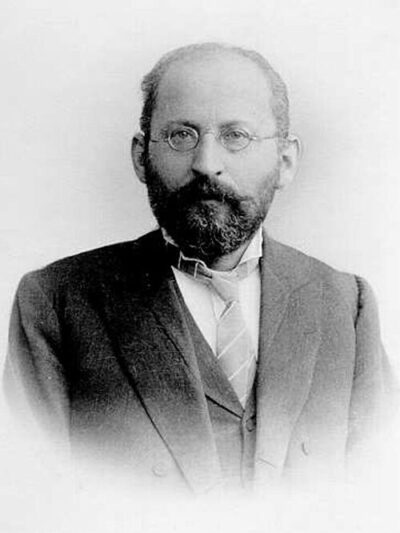
Eduard Bernstein
Eduard Bernstein was a German politician and theorist. Born January 6, 1850, in Schöneberg. Died December 18, 1932, in Berlin. Positions held include member of the Reichstag of the Weimar Republic (1920–1928) and member of the Reichstag of the German Empire (2 times) (1901–1918). Awards include Harvard Centennial Medal.
Facts
24 facts · 2 confirmed by two sources · 5 cited · 17 from one source
Where this comes from
Papalocal keeps its own record. It started from these sources; what each one said is kept here as it was copied, so a change on their side never changes this page by itself. Tap one to read its version.
What Wikidata says · copied November 16, 2026 · revision 2565962132
- Described as
- German politician and theorist (1850–1932)
- Born
- January 6, 1850 · 9 references
- Died
- December 18, 1932 · 8 references
- Born in
- Schöneberg
- Died in
- Berlin · 3 references
- Buried in
- I. Städtischer Friedhof Eisackstraße
- Citizen of
- German Empire; Weimar Republic
- Occupation
- philosopher; writer · 1 reference; economist; editing staff; historian; economic historian; opinion journalist · 1 reference; politician · 1 reference
- Positions held
- member of the Reichstag of the Weimar Republic (1920–1928); member of the Reichstag of the German Empire (2 times) (1901–1918)
- Political party
- Social Democratic Party of Germany; Independent Social Democratic Party of Germany (1917–1919); Social Democratic Workers' Party of Germany (1872–1875)
- Awards
- Harvard Centennial Medal
- Spouse
- Regina Bernstein · 1 reference
- Father
- Jakob Itzig Bernstein
- Religion
- Reform Judaism · 1 reference
- Wikipedias with a page
- 70
Wikidata item Q75786 (wikidata.org/wiki/Q75786), public domain (CC0). Copied November 16, 2026.
What Wikipedia says · copied November 16, 2026 · revision 1379610919
Eduard Bernstein (German: [ˈeːduaʁt ˈbɛʁnʃtaɪn]; 6 January 1850 – 18 December 1932) was a German social democratic politician and socialist theorist. A member of the Social Democratic Party (SPD), Bernstein is best known for his reformist challenge to Marxism known as evolutionary socialism or revisionism, in which he questioned the revolutionary predictions of Karl Marx and advocated for a gradual, parliamentary path to socialism. His political and theoretical work played a significant role in the development of social democracy and democratic socialism.
Born into a lower-middle-class Jewish family in Berlin, Bernstein became active in socialist politics in his early twenties. He spent years in exile in Switzerland and London during the period of the Anti-Socialist Laws in Germany, where he became a close associate of Friedrich Engels. During his time in London, his interactions with the reformist Fabian Society and his observation of the stability of late Victorian capitalism led him to question key tenets of orthodox Marxism.
After Engels's death in 1895, Bernstein began to publicly articulate his revisionist views. In his most influential work, Evolutionary Socialism (1899), he rejected the Hegelian dialectical method and disputed the Marxist predictions of the inevitable collapse of capitalism, the disappearance of the middle class, and the increasing immiseration of the proletariat. Instead, he argued that socialists should work for gradual social and political reforms through democratic institutions. His famous aphorism, "the goal is nothing, the movement everything," encapsulated his focus on the practical, democratic progress of the socialist movement over a dogmatic adherence to a revolutionary goal.
Although his views were officially condemned by the SPD, which maintained its orthodox Marxist Erfurt Program, the party's practical policies were largely reformist, reflecting the reality Bernstein described. His work sparked major debates within the international socialist movement, pitting him and his supporters against orthodox Marxists like Karl Kautsky and radicals like Rosa Luxemburg. During World War I, Bernstein's pacifist principles led him to break with the SPD's pro-war majority and co-found the anti-war Independent Social Democratic Party (USPD), though he rejoined the SPD after the war. He served in the Reichstag during the Weimar Republic, where he continued to advocate for democracy and peace. He died in Berlin in late 1932, weeks before the Nazi seizure of power.
- Born, in its opening lines
- January 6, 1850
- Died, in its opening lines
- December 18, 1932
From the Wikipedia article “Eduard Bernstein” (en.wikipedia.org/wiki/Eduard_Bernstein), by its contributors, under CC BY-SA 4.0 (creativecommons.org/licenses/by-sa/4.0/). Copied November 16, 2026; not changed.
Confirmed Two sources agree. Cited One source, and it names where it got it. One source One source, without a reference of its own. Sources disagree The sources disagree. We show the best-supported value and keep theirs below.
