
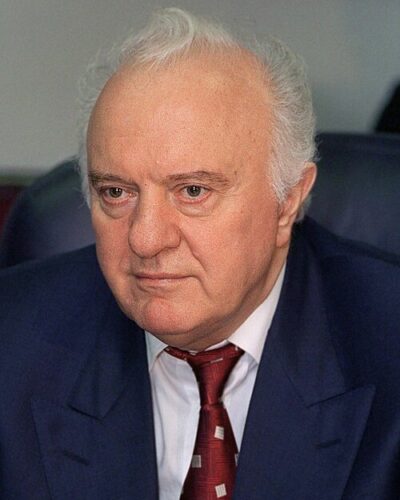
Eduard Shevardnadze
Eduard Shevardnadze was a Soviet and Georgian politician and diplomat, Soviet foreign minister and second President of Georgia. Born January 25, 1928, in Mamati. Died July 7, 2014, in Tbilisi. Positions held include Minister of Foreign Affairs of USSR (1985–1991), deputy of the Supreme Soviet of the Soviet Union and Candidate member of the Politburo of the CPSU Central Committee (1978–1985). Educated at Akaki Tsereteli State University. Awards include Hero of Socialist Labour, Order of the October Revolution and Order of the Patriotic War, 1st class.
Facts
42 facts · 2 confirmed by two sources · 8 cited · 31 from one source · 1 where the sources disagree
What’s different
- Name at birth: we show ედუარდ შევარდნაძე (Sources disagree). Wikidata also lists Эдуард Амвросиевич Шеварднадзе
Where this comes from
Papalocal keeps its own record. It started from these sources; what each one said is kept here as it was copied, so a change on their side never changes this page by itself. Tap one to read its version.
What Wikidata says · copied November 16, 2026 · revision 2563431259
- Described as
- Soviet and Georgian politician and diplomat, Soviet foreign minister and second President of Georgia (1995–2003)
- Other names
- Eduard Ambrosis dze Shevardnadze
- Born
- January 25, 1928 · 8 references
- Died
- July 7, 2014 · 5 references
- Born in
- Mamati
- Died in
- Tbilisi · 1 reference
- Buried in
- Krtsanisi
- Name at birth
- ედუარდ შევარდნაძე; Эдуард Амвросиевич Шеварднадзе
- Citizen of
- Soviet Union; Georgia
- Occupation
- politician · 2 references; diplomat
- Positions held
- Minister of Foreign Affairs of USSR (1985–1991); deputy of the Supreme Soviet of the Soviet Union; Candidate member of the Politburo of the CPSU Central Committee (1978–1985) · 1 reference; First Secretary of the Georgian Communist Party (1972–1985) · 1 reference; Member of the Politburo of the CPSU Central Committee (1985–1990) · 1 reference; President of Georgia (1995–2003) · 2 references; Prime Minister of Georgia (1993) · 1 reference
- Political party
- Union of Citizens of Georgia; Communist Party of the Soviet Union
- Education
- Akaki Tsereteli State University · 1 reference
- Member of
- Central Committee of the Communist Party of the Soviet Union; Politburo of the Central Committee of the Communist Party of the Soviet Union
- Awards
- Hero of Socialist Labour (1981); Order of the October Revolution (1976); Order of the Patriotic War, 1st class (1985); Order of the Red Banner of Labour (1966); Order of State of Republic of Turkey (1999); Independence Order (2000) · 1 reference; Grand Cross Special Class of the Order of Merit of the Federal Republic of Germany (1999); honorary citizen of Tbilisi · 1 reference; Order of Prince Yaroslav the Wise, 1st class (1999) · 2 references; Order of Outstanding Merit (2003) · 1 reference; Medal "For Labour Valour" (1960) · 1 reference; Jubilee Medal "In Commemoration of the 100th Anniversary of the Birth of Vladimir Ilyich Lenin" (1970) · 1 reference; Medal "For excellent service in the protection of public order" · 1 reference; Order of St. Mesrop Mashtots · 1 reference; Honored Worker of the Ministry of Internal Affairs · 1 reference
- Spouse
- Nanuli Shevardnadze
- Religion
- Eastern Orthodoxy; Georgian Orthodox Church
- Military branch
- Ministry of Internal Affairs of the Soviet Union
- Military rank
- major general
- Wikipedias with a page
- 100
Wikidata item Q151929 (wikidata.org/wiki/Q151929), public domain (CC0). Copied November 16, 2026.
What Wikipedia says · copied November 16, 2026 · revision 1376217431
Eduard Ambrosis dze Shevardnadze (Georgian: ედუარდ ამბროსის ძე შევარდნაძე; Russian: Эдуа́рд Амвро́сиевич Шевардна́дзе, romanized: Eduard Amvrosiyevich Shevardnadze; 25 January 1928 – 7 July 2014) was a Soviet and Georgian politician and diplomat who governed Georgia for several non-consecutive periods from 1972 until his resignation in 2003 and also served as the final Soviet minister of foreign affairs from 1985 to 1991.
Shevardnadze started his political career in the late 1940s as a leading member of his local Komsomol organisation. He was later appointed its Second Secretary, then its First Secretary. His rise in the Georgian Soviet hierarchy continued until 1961, when he was demoted after insulting a senior official. After spending two years in obscurity, Shevardnadze returned as the First Secretary of a Tbilisi city district, and was able to charge the Tbilisi First Secretary at the time with corruption. His anti-corruption work quickly garnered the interest of the Soviet government and Shevardnadze was appointed as First Deputy of the Ministry of Internal Affairs of the Georgian SSR. He would later become the head of the internal affairs ministry and was able to charge First Secretary (leader of Soviet Georgia) Vasil Mzhavanadze with corruption.
He served as First Secretary of the Georgian Communist Party (GPC) from 1972 to 1985, which made him the de facto leader of Georgia. As First Secretary, Shevardnadze launched several economic reforms, which would spur economic growth in the republic—an uncommon occurrence in the Soviet Union at the time when the country was experiencing nationwide economic stagnation. Shevardnadze's anti-corruption campaign continued until he resigned from his office as First Secretary of the GPC.
In 1985, Mikhail Gorbachev appointed Shevardnadze to the position of Minister of Foreign Affairs. He served in the position, except for a brief interruption between 1990 and 1991, until the fall of the Soviet Union. During that time, only Gorbachev outranked Shevardnadze in importance in Soviet foreign policy. Shevardnadze was responsible for many key decisions in Soviet foreign policy during the Gorbachev era and was seen by the outside world as the face of Soviet reforms, such as Perestroika.
In the aftermath of the Soviet Union's collapse in 1991, Shevardnadze returned to the newly independent Republic of Georgia after being asked to lead the country by the Military Council, which had recently deposed the country's first president, Zviad Gamsakhurdia. In 1992, Shevardnadze became the leader of Georgia (as Chairman of Parliament). He was formally elected as president in 1995. Under his rule, the Sochi agreement was signed, which effectively ended military hostilities in South Ossetia, although Georgia lost effective control over a large part of the territory. In August 1992, the war broke out in Abkhazia, which Georgia also lost. Shevardnadze also headed the country's government during the Georgian Civil War in 1993 against pro-Gamsakhurdia forces, which refused to recognize Shevardnadze as a legitimate leader and tried to regain power. The war ended with Shevardnadze's victory. In this regard, he signed a treaty of Georgia's accession to the Commonwealth of Independent States, in return receiving substantial assistance from Russia to end the conflict, although Georgia also deepened its ties with the European Union and the United States. Consequently, in 1999, he signed the country's accession to the Council of Europe, while in 2002, he declared his intention for Georgia to join NATO. Shevardnadze oversaw large-scale privatization and other political and economic changes. His rule was marked by rampant corruption and accusations of nepotism. Allegations of electoral fraud during the 2003 legislative election led to a series of public protests and demonstrations colloquially known as the Rose Revolution. Eventually, Shevardnadze agreed to resign. He later published his memoirs and lived in relative obscurity until he died in 2014.
- Born, in its opening lines
- January 25, 1928
- Died, in its opening lines
- July 7, 2014
From the Wikipedia article “Eduard Shevardnadze” (en.wikipedia.org/wiki/Eduard_Shevardnadze), by its contributors, under CC BY-SA 4.0 (creativecommons.org/licenses/by-sa/4.0/). Copied November 16, 2026; not changed.
Confirmed Two sources agree. Cited One source, and it names where it got it. One source One source, without a reference of its own. Sources disagree The sources disagree. We show the best-supported value and keep theirs below.
