
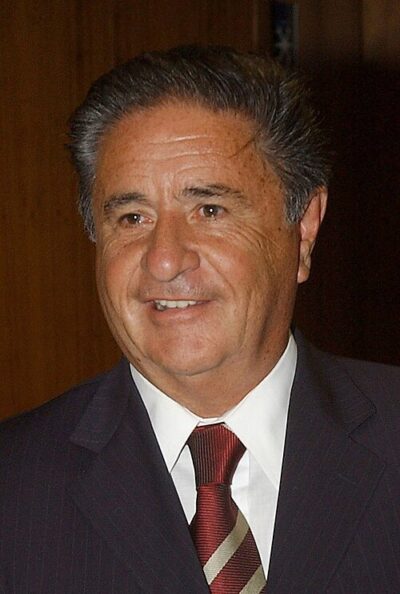
Eduardo Duhalde
Eduardo Duhalde is a President of Argentina from 2002 to 2003. Born October 5, 1941, in Lomas de Zamora. Positions held include Governor of Buenos Aires Province (–1999), member of the Argentine Chamber of Deputies and member of the Argentine Chamber of Senators (2001–2002). Educated at University of Buenos Aires. Awards include Grand Cross of the Order of the Sun of Peru and Medal of the Oriental Republic of Uruguay.
Facts
17 facts · 1 confirmed by two sources · 3 cited · 13 from one source
Where this comes from
Papalocal keeps its own record. It started from these sources; what each one said is kept here as it was copied, so a change on their side never changes this page by itself. Tap one to read its version.
What Wikidata says · copied November 16, 2026 · revision 2567503331
- Described as
- President of Argentina from 2002 to 2003
- Other names
- Eduardo Alberto Duhalde, Eduardo Alberto Duhalde Maldonado
- Born
- October 5, 1941 · 3 references
- Born in
- Lomas de Zamora
- Citizen of
- Argentina
- Occupation
- lawyer; politician · 2 references
- Positions held
- Governor of Buenos Aires Province (–1999); member of the Argentine Chamber of Deputies; member of the Argentine Chamber of Senators (2001–2002) · 1 reference; President of Argentina (2002–2003); President of the Commission of Permanent Representatives of Mercosur (2003–2005); Vice President of Argentina (1989–1991)
- Political party
- Justicialist Party
- Education
- University of Buenos Aires
- Awards
- Grand Cross of the Order of the Sun of Peru; Medal of the Oriental Republic of Uruguay (2003) · 1 reference
- Spouse
- Hilda González de Duhalde
- Religion
- Catholicism
- Wikipedias with a page
- 52
Wikidata item Q294578 (wikidata.org/wiki/Q294578), public domain (CC0). Copied November 16, 2026.
What Wikipedia says · copied November 16, 2026 · revision 1379799171
Eduardo Alberto Duhalde (Spanish pronunciation: [eˈðwaɾðo alˈβeɾto ˈðwalde] ; born 5 October 1941) is a former politician from Argentina. A member of the Peronist party, Duhalde served as the President of Argentina from January 2002 to May 2003. In the 1990s, he also held the positions of vice president and governor of Buenos Aires.
Duhalde was elected to the local legislature and appointed intendente (mayor) in 1973. He was deposed during the 1976 Argentine coup d'état. After democracy returned, he was elected again in 1983. He was elected vice president of Argentina in 1989, under President Carlos Menem. Duhalde resigned as vice president and was elected governor of Buenos Aires Province in 1991, and re-elected in 1995.
He ran for president in 1999 and was defeated by Fernando de la Rúa, who ended up resigning during the December 2001 riots. After he resigned, Congress appointed the governor of San Luis Province Adolfo Rodríguez Saá as president. When Rodríguez Saá also resigned, Congress appointed Duhalde. During Duhalde’s presidency, a major currency devaluation and rising exchange rates contributed to a gradual economic recovery. He successfully supported the candidate Néstor Kirchner against Menem. Duhalde is largely retired from politics since his defeat in the 2011 presidential elections.
- Born, in its opening lines
- October 5, 1941
From the Wikipedia article “Eduardo Duhalde” (en.wikipedia.org/wiki/Eduardo_Duhalde), by its contributors, under CC BY-SA 4.0 (creativecommons.org/licenses/by-sa/4.0/). Copied November 16, 2026; not changed.
Confirmed Two sources agree. Cited One source, and it names where it got it. One source One source, without a reference of its own. Sources disagree The sources disagree. We show the best-supported value and keep theirs below.
