
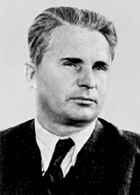
Edward Osóbka-Morawski
Edward Osóbka-Morawski was a Polish politician. Born October 5, 1909, in Bliżyn. Died January 9, 1997, in Warsaw. Positions held include member of the Sejm of the Polish People's Republic. Awards include Order of the Cross of Grunwald, 3rd class, Grand Cross of the Order of Polonia Restituta and Partisan Cross (Poland).
Facts
21 facts · 2 confirmed by two sources · 4 cited · 15 from one source
Where this comes from
Papalocal keeps its own record. It started from these sources; what each one said is kept here as it was copied, so a change on their side never changes this page by itself. Tap one to read its version.
What Wikidata says · copied November 18, 2026 · revision 2569707289
- Described as
- Polish politician (1909-1997)
- Other names
- Edward Osobka-Morawski
- Born
- October 5, 1909 · 3 references
- Died
- January 9, 1997 · 3 references
- Born in
- Bliżyn · 1 reference
- Died in
- Warsaw · 1 reference
- Buried in
- Powązki Military Cemetery
- Citizen of
- Congress Poland; Second Polish Republic; Polish People's Republic; Poland
- Occupation
- politician · 1 reference; diplomat
- Positions held
- member of the Sejm of the Polish People's Republic · 1 reference
- Political party
- Polish Socialist Party; Polish United Workers' Party
- Member of
- Polish Committee of National Liberation
- Awards
- Order of the Cross of Grunwald, 3rd class; Grand Cross of the Order of Polonia Restituta; Partisan Cross (Poland); Medal of Victory and Freedom 1945; Medal for Warsaw 1939-1945
- Spouse
- Wisła Pankiewicz
- Wikipedias with a page
- 23
Wikidata item Q1293166 (wikidata.org/wiki/Q1293166), public domain (CC0). Copied November 18, 2026.
What Wikipedia says · copied November 18, 2026 · revision 1349613344
Edward Bolesław Osóbka-Morawski ['edvart ɔˈsupka mɔˈrafskʲi] (5 October 1909 – 9 January 1997) was a Polish activist and politician in the Polish Socialist Party (PPS) before World War II, and after the Soviet takeover of Poland, Chairman of the Communist-dominated interim government, the Polish Committee of National Liberation (Polski Komitet Wyzwolenia Narodowego) formed in Lublin with Stalin's approval.
In October 1944, Osóbka-Morawski was given the role of Minister of Foreign Affairs and Agriculture. Several months later, in June 1945, he was appointed Prime Minister of the Provisional Government of National Unity (Tymczasowy Rząd Jedności Narodowej), in office until February 1947. Osóbka-Morawski believed the PPS should join with the other non-communist party in Poland, the Polish Peasant Party, to form a united front against the Communist Polish Workers' Party. However, another prominent socialist, Józef Cyrankiewicz argued that the PPS should support the communists while opposing the creation of a one-party state. The Communists, with Soviet support, played on this division and forced Osóbka-Morawski to resign in favour of Cyrankiewicz.
Osóbka-Morawski would make his peace with the Communists, and gradually became a Stalinist. Nonetheless, in 1949 he was dismissed from his new post as the Minister of Public Administration, for "deviationist" tendencies. He was readmitted to the Communist Party, now called the Polish United Workers' Party, during the Polish October revolution of 1956. He then worked as a party official throughout most of his life in the People's Republic of Poland prior to the Revolutions of 1989, and in 1990 failed in his attempt to recreate the old Polish Socialist Party. He died in Warsaw in 1997.
- Born, in its opening lines
- October 5, 1909
- Died, in its opening lines
- January 9, 1997
From the Wikipedia article “Edward Osóbka-Morawski” (en.wikipedia.org/wiki/Edward_Osóbka-Morawski), by its contributors, under CC BY-SA 4.0 (creativecommons.org/licenses/by-sa/4.0/). Copied November 18, 2026; not changed.
Confirmed Two sources agree. Cited One source, and it names where it got it. One source One source, without a reference of its own. Sources disagree The sources disagree. We show the best-supported value and keep theirs below.
