
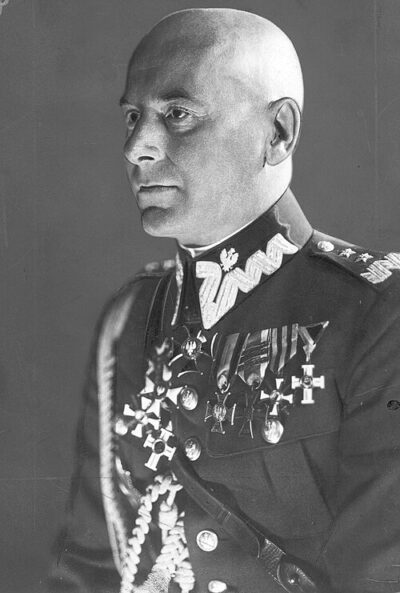
Edward Rydz-Śmigły
Edward Rydz-Śmigły was a Polish general, politician, marshal of Poland, poet, and painter. Born March 11, 1886, in Berezhany. Died December 2, 1941, in Warsaw. Positions held include president. Educated at Jagiellonian University and Jan Matejko Academy of Fine Arts in Krakow. Awards include Order of the White Eagle, Knight Grand Cross of the Order of the White Eagle and Grand Cross of the Order of the White Rose of Finland.
Facts
34 facts · 2 confirmed by two sources · 5 cited · 27 from one source
Where this comes from
Papalocal keeps its own record. It started from these sources; what each one said is kept here as it was copied, so a change on their side never changes this page by itself. Tap one to read its version.
What Wikidata says · copied November 16, 2026 · revision 2557861954
- Described as
- Polish general, politician, marshal of Poland, poet, and painter (1886–1941)
- Other names
- Edward Rydz-Smigly, Edward Śmigły-Rydz, Edward Smigly-Rydz, Edward Rydz, Edward Rydz Śmigły, Edward Rydz Smigly, Edward Śmigły Rydz, Edward Smigly Rydz, Edouard Rydz-Śmigły, Eduard Rydz-Śmigły, A. Szański, Rydz-Śmigły
- Born
- March 11, 1886 · 1 reference
- Died
- December 2, 1941 · 2 references
- Born in
- Berezhany · 1 reference
- Died in
- Warsaw · 2 references
- Buried in
- Powązki Cemetery
- Cause of death
- myocardial infarction
- Citizen of
- Poland
- Occupation
- military officer; poet; painter · 1 reference; writer; politician · 2 references; marshal · 1 reference
- Positions held
- president
- Political party
- Camp of National Unity
- Education
- Jagiellonian University; Jan Matejko Academy of Fine Arts in Krakow
- Awards
- Order of the White Eagle (1936); Knight Grand Cross of the Order of the White Eagle; Grand Cross of the Order of the White Rose of Finland; Commander of the Order of Military Virtue; Silver Cross of the Virtuti Militari (1920); Grand Cross of the Order of Polonia Restituta (1928); Commander with Star of the Order of Polonia Restituta (1925); Commander of the Order of Polonia Restituta (1921); Decade of Independence Regained; Cross of Independence with Swords (1930); Cross of Valour; Gold Cross of Merit (1930); Cross of Merit of the Army of Central Lithuania; Commemorative Medal for the War of 1918–1921; Order of the Rising Sun, 1st class
- Military branch
- infantry
- Military rank
- Marshal of Poland
- Wikipedias with a page
- 49
Wikidata item Q295688 (wikidata.org/wiki/Q295688), public domain (CC0). Copied November 16, 2026.
What Wikipedia says · copied November 16, 2026 · revision 1382775419
Marshal Edward Śmigły-Rydz (surname also formulated as Rydz-Śmigły; [ˈɛdvard ˈɕmiɡɫɨ rɨdz] 11 March 1886 – 2 December 1941) was a Polish politician, statesman, Marshal of Poland and Commander-in-Chief of the Polish Armed Forces, as well as a painter and poet.
Born in 1886 and orphaned at age 13, Śmigły-Rydz was raised by his maternal grandparents. He graduated with distinction from the local Gymnasium. He completed his studies in philosophy and art history at the Jagiellonian University.
During the interwar period, he cultivated a dictatorial cult of personality, and was regarded as a hero for his exemplary record as an army commander in the Polish Legions of World War I and the ensuing Polish–Soviet War in 1920. He was appointed Commander-in-Chief and Inspector General of the Polish Armed Forces following Marshal Józef Piłsudski's death in 1935. Rydz served in this capacity at the start of World War II during the invasion of Poland.
As the war approached, Rydz's stature began to eclipse even that of the president. The shock of the Polish defeat made objective evaluations of his legacy during and after the war difficult; his reputation remains highly controversial in Poland. This is a consequence attributable to missteps made during the critical early months of World War II, the evacuation of government of Poland for Romania, especially paired with the image of invulnerability he constructed beforehand. However, others claim that there was nothing else Śmigły could have done that would've changed the outcome, and the evacuation of the Polish government which saved Poland's gold reserves and established the Polish government-in-exile was in fact a wise move.
- Born, in its opening lines
- March 11, 1886
- Died, in its opening lines
- December 2, 1941
From the Wikipedia article “Edward Śmigły-Rydz” (en.wikipedia.org/wiki/Edward_Śmigły-Rydz), by its contributors, under CC BY-SA 4.0 (creativecommons.org/licenses/by-sa/4.0/). Copied November 16, 2026; not changed.
Confirmed Two sources agree. Cited One source, and it names where it got it. One source One source, without a reference of its own. Sources disagree The sources disagree. We show the best-supported value and keep theirs below.
