
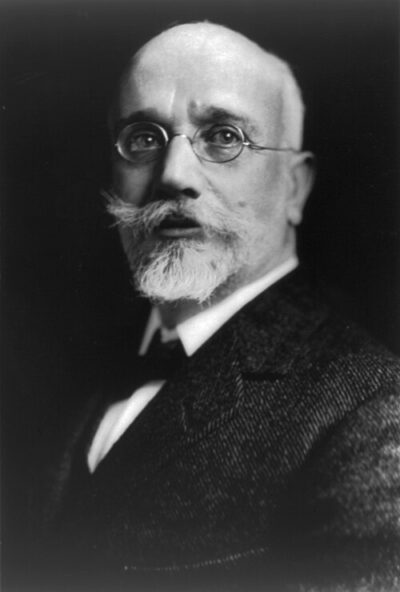
Eleftherios Venizelos
Eleftherios Venizelos was a Greek politician, former Prime Minister of Greece. Born August 23, 1864, in Mournies. Died March 18, 1936, in Paris. Positions held include Prime Minister of the Cretan State (2 times) (1899–1910), Prime Minister of Greece (4 times) (1910–1933) and Speaker of the Hellenic Parliament. Educated at National and Kapodistrian University of Athens. Awards include Grand Cross of the Legion of Honour, Order of the White Eagle and Order of the Redeemer.
Facts
34 facts · 2 confirmed by two sources · 5 cited · 27 from one source
Where this comes from
Papalocal keeps its own record. It started from these sources; what each one said is kept here as it was copied, so a change on their side never changes this page by itself. Tap one to read its version.
What Wikidata says · copied November 16, 2026 · revision 2562773391
- Described as
- Greek politician, former Prime Minister of Greece (1864–1936)
- Other names
- Eleftherios Kyriakou Venizelos
- Born
- August 23, 1864 · 3 references
- Died
- March 18, 1936 · 10 references
- Born in
- Mournies · 1 reference
- Died in
- Paris · 3 references
- Buried in
- Venizelos graves
- Cause of death
- cerebral hemorrhage
- Citizen of
- Ottoman Empire; Cretan State; Kingdom of Greece
- Occupation
- politician · 1 reference; lawyer · 1 reference; writer; journalist; diplomat; head of government · 1 reference
- Positions held
- Prime Minister of the Cretan State (2 times) (1899–1910); Prime Minister of Greece (4 times) (1910–1933); Speaker of the Hellenic Parliament; member of the Hellenic Parliament
- Political party
- Liberal Party
- Education
- National and Kapodistrian University of Athens (1881–1886)
- Awards
- Grand Cross of the Legion of Honour; Order of the White Eagle; Order of the Redeemer · 1 reference
- Spouse
- Maria Venizelou (1891–1894); Helena Schilizzi (1921–1936)
- Children
- Sofoklis Venizelos; Kyriakos Venizelos
- Father
- Kyriakos Venizelos
- Mother
- Stiliani Ploumidaki
- Siblings
- Aikaterini (Katigko) Venizelou; Evanthia Venizelou
- Religion
- Eastern Orthodox Church
- Website
- http://www.venizelos-foundation.gr
- Wikipedias with a page
- 66
Wikidata item Q205545 (wikidata.org/wiki/Q205545), public domain (CC0). Copied November 16, 2026.
What Wikipedia says · copied November 16, 2026 · revision 1382210434
Eleftherios Kyriakou Venizelos (Greek: Ελευθέριος Κυριάκου Βενιζέλος, romanized: Eleuthérios Kyriákou Venizélos, pronounced [elefˈθeri.os cirˈʝaku veniˈzelos]; 23 August [O.S. 11 August] 1864 – 18 March 1936) was a Greek statesman and leader of the Greek national liberation movement. As the leader of the Liberal Party, Venizelos served as prime minister of Greece for over 12 years, spanning eight terms from 1910 to 1933.
A prominent figure of the 1897 Cretan Revolt, Venizelos first made his mark on the international stage with his leading role in securing the autonomy of the Cretan State, and later in the island's union with Greece. He led the Theriso revolt in 1905 and the declaration of union with Greece following the Young Turk Revolution. In 1909, he was invited to Athens to resolve the political deadlock and became Prime Minister. He initiated constitutional and economic reforms like labour laws, free education, and others that set the basis for the modernization of Greek society, culminating in the transformative 1911 Constitution, and of the Greek Army and the Greek Navy in preparation for future conflicts. Before the Balkan Wars of 1912–1913, Venizelos's catalytic role helped Greece to gain entrance to the Balkan League, an alliance of the Balkan states against the Ottoman Empire. Through his diplomatic acumen with the Great Powers and with the other Balkan countries, Greece doubled its area and population with the liberation of Macedonia, Epirus, and most of the Aegean islands.
In World War I (1914–1918), he brought Greece on the side of the Allies, further expanding the Greek borders. However, his pro-Allied foreign policy brought him into conflict with the nonaligned faction of Constantine I of Greece, causing the National Schism of the 1910s. The Schism became an unofficial civil war of the pro-Venizelos northern provisional government and the pro-royal government of Athens, with the struggle for power between them polarizing the population between the royalists and Venizelists for decades. Following the Allied victory, Venizelos secured new territorial concessions in Western Anatolia and Thrace in an attempt to accomplish the Megali Idea, which would have united all Greek-speaking people along the Aegean Sea under the banner of Greece. He was, however, defeated in the 1920 General Election, which contributed to the eventual Greek defeat in the Greco-Turkish War (1919–22). Venizelos, in self-imposed exile, represented Greece in the negotiations that led to the signing of the Treaty of Lausanne and the agreement of a mutual population exchange between Greece and Turkey.
As a leading figure of the Second Republic, Venizelos returned to active politics with a landslide victory in the 1928 elections. His final tenure focused on improving relations with Turkey, resettlement policies for refugees from Asia Minor, anti-communism and responding to the Great Depression. After electoral defeats in 1932 and 1933, In January of that year, Venizelos became prime minister for the last time, before a failed coup attempt tried to keep him in power. In March 1935, after a second coup attempt, he was sentenced to death in absentia, after having fled to Paris, where he died.
Under his leadership, Greece underwent profound modernization through liberal-democratic policies. His diplomatic and military efforts expanded Greece's territory, marking a shift in the country's orientation from East to West. Venizelos achieved international fame in his lifetime, and is often called "The Maker of Modern Greece" for his transformative role. His legacy as the "Ethnarch" continues to endure.
- Born, in its opening lines
- August 23, 1864
- Died, in its opening lines
- March 18, 1936
From the Wikipedia article “Eleftherios Venizelos” (en.wikipedia.org/wiki/Eleftherios_Venizelos), by its contributors, under CC BY-SA 4.0 (creativecommons.org/licenses/by-sa/4.0/). Copied November 16, 2026; not changed.
Confirmed Two sources agree. Cited One source, and it names where it got it. One source One source, without a reference of its own. Sources disagree The sources disagree. We show the best-supported value and keep theirs below.
