
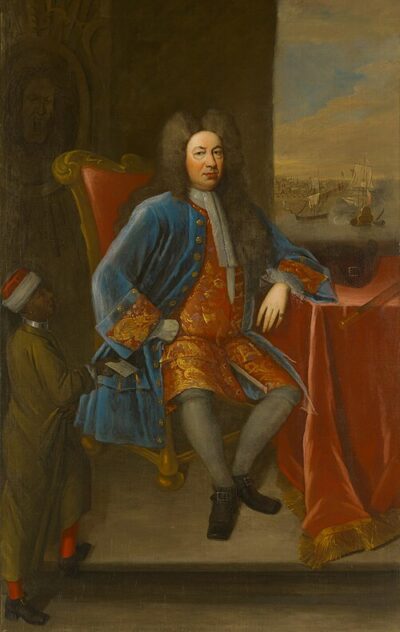
Elihu Yale
Elihu Yale was a Welsh merchant, slave trader and philanthropist. Born April 5, 1649, in Boston. Died July 8, 1721, in London. Positions held include Governor of Madras. Educated at Yale University. Awards include Fellow of the Royal Society.
Facts
23 facts · 2 confirmed by two sources · 14 cited · 7 from one source
Where this comes from
Papalocal keeps its own record. It started from these sources; what each one said is kept here as it was copied, so a change on their side never changes this page by itself. Tap one to read its version.
What Wikidata says · copied November 18, 2026 · revision 2570939229
- Described as
- Welsh merchant, slave trader and philanthropist (1649–1721)
- Other names
- Eli Yale, Eliyu Yale
- Born
- April 5, 1649 · 4 references
- Died
- July 8, 1721 · 4 references
- Born in
- Boston · 1 reference
- Died in
- London · 2 references
- Buried in
- Tomb Of Elihu Yale, West Of Church Of St. Giles, Church Street (s Side)
- Citizen of
- Kingdom of Great Britain
- Occupation
- merchant · 1 reference; art collector · 1 reference; slave trader · 2 references
- Positions held
- Governor of Madras
- Education
- Yale University
- Member of
- Royal Society of London (1717–)
- Awards
- Fellow of the Royal Society
- Spouse
- Hieronima de Paiva · 1 reference; Catherine Elford · 1 reference
- Children
- Anne Yale · 2 references; Catherine Yale · 3 references; Charles Yale · 1 reference; David Yale · 2 references; Ursula Yale · 2 references
- Father
- David Yale · 2 references
- Mother
- Ursula Knight · 2 references
- Lived in
- Plas Grono
- Wikipedias with a page
- 22
Wikidata item Q514846 (wikidata.org/wiki/Q514846), public domain (CC0). Copied November 18, 2026.
What Wikipedia says · copied November 18, 2026 · revision 1379779742
Elihu Yale (5 April 1649 – 8 July 1721) was a British colonial administrator. Born in Boston, Massachusetts Bay Colony, Yale lived in America only as a child, and spent the rest of his life in England, Wales, and India. He became a clerk for the East India Company at Fort St. George, later Madras, and eventually rose to the Presidency of the settlement. He was later removed from the post under charges of corruption for self-dealing, and required to pay a fine. In 1699, he returned to Britain with a considerable fortune, around £200,000 (equivalent to £32.2 million in 2025), mostly made by selling diamonds, and spent his time and wealth in philanthropy and art collecting.
He was the primary benefactor of Yale College, now Yale University, which was named in his honor, following a donation of books, portraits, and textiles at the request of Rev. Cotton Mather, a Harvard University graduate. He had no male heir, and no descendants of his have survived past his grandchildren. In the 21st century, Yale's connections to slavery in India began to be more closely explored, a process assisted by the digitalisation and online publication of the East India Company's records. In 2020, Peter Salovey, president of Yale University, launched the Yale and Slavery Research Project to explore the university's historical links with slavery and colonialism, including Elihu Yale's role.
- Born, in its opening lines
- April 5, 1649
- Died, in its opening lines
- July 8, 1721
From the Wikipedia article “Elihu Yale” (en.wikipedia.org/wiki/Elihu_Yale), by its contributors, under CC BY-SA 4.0 (creativecommons.org/licenses/by-sa/4.0/). Copied November 18, 2026; not changed.
Confirmed Two sources agree. Cited One source, and it names where it got it. One source One source, without a reference of its own. Sources disagree The sources disagree. We show the best-supported value and keep theirs below.
