
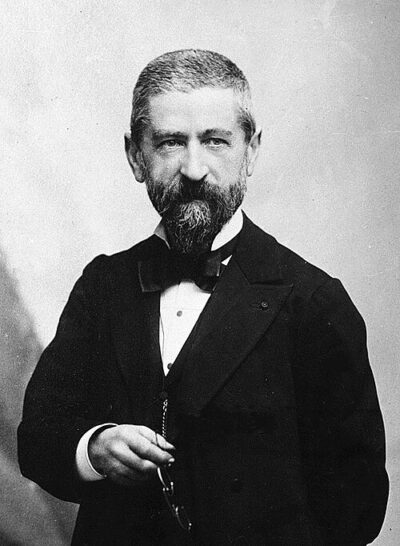
Émile Duclaux
Émile Duclaux was a French microbiologist and chemist. Born June 24, 1840, in Aurillac. Died May 3, 1904, in 7th arrondissement of Paris. Positions held include director (1895–1904). Educated at École Normale Supérieure and Lycée Saint-Louis. Awards include Commander of the Legion of Honour and Commander of the Order of Agricultural Merit.
Facts
32 facts · 1 confirmed by two sources · 13 cited · 17 from one source · 1 where the sources disagree
What’s different
- Died: we show May 3, 1904 (Sources disagree). Wikipedia says May 2, 1904
Where this comes from
Papalocal keeps its own record. It started from these sources; what each one said is kept here as it was copied, so a change on their side never changes this page by itself. Tap one to read its version.
What Wikidata says · copied November 18, 2026 · revision 2569615626
- Described as
- French microbiologist and chemist (1840-1904)
- Other names
- Emile Duclaux
- Born
- June 24, 1840 · 5 references
- Died
- May 3, 1904 · 2 references
- Born in
- Aurillac · 1 reference
- Died in
- 7th arrondissement of Paris
- Name at birth
- Pierre Émile Duclaux · 1 reference
- Citizen of
- France
- Occupation
- physician; Esperantist; chemist · 1 reference; physicist · 1 reference; biochemist · 1 reference; microbiologist · 2 references; university teacher · 1 reference; botanist
- Positions held
- director (1895–1904)
- Worked for
- University of Lyon · 1 reference; Pasteur Institute · 1 reference; University of Paris · 1 reference
- Education
- École Normale Supérieure; Lycée Saint-Louis
- Member of
- Human Rights League; French Academy of Sciences (1888–); Académie Nationale de Médecine (1894–); Academy of Agriculture of France (1890–)
- Awards
- Commander of the Legion of Honour (1895) · 1 reference; Commander of the Order of Agricultural Merit (1900)
- Field
- microbiology · 1 reference; chemistry · 1 reference; physics · 1 reference; meteorology · 1 reference
- Spouse
- Agnes Mary Frances Duclaux (1901–) · 1 reference
- Children
- Jacques Duclaux
- Wikipedias with a page
- 22
Wikidata item Q2354446 (wikidata.org/wiki/Q2354446), public domain (CC0). Copied November 18, 2026.
What Wikipedia says · copied November 18, 2026 · revision 1342323410
Émile Duclaux (24 June 1840 – May 2, 1904) was a French microbiologist and chemist born in Aurillac, Cantal.
He studied at the College of Aurillac, the Lycée Saint-Louis in Paris and at École Normale Supérieure. In 1862 he began work as an assistant in the laboratory of Louis Pasteur (1822–1895). During his career, he taught classes in Tours (1865), Clermont-Ferrand (1866), Lyon (from 1873) and Paris (from 1878). In Paris, he was a professor of meteorology at the Institute of Agronomy. For much of his career he was associated with the work of Louis Pasteur.
In 1888 he was elected to the Académie des sciences, and in 1894 became a member of the Académie Nationale de Médecine.
Duclaux's work was largely in the fields of chemistry, bacteriology, hygiene and agriculture. Duclaux initiated the custom of naming enzymes by adding the suffix "-ase" to the enzyme's substrate. His intention was to honor the first scientists (namely Anselme Payen, 1795–1871; and Jean-François Persoz, 1805–1868) to isolate an enzyme; "diastase", in 1833. With Pasteur, he collaborated in the study of silkworm diseases, and also took part in experiments to debunk the theory of spontaneous generation. In the 1870s, he undertook studies of phylloxera, an aphid-like pest that plagued grape vineyards. In addition, he performed research on the composition of milk, and conducted studies on beer and wine.
In 1887 he began publication of the Annales de l'Institut Pasteur, with Charles Chamberland (1851-1908), Jacques-Joseph Grancher (1843–1907), Edmond Nocard (1850–1903) and Pierre Paul Émile Roux (1853–1933) as members of the first editorial board. Following Pasteur's death in 1895, Duclaux became director of the Institute, with Roux and Chamberland serving as its sub-directors.
Duclaux was a prolific writer, some of his better known publications were Traité de microbiologie, L'hygiène sociale, Ferments et maladies and Pasteur, histoire d'un esprit, the latter being a biography dedicated to Pasteur.
Being actively involved in French politics, he was a vocal supporter of Alfred Dreyfus (1859-1935), when the latter was unjustly accused of treason. Duclaux's second wife, Agnes Mary Frances Duclaux (maiden name Agnes Mary Frances Robinson 1857–1944), was a well-known author, and his son, Jacques Eugène Duclaux (1877–1978), was a highly regarded chemist.
- Born, in its opening lines
- June 24, 1840
- Died, in its opening lines
- May 2, 1904
From the Wikipedia article “Émile Duclaux” (en.wikipedia.org/wiki/Émile_Duclaux), by its contributors, under CC BY-SA 4.0 (creativecommons.org/licenses/by-sa/4.0/). Copied November 18, 2026; not changed.
Confirmed Two sources agree. Cited One source, and it names where it got it. One source One source, without a reference of its own. Sources disagree The sources disagree. We show the best-supported value and keep theirs below.
