
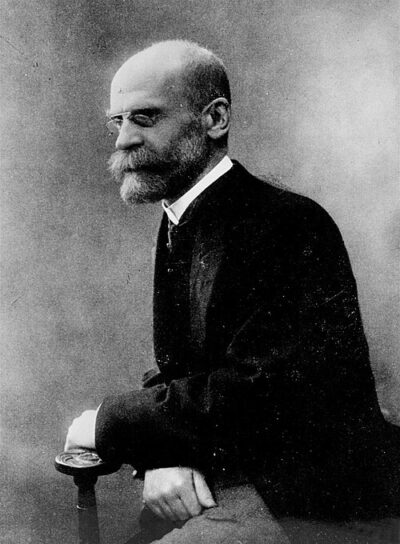
Émile Durkheim
Émile Durkheim was a French sociologist. Born April 15, 1858, in Épinal. Died November 15, 1917, in Paris. Known for The Elementary Forms of the Religious Life, The Division of Labour in Society and Education and Sociology (book). Educated at École Normale Supérieure and Lycée Louis-le-Grand. Awards include Knight of the Legion of Honour.
Facts
31 facts · 2 confirmed by two sources · 15 cited · 14 from one source
Where this comes from
Papalocal keeps its own record. It started from these sources; what each one said is kept here as it was copied, so a change on their side never changes this page by itself. Tap one to read its version.
What Wikidata says · copied November 16, 2026 · revision 2561518245
- Described as
- French sociologist (1858–1917)
- Other names
- David Émile Durkheim, Durkheim, Emile Durkheim
- Born
- April 15, 1858 · 15 references
- Died
- November 15, 1917 · 13 references
- Born in
- Épinal · 3 references
- Died in
- Paris · 3 references
- Buried in
- Montparnasse Cemetery
- Cause of death
- cerebral hemorrhage
- Name at birth
- David Émile Durkheim
- Citizen of
- France · 1 reference
- Occupation
- anthropologist; philosopher · 1 reference; sociologist · 2 references; professor; historian of religion; pedagogue · 1 reference; ethnologist · 1 reference
- Worked for
- University of Paris (1902–) · 1 reference; École pratique des hautes études (1905) · 1 reference; University of Bordeaux (1886–1902) · 1 reference
- Education
- École Normale Supérieure · 1 reference; Lycée Louis-le-Grand · 1 reference; Leipzig University; University of Bordeaux · 1 reference
- Member of
- Human Rights League
- Known for
- The Elementary Forms of the Religious Life; The Division of Labour in Society; Education and Sociology (book)
- Awards
- Knight of the Legion of Honour (1858) · 1 reference
- Field
- sociology of religion; ethnology
- Spouse
- Louise Dreyfus
- Religion
- atheism · 3 references
- Wikipedias with a page
- 125
Wikidata item Q15948 (wikidata.org/wiki/Q15948), public domain (CC0). Copied November 16, 2026.
What Wikipedia says · copied November 16, 2026 · revision 1379859561
David Émile Durkheim (; French: [emil dyʁkɛm] or [dyʁkajm]; 15 April 1858 – 15 November 1917) was a French sociologist. He formally established the academic discipline of sociology and is commonly cited as one of the principal architects of modern social science, along with Karl Marx and Max Weber.
Much of Durkheim's work concerns the inability of societies to maintain their integrity and coherence in modernity, an era in which traditional social and religious ties are much less universal, and in which new social institutions have come into being. His conception of the scientific study of society laid the groundwork for great modern sociology. He used such scientific tools as statistics, surveys, and historical observation in his analysis of suicides in Roman Catholic and Protestant groups.
Durkheim's first major sociological work was De la division du travail social (1893; The Division of Labour in Society), followed in 1895 by Les Règles de la méthode sociologique (The Rules of Sociological Method). Also in 1895, he set up the first European department of sociology and became France's first professor of sociology. His seminal monograph, Le Suicide (1897), a study of suicide rates in Roman Catholic and Protestant populations, pioneered modern social research, serving to distinguish social science from psychology and political philosophy. In 1898, he established the journal L'Année sociologique. Les formes élémentaires de la vie religieuse (1912; The Elementary Forms of the Religious Life) presented a theory of religion, comparing the social and cultural lives of aboriginal and modern societies.
Durkheim was preoccupied with the acceptance of sociology as a legitimate science. Refining the positivism originally set forth by Auguste Comte, he promoted what could be considered as a form of epistemological realism, as well as the use of the hypothetico-deductive model in social science. For Durkheim, sociology was the science of institutions, understanding the term in its broader meaning as the "beliefs and modes of behaviour instituted by the collectivity," with its aim being to discover structural social facts. He was a major proponent of structural functionalism, a foundational perspective in both sociology and anthropology. In his view, social science should be purely holistic in the sense that sociology should study phenomena attributed to society at large, rather than being limited to the study of specific actions of individuals.
Durkheim remained a dominant force in French intellectual life until his death in 1917, presenting numerous lectures and publishing works on a variety of topics, including the sociology of knowledge, morality, social stratification, religion, law, education, and deviance. Some terms that he coined, such as "collective consciousness", are now also used by laypeople.
- Born, in its opening lines
- April 15, 1858
- Died, in its opening lines
- November 15, 1917
From the Wikipedia article “Émile Durkheim” (en.wikipedia.org/wiki/Émile_Durkheim), by its contributors, under CC BY-SA 4.0 (creativecommons.org/licenses/by-sa/4.0/). Copied November 16, 2026; not changed.
Confirmed Two sources agree. Cited One source, and it names where it got it. One source One source, without a reference of its own. Sources disagree The sources disagree. We show the best-supported value and keep theirs below.
