
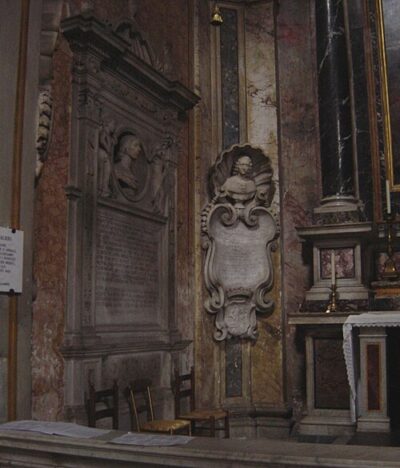
Emilio de' Cavalieri
Emilio de' Cavalieri was an Italian composer, producer, organist, diplomat, choreographer and dancer. Born 1550, in Rome. Died March 11, 1602, in Rome.
Facts
13 facts · 2 confirmed by two sources · 4 cited · 7 from one source
Where this comes from
Papalocal keeps its own record. It started from these sources; what each one said is kept here as it was copied, so a change on their side never changes this page by itself. Tap one to read its version.
What Wikidata says · copied November 18, 2026 · revision 2568062418
- Described as
- Italian composer, producer, organist, diplomat, choreographer and dancer
- Other names
- Emilio De' Cavalieri
- Born
- 1550 · 8 references
- Died
- March 11, 1602 · 5 references
- Born in
- Rome · 1 reference
- Died in
- Rome · 1 reference
- Occupation
- composer · 1 reference; diplomat; dancer; choreographer; organist · 2 references
- Genre
- opera
- Instrument
- organ
- Field
- performing arts
- Father
- Tommaso dei Cavalieri
- Wikipedias with a page
- 23
Wikidata item Q360436 (wikidata.org/wiki/Q360436), public domain (CC0). Copied November 18, 2026.
What Wikipedia says · copied November 18, 2026 · revision 1385390817
Emilio de' Cavalieri (c. 1550 – 11 March 1602), or Emilio dei Cavalieri (the spellings "del" and "Cavaliere" are contemporary typographical errors), was an Italian composer, producer, organist, diplomat, choreographer and dancer at the end of the Renaissance era. His work, along with that of other composers active in Rome, Florence and Venice, was critical in defining the beginning of the musical Baroque era. A member of the Roman School of composers, he was an influential early composer of monody, and wrote what is usually considered to be the first oratorio.
- Born, in its opening lines
- c. 1550
- Died, in its opening lines
- March 11, 1602
From the Wikipedia article “Emilio de' Cavalieri” (en.wikipedia.org/wiki/Emilio_de'_Cavalieri), by its contributors, under CC BY-SA 4.0 (creativecommons.org/licenses/by-sa/4.0/). Copied November 18, 2026; not changed.
Confirmed Two sources agree. Cited One source, and it names where it got it. One source One source, without a reference of its own. Sources disagree The sources disagree. We show the best-supported value and keep theirs below.
