
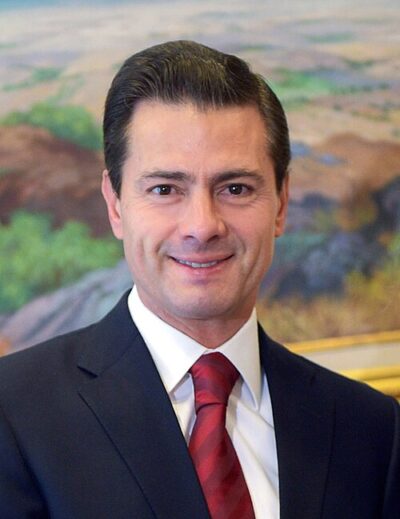
Enrique Peña Nieto
Enrique Peña Nieto is the 64th President of Mexico. Born July 20, 1966, in Atlacomulco de Fabela. Positions held include Governor of the State of Mexico (2005–2011) and President of Mexico (2012–2018). Educated at Panamerican University and Monterrey Institute of Technology and Higher Education. Awards include Collar of the Order of Isabella the Catholic, Grand Cross, Special Class of the Order of the Sun of Peru and Collar of the Order of Charles III.
Facts
31 facts · 1 confirmed by two sources · 20 cited · 10 from one source
Where this comes from
Papalocal keeps its own record. It started from these sources; what each one said is kept here as it was copied, so a change on their side never changes this page by itself. Tap one to read its version.
What Wikidata says · copied November 16, 2026 · revision 2567901639
- Described as
- 64th President of Mexico
- Other names
- Enrique Pena Nieto, EPN
- Born
- July 20, 1966 · 2 references
- Born in
- Atlacomulco de Fabela · 1 reference
- Name at birth
- Enrique Peña Nieto
- Citizen of
- Mexico
- Occupation
- politician · 2 references; lawyer · 1 reference
- Positions held
- Governor of the State of Mexico (2005–2011); President of Mexico (2012–2018) · 1 reference
- Political party
- Institutional Revolutionary Party
- Education
- Panamerican University; Monterrey Institute of Technology and Higher Education
- Awards
- Collar of the Order of Isabella the Catholic (2014) · 2 references; Grand Cross, Special Class of the Order of the Sun of Peru (2014) · 1 reference; Collar of the Order of Charles III (2015) · 2 references; Order of Juan Mora Fernández (2013) · 1 reference; King Abdulaziz Medal (2016) · 1 reference; Knight of the Order of the Elephant (2016) · 1 reference; Knight Grand Cross with Collar of the Order of Merit of the Italian Republic (2016) · 1 reference; Grand Collar of the Order of Prince Henry (2014) · 1 reference; Medal of the Oriental Republic of Uruguay (2018) · 1 reference; Grand Cross with Collar of the Order of the White Rose of Finland (2015) · 1 reference; Honorary Knight Grand Cross of the Order of the Bath (2015) · 1 reference; Order of the Quetzal (2015) · 1 reference; Grand Collar of the Order of the Southern Cross (2015) · 1 reference; Order of Mubarak the Great (2016) · 1 reference; Global Citizen Awards (2014) · 1 reference
- Spouse
- Angélica Rivera (2010–2019) · 2 references
- Religion
- Catholic Church · 1 reference
- Lived in
- Pozuelo de Alarcón (2019–) · 1 reference
- Height
- 1.69 m (5 ft 7 in)
- Website
- http://www.enriquepenanieto.com
- Wikipedias with a page
- 84
Wikidata item Q296741 (wikidata.org/wiki/Q296741), public domain (CC0). Copied November 16, 2026.
What Wikipedia says · copied November 16, 2026 · revision 1382610876
Enrique Peña Nieto (Spanish pronunciation: [enˈrike ˈpeɲa ˈnjeto] ; born 20 July 1966), commonly referred to by his initials EPN, is a Mexican former politician and lawyer who served as the 64th president of Mexico from 2012 to 2018. A member of the Institutional Revolutionary Party (PRI), he previously was Governor of the State of Mexico from 2005 to 2011, local deputy from 2003 to 2004, and Secretary of Administration from 2000 to 2002.
Born in Atlacomulco and raised in Toluca, Peña Nieto attended Panamerican University, graduating with a B.A. in legal studies. After attaining an MBA from ITESM, he began his political career by joining the Institutional Revolutionary Party (PRI) in 1984. After serving as a public notary in Mexico City, he began an ascent through local political ranks in the late 1990s, culminating in his 2005 campaign for Governor of the State of Mexico. As governor, he pledged to deliver 608 compromisos (commitments) to his constituency to varying levels of success. His tenure was marked by low-to-moderate approval of his handling of a rising murder rate, the San Salvador Atenco civil unrest, and various public health issues. He launched his 2012 presidential campaign on a platform of economic competitiveness and open government. After performing well in polls and a series of high-profile candidate withdrawals, Peña Nieto was elected president with 38.14% of the vote.
As president, he instated the multilateral Pact for Mexico, which soothed inter-party fighting and increased legislation across the political spectrum. During his first four years, Peña Nieto led a breakup of state monopolies, liberalized Mexico's energy sector, instituted public education reforms, and modernized the country's financial regulation. However, political gridlock and allegations of media control gradually worsened, along with corruption, crime, and drug trade in Mexico. Global drops in oil prices limited the success of his economic reforms. His handling of the Iguala mass kidnapping in 2014 and the escape of drug lord Joaquín "El Chapo" Guzmán from Altiplano prison in 2015 sparked international criticism. Guzmán himself claims to have bribed Peña Nieto during his trial. As of 2022, he is additionally part of the Odebrecht controversy, with former Pemex CEO Emilio Lozoya Austin declaring that Peña Nieto's presidential campaign benefited from illegal campaign funds provided by Odebrecht in exchange for securing public contracts and political favors.
Historical evaluations and approval rates of his presidency have been mostly negative. Detractors highlight a series of failed policies and a strained public presence, while supporters note increased economic competitiveness and loosening of gridlock. He began his term with an approval rate of 50%, hovered around 35% during his inter-years, and finally bottomed out at 12% in January 2017. He left office with an approval rating of only 18% and 77% disapproval. Peña Nieto is seen as one of the most controversial and least popular presidents in the history of Mexico.
- Born, in its opening lines
- July 20, 1966
From the Wikipedia article “Enrique Peña Nieto” (en.wikipedia.org/wiki/Enrique_Peña_Nieto), by its contributors, under CC BY-SA 4.0 (creativecommons.org/licenses/by-sa/4.0/). Copied November 16, 2026; not changed.
Confirmed Two sources agree. Cited One source, and it names where it got it. One source One source, without a reference of its own. Sources disagree The sources disagree. We show the best-supported value and keep theirs below.
