
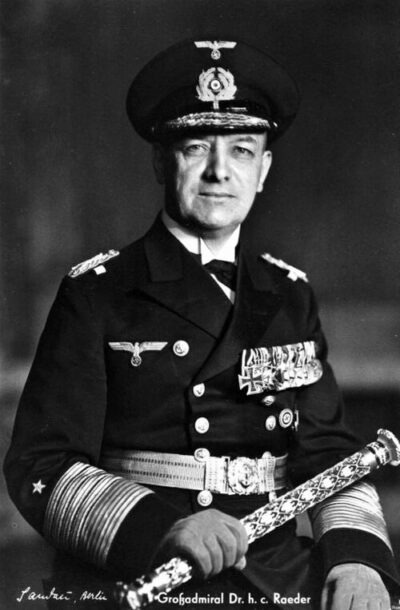
Erich Raeder
Erich Raeder was a German admiral. Born April 24, 1876, in Wandsbek. Died November 6, 1960, in Kiel. Educated at Naval Academy at Mürwik. Awards include Military Merit Cross III. Class, Knight's Cross of the Iron Cross and Order of the Red Eagle 4th Class.
Facts
31 facts · 2 confirmed by two sources · 9 cited · 19 from one source · 1 where the sources disagree
What’s different
- Died in: we show Kiel (Sources disagree). Wikidata also lists Kiel-Windeweer
Where this comes from
Papalocal keeps its own record. It started from these sources; what each one said is kept here as it was copied, so a change on their side never changes this page by itself. Tap one to read its version.
What Wikidata says · copied November 16, 2026 · revision 2569028630
- Described as
- German admiral (1876–1960)
- Other names
- Erich Johann Albert Raeder
- Born
- April 24, 1876 · 11 references
- Died
- November 6, 1960 · 12 references
- Born in
- Wandsbek · 1 reference
- Died in
- Kiel · 4 references; Kiel-Windeweer · 1 reference
- Buried in
- Kiel North Cemetery
- Name at birth
- Erich Johann Albert Raeder
- Citizen of
- Germany
- Occupation
- naval officer · 1 reference; historian · 1 reference
- Political party
- Nazi Party (1937–) · 1 reference
- Education
- Naval Academy at Mürwik
- Awards
- Military Merit Cross III. Class; Knight's Cross of the Iron Cross; Order of the Red Eagle 4th Class; Knight Grand Officer of the Order of Franz Josef I (1911) · 1 reference; Grand Cross of the Order of the White Rose of Finland (1936) · 1 reference; Golden Party Badge (1937); Order of Saint Stanislaus, 2nd class; Order of Michael the Brave; Grand Cross of Naval Merit with white badge (1930) · 1 reference; Grand Cross of the Order of the Cross of Liberty (1942) · 1 reference; Order of Military Merit (Bulgaria), 1st class (1934) · 2 references; Grand Cross of the Order of Saint Alexander (1941) · 1 reference; Imtiyaz Medal
- Father
- Hans Raeder
- Military branch
- Imperial German Navy; German Navy (1894–) · 1 reference; Kriegsmarine
- Military rank
- Großadmiral (1939–) · 1 reference; lieutenant (1897–) · 1 reference; admiral (1943–) · 1 reference
- Wikipedias with a page
- 59
Wikidata item Q57154 (wikidata.org/wiki/Q57154), public domain (CC0). Copied November 16, 2026.
What Wikipedia says · copied November 16, 2026 · revision 1378817532
Erich Johann Albert Raeder ([ˈeːʁɪç ˈʁɛːdɐ]; 24 April 1876 – 6 November 1960) was a German admiral who played a major role in the naval history of World War II and was convicted of war crimes after the war. He attained the highest possible naval rank, that of grand admiral, in 1939. Raeder led the Kriegsmarine for the first half of the war; he resigned in January 1943 and was replaced by Karl Dönitz. At the Nuremberg trials he was sentenced to life imprisonment but was released early owing to failing health in 1955.
- Born, in its opening lines
- April 24, 1876
- Died, in its opening lines
- November 6, 1960
From the Wikipedia article “Erich Raeder” (en.wikipedia.org/wiki/Erich_Raeder), by its contributors, under CC BY-SA 4.0 (creativecommons.org/licenses/by-sa/4.0/). Copied November 16, 2026; not changed.
Confirmed Two sources agree. Cited One source, and it names where it got it. One source One source, without a reference of its own. Sources disagree The sources disagree. We show the best-supported value and keep theirs below.
