
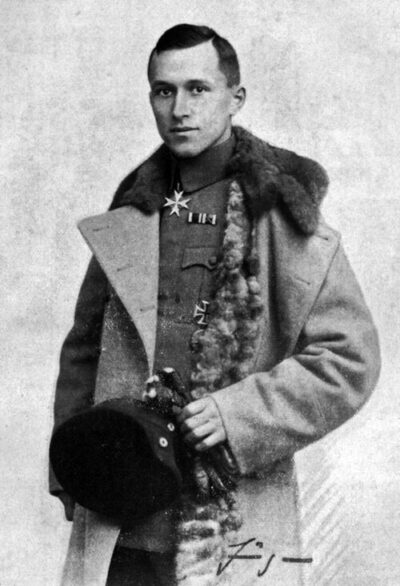
Ernst Jünger
Ernst Jünger was a German writer. Born March 29, 1895, in Heidelberg. Died February 17, 1998, in Riedlingen. Known for The forest passage, Storm of Steel and Eumeswil. Educated at Leipzig University. Awards include Pour le Mérite, Order of Merit of Baden-Württemberg and Prix mondial Cino Del Duca.
Facts
50 facts · 2 confirmed by two sources · 21 cited · 27 from one source
Where this comes from
Papalocal keeps its own record. It started from these sources; what each one said is kept here as it was copied, so a change on their side never changes this page by itself. Tap one to read its version.
What Wikidata says · copied November 16, 2026 · revision 2569143001
- Described as
- German writer (1895–1998)
- Born
- March 29, 1895 · 15 references
- Died
- February 17, 1998 · 16 references
- Born in
- Heidelberg · 4 references
- Died in
- Riedlingen · 1 reference
- Buried in
- Wilflingen Cemetery · 1 reference
- Citizen of
- Germany · 1 reference
- Occupation
- military personnel · 1 reference; entomologist · 3 references; philosopher · 3 references; writer · 4 references; diarist; journalist · 1 reference; science fiction writer; poet · 1 reference
- Education
- Leipzig University
- Known for
- The forest passage; Storm of Steel; Eumeswil
- Awards
- Pour le Mérite; Order of Merit of Baden-Württemberg (1980); Prix mondial Cino Del Duca (1981) · 1 reference; Great Cross with Star and Sash of the Order of Merit of the Federal Republic of Germany (1985) · 1 reference; Schiller Memorial Prize (1974); Goethe Prize of the City of Frankfurt (1982); Bavarian Maximilian Order for Science and Art (1986); Immermann Prize (1965); honorary doctor of the University of Madrid Complutense (1995); Literaturpreis der Stadt Bremen (1956) · 1 reference; Alfred-de-Vigny prize (1997) · 1 reference; Iron Cross (1914), 2nd class (1916) · 1 reference; Iron Cross (1914), 1st class (1916) · 1 reference; knight of the Royal House Order of Hohenzollern with Swords (1917) · 1 reference; Wound Badge (1918) in Gold (1918) · 1 reference
- Field
- philosophy; German-language literature · 1 reference; entomology · 1 reference
- Spouse
- Liselotte Jünger · 1 reference; Gretha Jünger · 1 reference
- Children
- Alexander Jünger; Ernstel Jünger · 1 reference
- Father
- Ernst Jünger · 1 reference
- Mother
- Lily Jünger
- Siblings
- Friedrich Georg Jünger · 1 reference; Wolfgang Jünger; Hans Otto Jünger; Johanna Deventer-Jünger
- Religion
- Catholicism · 1 reference
- Military branch
- Imperial German Army
- Military rank
- captain · 1 reference
- Website
- http://www.juenger-haus.de/
- Wikipedias with a page
- 71
Wikidata item Q76727 (wikidata.org/wiki/Q76727), public domain (CC0). Copied November 16, 2026.
What Wikipedia says · copied November 16, 2026 · revision 1385454000
Ernst Jünger (German: [ɛʁnst ˈjʏŋɐ] ; 29 March 1895 – 17 February 1998) was a German author, soldier, philosopher, and entomologist who became publicly known for his World War I memoir Storm of Steel. A prolific writer of over forty books, Jünger wrote particularly in the furtherance of conservatism and against what he perceived as the spiritual oppression of man.
The son of a successful businessman and chemist, Jünger rebelled against an affluent upbringing and sought adventure in the Wandervogel German youth movement, before running away to briefly serve in the French Foreign Legion, which was an illegal act in Germany. However, he escaped prosecution due to his father's efforts and was able to enlist in the Imperial German Army on the outbreak of World War I in 1914. During an ill-fated offensive in 1918 Jünger was badly wounded and was awarded the Pour le Mérite, a rare decoration for one of his rank and was the last living recipient when he died in 1998.
Jünger wrote against liberal values, democracy, and the Weimar Republic, but rejected the advances of the Nazis who were rising to power. During World War II Jünger served as an army captain in occupied Paris, but by 1943, he had turned decisively against Nazi totalitarianism, a change manifested in his work The Peace. Jünger was dismissed from the army in 1944 after he was indirectly implicated with fellow officers who had plotted to assassinate Hitler. A few months later, his son died in combat in Italy after having been sentenced to a penal battalion for political reasons.
Immediately after the war, Jünger was punished as a possible fellow traveller of the Nazis but his disengagement from politics in the following years meant his relationship with the radical right remained ambiguous. Jünger died an honoured figure in German literature; although critics continued to charge him with the glorification of war as a transcendental experience in some of his early works.
- Born, in its opening lines
- March 29, 1895
- Died, in its opening lines
- February 17, 1998
From the Wikipedia article “Ernst Jünger” (en.wikipedia.org/wiki/Ernst_Jünger), by its contributors, under CC BY-SA 4.0 (creativecommons.org/licenses/by-sa/4.0/). Copied November 16, 2026; not changed.
Confirmed Two sources agree. Cited One source, and it names where it got it. One source One source, without a reference of its own. Sources disagree The sources disagree. We show the best-supported value and keep theirs below.
