
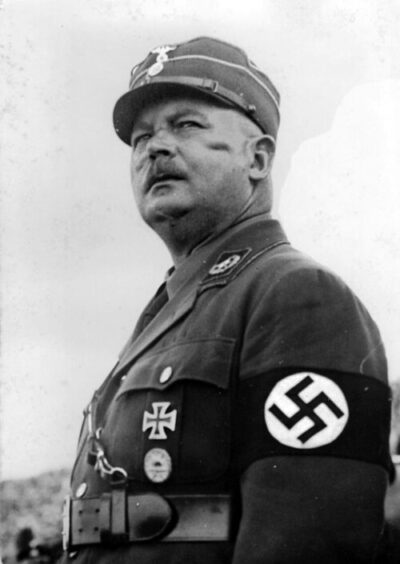
Ernst Röhm
Ernst Röhm was a German Nazi politician, military officer and leader of the Sturmabteilung. Born November 28, 1887, in Munich. Died July 1, 1934, in Munich Prison. Positions held include member of the Reichstag of the Weimar Republic and member of the Reichstag of Nazi Germany. Awards include Iron Cross, Military Merit Order (Bavaria) and Blood Order.
Facts
25 facts · 2 confirmed by two sources · 6 cited · 17 from one source
Where this comes from
Papalocal keeps its own record. It started from these sources; what each one said is kept here as it was copied, so a change on their side never changes this page by itself. Tap one to read its version.
What Wikidata says · copied November 16, 2026 · revision 2568910689
- Described as
- German Nazi politician, military officer and leader of the Sturmabteilung (1887-1934)
- Other names
- The Brownshirt Thug Leader
- Born
- November 28, 1887 · 9 references
- Died
- July 1, 1934 · 5 references
- Born in
- Munich · 3 references
- Died in
- Munich Prison · 1 reference
- Buried in
- Westfriedhof
- Cause of death
- extra-judicial killing
- Name at birth
- Ernst Julius Günther Röhm
- Citizen of
- Germany · 1 reference
- Occupation
- politician · 1 reference; military personnel · 1 reference; military officer · 1 reference; minister · 1 reference
- Positions held
- member of the Reichstag of the Weimar Republic; member of the Reichstag of Nazi Germany
- Political party
- Nazi Party; German Workers' Party; German Völkisch Freedom Party; National Socialist Freedom Movement
- Member of
- Sturmabteilung
- Awards
- Iron Cross · 1 reference; Military Merit Order (Bavaria) · 1 reference; Blood Order · 1 reference; Golden Party Badge · 1 reference
- Military branch
- Imperial German Army · 1 reference
- Military rank
- Hauptmann
- Wikipedias with a page
- 68
Wikidata item Q58583 (wikidata.org/wiki/Q58583), public domain (CC0). Copied November 16, 2026.
What Wikipedia says · copied November 16, 2026 · revision 1384554608
Ernst Julius Günther Röhm (German: [ɛʁnst ˈʁøːm]; 28 November 1887 – 1 July 1934) was a German military officer, politician, and a leading member of the Nazi Party. A close friend and early ally of Adolf Hitler, Röhm was the co-founder and leader of the Sturmabteilung (SA), the Nazi Party's original paramilitary wing, which played a significant role in Hitler's rise to power. He served as chief of the SA (Stabschef) from 1931 until his assassination by the SS in 1934 during the Night of the Long Knives.
Born in Munich, Röhm joined the Royal Bavarian Army in 1906 and fought in the First World War. He was wounded in action three times and received the Iron Cross First Class. After the war, he continued his military career as a captain in the Reichswehr and provided assistance to Franz Ritter von Epp's Freikorps Epp. In 1919, Röhm joined the German Workers' Party, the precursor of the Nazi Party, and became a close associate of Adolf Hitler. Using his military connections, he helped build up several paramilitary groups in service of Hitler, one of which became the SA. In 1923, he took part in Hitler's failed Beer Hall Putsch to seize governmental power in Munich and was given a suspended prison sentence. After a stint as a Reichstag deputy, Röhm broke with Hitler in 1925 over the future direction of the Nazi Party. He resigned from all positions and emigrated to Bolivia, where he served as an advisor to the Bolivian Army.
In 1930, at Hitler's request, Röhm returned to Germany and was officially appointed chief of staff of the SA in 1931. He reorganised the SA, which at the time numbered over a million members, and continued its campaign of political violence against communists, rival political parties, Jews and other groups deemed hostile to the Nazi agenda. At the same time, opposition to Röhm intensified as his homosexuality gradually became public knowledge. Nevertheless, he retained the trust of Hitler for a time. After Hitler became Chancellor of Germany in 1933, Röhm was named a Reichsleiter, the second highest political rank in the Nazi Party, and appointed to the Reich cabinet as a Reichsminister without portfolio.
As the Nazi government began to consolidate its rule, the tension between Röhm and Hitler escalated. Throughout 1933 and 1934, Röhm alarmed the German conservative elites and powerful industrialists by calling for a "second revolution" focused on socialist economic reforms and wealth redistribution. Additionally, Röhm sought to absorb the traditional German army (the 100,000-man Reichswehr) into his 3-million-strong SA to create a radical "Soldier’s State" (German: Soldatenstaat), with himself as its commander and defense minister—a direct threat to the Reichswehr's autonomy. Hitler thus came to see his long-time ally as a rival and a liability, and in order to secure the backing of the Reichswehr and the traditional establishment, made the decision to eliminate Röhm and his powerful SA allies with the assistance of SS leaders Heinrich Himmler and Reinhard Heydrich. On 30 June 1934, the entire SA leadership were purged by the SS during an event known as the Night of the Long Knives. Röhm, at the Hanselbauer Hotel in Bad Wiessee at the time, was arrested and taken to Stadelheim Prison in Munich, where, after declining an offer to honorably take his own life, he was summarily shot on 1 July 1934.
- Born, in its opening lines
- November 28, 1887
- Died, in its opening lines
- July 1, 1934
From the Wikipedia article “Ernst Röhm” (en.wikipedia.org/wiki/Ernst_Röhm), by its contributors, under CC BY-SA 4.0 (creativecommons.org/licenses/by-sa/4.0/). Copied November 16, 2026; not changed.
Confirmed Two sources agree. Cited One source, and it names where it got it. One source One source, without a reference of its own. Sources disagree The sources disagree. We show the best-supported value and keep theirs below.
