
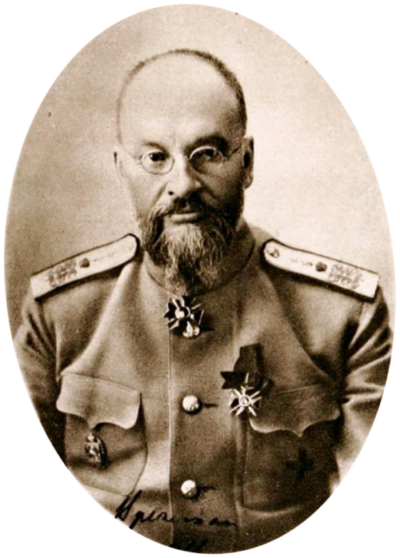
Eugene Botkin
Eugene Botkin was a Court physician for Tsar Nicholas II. Born May 27, 1865, in Pushkin. Died July 17, 1918, in Yekaterinburg. Educated at S. M. Kirov Military Medical Academy and Imperial Academy of Medical Surgery. Awards include Order of Saint Anna, 2nd class, Order of Saint Stanislaus, 3rd class and Order of St. Vladimir, 3rd class.
Facts
27 facts · 1 confirmed by two sources · 3 cited · 22 from one source · 1 where the sources disagree
What’s different
- Born: we show May 27, 1865 (Sources disagree). Wikipedia says March 27, 1865
Where this comes from
Papalocal keeps its own record. It started from these sources; what each one said is kept here as it was copied, so a change on their side never changes this page by itself. Tap one to read its version.
What Wikidata says · copied November 18, 2026 · revision 2567336350
- Described as
- Court physician for Tsar Nicholas II
- Other names
- Yevgeny Sergeyevich Botkin
- Born
- May 27, 1865
- Died
- July 17, 1918
- Born in
- Pushkin · 1 reference
- Died in
- Yekaterinburg · 1 reference
- Buried in
- Peter and Paul Cathedral
- Cause of death
- gunshot wound
- Citizen of
- Russian Empire; Russian Socialist Federative Soviet Republic · 1 reference
- Occupation
- physician · 1 reference
- Worked for
- Imperial Academy of Medical Surgery · 1 reference
- Education
- S. M. Kirov Military Medical Academy; Imperial Academy of Medical Surgery · 1 reference; The Second Saint Petersburg Gymnasium
- Awards
- Order of Saint Anna, 2nd class; Order of Saint Stanislaus, 3rd class; Order of St. Vladimir, 3rd class; Order of St. Vladimir, 2nd class; Medal In memory of coronation of Nikolay II · 1 reference; Order of St. Sava · 1 reference; Order of Civil Merit · 1 reference
- Field
- medicine · 1 reference
- Spouse
- Olga Botkina (–1910)
- Children
- Tatiana Botkina; Gleb Botkin
- Father
- Sergey Petrovich Botkin
- Mother
- Anastasiya Alexandrovna Botkina
- Religion
- Eastern Orthodox Church
- Wikipedias with a page
- 21
Wikidata item Q951539 (wikidata.org/wiki/Q951539), public domain (CC0). Copied November 18, 2026.
What Wikipedia says · copied November 18, 2026 · revision 1375135038
Yevgeny Sergeyevich Botkin (Russian: Евгений Сергеевич Боткин; 27 March 1865 – 17 July 1918), commonly known as Eugene Botkin, was the court physician since 1908 for Emperor Nicholas II and Empress Alexandra. He sometimes treated the Tsarevich Alexei Nikolaevich of Russia for haemophilia-related complications, like in Spała in 1912.
Following the Russian Revolution of 1917, Botkin went into exile with the Romanov family, accompanying them to Tobolsk and Yekaterinburg in Siberia. He was murdered with the Imperial family by guards on 17 July 1918.
Like the Romanov family, Botkin was canonised in 1981 as a New Martyr by the Russian Orthodox Church Outside of Russia.
In 2000, the Russian Orthodox Church canonised the Romanov family as passion bearers. On 3 February 2016, the Bishop's Council of the Russian Orthodox Church canonised Botkin as Righteous Passion-Bearer Yevgeny the Physician.
- Born, in its opening lines
- March 27, 1865
- Died, in its opening lines
- July 17, 1918
From the Wikipedia article “Eugene Botkin” (en.wikipedia.org/wiki/Eugene_Botkin), by its contributors, under CC BY-SA 4.0 (creativecommons.org/licenses/by-sa/4.0/). Copied November 18, 2026; not changed.
Confirmed Two sources agree. Cited One source, and it names where it got it. One source One source, without a reference of its own. Sources disagree The sources disagree. We show the best-supported value and keep theirs below.
