
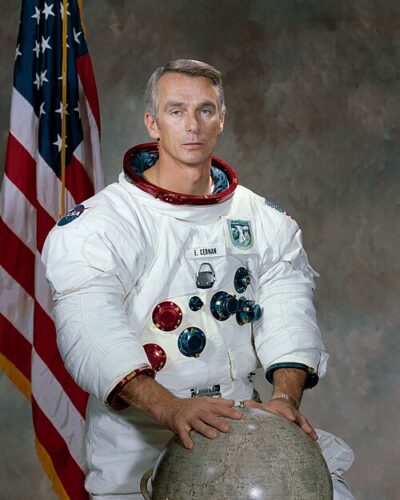
Eugene Cernan
Eugene Cernan was a NASA astronaut, Naval aviator, aeronautical engineer, electrical engineer, fighter pilot, eleventh human to walk on the Moon (Apollo 10 and Apollo 17). Born March 14, 1934, in Chicago. Died January 16, 2017, in Houston. Educated at Purdue University and Naval Postgraduate School. Awards include Distinguished Flying Cross, National Aviation Hall of Fame and United States Astronaut Hall of Fame.
Facts
31 facts · 2 confirmed by two sources · 12 cited · 17 from one source
Where this comes from
Papalocal keeps its own record. It started from these sources; what each one said is kept here as it was copied, so a change on their side never changes this page by itself. Tap one to read its version.
What Wikidata says · copied November 13, 2026 · revision 2565947268
- Described as
- NASA astronaut, Naval aviator, aeronautical engineer, electrical engineer, fighter pilot, eleventh human to walk on the Moon (Apollo 10 and Apollo 17)
- Other names
- Gene Cernan, Eugene A. Cernan, Eugene Andrew Cernan
- Born
- March 14, 1934 · 12 references
- Died
- January 16, 2017 · 9 references
- Born in
- Chicago · 2 references
- Died in
- Houston · 1 reference
- Buried in
- Texas State Cemetery (2017–) · 3 references
- Name at birth
- Eugene Andrew Cernan · 1 reference
- Citizen of
- United States
- Occupation
- naval officer; astronaut · 1 reference; fighter pilot; autobiographer; businessperson; military flight engineer; naval aviator
- Worked for
- National Aeronautics and Space Administration
- Education
- Purdue University; Naval Postgraduate School
- Member of
- NASA Astronaut Group 3
- Awards
- Distinguished Flying Cross; National Aviation Hall of Fame (2000) · 1 reference; United States Astronaut Hall of Fame; Grand Officer of the Order of the White Double Cross (1994) · 1 reference; NASA Distinguished Service Medal (2 times) (1969, 1973) · 1 reference; International Space Hall of Fame (1982) · 2 references; Washington Award (2003) · 1 reference; Wright Brothers Memorial Trophy (2007); honorary doctor of Comenius University (1994) · 1 reference; honorary doctorate of Slovak University of Technology in Bratislava (2004) · 1 reference
- Military branch
- United States Navy
- Military rank
- captain · 1 reference
- Nickname
- Gene
- Wikipedias with a page
- 59
Wikidata item Q158486 (wikidata.org/wiki/Q158486), public domain (CC0). Copied November 13, 2026.
What Wikipedia says · copied November 13, 2026 · revision 1381200256
Eugene Andrew Cernan (; March 14, 1934 – January 16, 2017) was an American astronaut, naval aviator, electrical engineer, aeronautical engineer, and fighter pilot. As of 2026, he is the last person to walk on the Moon.
Cernan traveled into space three times and to the Moon twice: as pilot of Gemini 9A in June 1966, as Lunar Module pilot of Apollo 10 in May 1969, and as commander of Apollo 17 in December 1972, the final Apollo lunar landing. He was also a backup crew member of Gemini 12, Apollo 7, and Apollo 14. During the Apollo 17 mission, he became the 11th person to walk on the Moon as well as the astronaut with the longest time spent walking on the Moon.
Before becoming an astronaut, Cernan graduated with a Bachelor of Science degree in electrical engineering from Purdue University in Indiana, and joined the U.S. Navy through the Naval Reserve Officers Training Corps (NROTC). After flight training, he received his naval aviator wings and served as a fighter pilot. In 1963, he received a Master of Science degree in aeronautical engineering from the U.S. Naval Postgraduate School. Achieving the rank of captain, he retired from the Navy in 1976.
- Born, in its opening lines
- March 14, 1934
- Died, in its opening lines
- January 16, 2017
From the Wikipedia article “Gene Cernan” (en.wikipedia.org/wiki/Gene_Cernan), by its contributors, under CC BY-SA 4.0 (creativecommons.org/licenses/by-sa/4.0/). Copied November 13, 2026; not changed.
Confirmed Two sources agree. Cited One source, and it names where it got it. One source One source, without a reference of its own. Sources disagree The sources disagree. We show the best-supported value and keep theirs below.
