
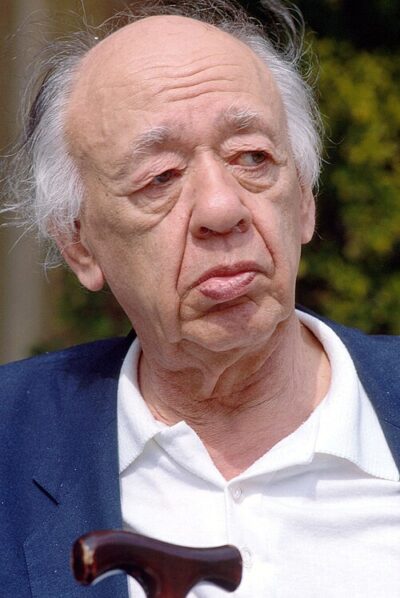
Eugène Ionesco
Eugène Ionesco was a Romanian-French playwright. Born November 26, 1909, in Slatina. Died March 28, 1994, in 14th arrondissement of Paris. Positions held include Member of the Académie française (1970–1994). Known for The Chairs, Rhinoceros and The Killer. Educated at University of Bucharest and Carol I National College. Awards include Commandeur des Arts et des Lettres, Prince Pierre Award and Commander of the National Order of Merit.
Facts
50 facts · 2 confirmed by two sources · 22 cited · 26 from one source
Where this comes from
Papalocal keeps its own record. It started from these sources; what each one said is kept here as it was copied, so a change on their side never changes this page by itself. Tap one to read its version.
What Wikidata says · copied November 16, 2026 · revision 2568944143
- Described as
- Romanian-French playwright (1909–1994)
- Other names
- Eugene Ionesco, Eugen Ionesco, Ionesco
- Born
- November 26, 1909 · 3 references
- Died
- March 28, 1994 · 5 references
- Born in
- Slatina · 2 references
- Died in
- 14th arrondissement of Paris · 1 reference
- Buried in
- Montparnasse Cemetery
- Name at birth
- Eugen Dimitri Ionescu · 1 reference
- Citizen of
- Romania; France · 1 reference
- Occupation
- playwright · 2 references; poet · 1 reference; literary critic; diarist · 1 reference; illustrator · 1 reference; graphic artist · 1 reference; film actor · 1 reference; television actor · 1 reference
- Positions held
- Member of the Académie française (1970–1994) · 1 reference
- Political party
- Transnational Radical Party
- Education
- University of Bucharest; Carol I National College; Fraţii Buzeşti National College; Saint Sava College
- Member of
- Romanian Academy (2009–); Académie Française (1970–1994) · 1 reference; College of 'Pataphysics; American Academy of Arts and Sciences; Bavarian Academy of Fine Arts; Comité des intellectuels pour l'Europe des libertés (1978–); Academy of Arts, Berlin (1976–1994) · 1 reference
- Known for
- The Chairs; Rhinoceros; The Killer; The New Tenant; The Bald Soprano
- Awards
- Commandeur des Arts et des Lettres · 1 reference; Prince Pierre Award; Commander of the National Order of Merit · 1 reference; Jerusalem Prize (1973); Pour le Mérite for Sciences and Arts order; Prix du Brigadier; Austrian State Prize for European Literature (1971) · 1 reference; Officer of the Legion of Honour · 1 reference; star on Playwrights' Sidewalk · 1 reference
- Field
- performing arts; literary activity · 1 reference; drama · 1 reference; poetry · 1 reference
- Spouse
- Rodica Ionesco (1936–)
- Children
- Marie-France Ionesco · 1 reference
- Religion
- Eastern Orthodoxy · 1 reference
- Wikipedias with a page
- 103
Wikidata item Q46706 (wikidata.org/wiki/Q46706), public domain (CC0). Copied November 16, 2026.
What Wikipedia says · copied November 16, 2026 · revision 1374894281
Eugène Ionesco (; French: [øʒɛn jɔnɛsko]; born Eugen Ionescu, Romanian: [e.uˈdʒen joˈnesku] ; 26 November 1909 – 28 March 1994) was a Romanian-French playwright who wrote mostly in French, and was one of the foremost figures of the French avant-garde theatre in the 20th century. Ionesco instigated a revolution in ideas and techniques of drama, beginning with his "anti play", The Bald Soprano, which contributed to the beginnings of what is known as the Theatre of the Absurd. He wrote a number of plays that, following the ideas of the philosopher Albert Camus, explore concepts of absurdism and surrealism. He was made a member of the Académie française in 1970, and was awarded the 1970 Austrian State Prize for European Literature, and the 1973 Jerusalem Prize.
- Born, in its opening lines
- November 26, 1909
- Died, in its opening lines
- March 28, 1994
From the Wikipedia article “Eugène Ionesco” (en.wikipedia.org/wiki/Eugène_Ionesco), by its contributors, under CC BY-SA 4.0 (creativecommons.org/licenses/by-sa/4.0/). Copied November 16, 2026; not changed.
Confirmed Two sources agree. Cited One source, and it names where it got it. One source One source, without a reference of its own. Sources disagree The sources disagree. We show the best-supported value and keep theirs below.
