
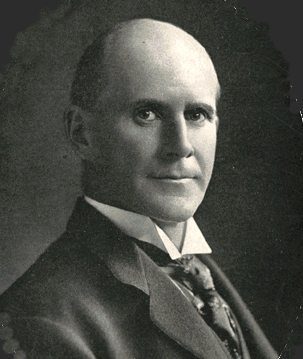
Eugene V. Debs
Eugene V. Debs was an American labor and political leader. Born November 5, 1855, in Terre Haute. Died October 20, 1926, in Elmhurst. Positions held include member of the Indiana House of Representatives (1885–1887) and municipal clerk (1879–1883). Awards include Labor Hall of Honor.
Facts
25 facts · 2 confirmed by two sources · 9 cited · 14 from one source
Where this comes from
Papalocal keeps its own record. It started from these sources; what each one said is kept here as it was copied, so a change on their side never changes this page by itself. Tap one to read its version.
What Wikidata says · copied November 13, 2026 · revision 2567386678
- Described as
- American labor and political leader (1855–1926)
- Other names
- Convict Number 9653, Gene Debs, The Revolutionist, Eugene V Debs, Eugene Victor Debs, Convict No. 9653, Eugene Debs, Inmate Number 9653, 9653
- Born
- November 5, 1855 · 7 references
- Died
- October 20, 1926 · 7 references
- Born in
- Terre Haute · 1 reference
- Died in
- Elmhurst · 1 reference
- Buried in
- Highland Lawn Cemetery
- Cause of death
- heart failure
- Citizen of
- United States
- Occupation
- politician · 2 references; trade unionist · 1 reference; peace activist; political activist; writer · 1 reference; socialist · 1 reference; author · 1 reference; union member · 1 reference
- Positions held
- member of the Indiana House of Representatives (1885–1887); municipal clerk (1879–1883)
- Political party
- Socialist Party of America (1901–); Democratic Party (–1896); Social Democracy of America (1897–1898); Social Democratic Party of America (1898–1901)
- Awards
- Labor Hall of Honor (1990) · 1 reference
- Siblings
- Theodore Debs
- Nickname
- Convict Number 9653 · 1 reference
- Website
- https://debs.institute/
- Wikipedias with a page
- 50
Wikidata item Q334993 (wikidata.org/wiki/Q334993), public domain (CC0). Copied November 13, 2026.
What Wikipedia says · copied November 13, 2026 · revision 1384331824
Eugene Victor Debs (November 5, 1855 – October 20, 1926) was an American socialist activist and trade unionist. He was one of the founding members of the Industrial Workers of the World (IWW) and a five-time candidate of the Socialist Party of America for President of the United States; through his presidential candidacies as well as his work with labor movements, Debs eventually became one of the best-known socialists living in the United States.
Early in his political career, Debs was a member of the Democratic Party. He was elected as a Democrat to the Indiana General Assembly in 1884. After working with several smaller unions, including the Brotherhood of Locomotive Firemen, Debs led his union in a major ten-month strike against the CB&Q Railroad in 1888. Debs was instrumental in the founding of the American Railway Union (ARU), one of the nation's first industrial unions. After workers at the Pullman Palace Car Company organized a wildcat strike over pay cuts in the summer of 1894, Debs signed many into the ARU. He led a boycott by the ARU against handling trains with Pullman cars in what became the nationwide Pullman Strike, affecting most lines west of Detroit and more than 250,000 workers in 27 states. Purportedly to keep the mail running, President Grover Cleveland used the United States Army to break the strike. As a leader of the ARU, Debs was convicted of federal charges for defying a court injunction against the strike and served six months in prison.
In prison, Debs read various works of socialist theory and emerged six months later as a committed adherent of the international socialist movement. Debs was a founding member of the Social Democracy of America (1897), the Social Democratic Party of America (1898) and the Socialist Party of America (1901). Debs ran as a Socialist candidate for President of the United States five times: 1900 (earning 0.6 percent of the popular vote), 1904 (3.0 percent), 1908 (2.8 percent), 1912 (6.0 percent), and 1920 (3.4 percent), the last time from a prison cell. He was also a candidate for United States Congress from his home state Indiana in 1916.
Debs was noted for his oratorical skills, and his speech denouncing American participation in World War I would lead to his second arrest in 1918. He was convicted under the Sedition Act of 1918 and stripped of his U.S. citizenship for encouraging young men to evade the draft. He was sentenced to two 10-year prison terms. President Warren G. Harding commuted his sentence in December 1921, but did not have his citizenship restored during his lifetime. Debs died in 1926, not long after being admitted to a sanatorium due to cardiovascular problems that had developed during his time in prison.
- Born, in its opening lines
- November 5, 1855
- Died, in its opening lines
- October 20, 1926
From the Wikipedia article “Eugene V. Debs” (en.wikipedia.org/wiki/Eugene_V._Debs), by its contributors, under CC BY-SA 4.0 (creativecommons.org/licenses/by-sa/4.0/). Copied November 13, 2026; not changed.
Confirmed Two sources agree. Cited One source, and it names where it got it. One source One source, without a reference of its own. Sources disagree The sources disagree. We show the best-supported value and keep theirs below.
