
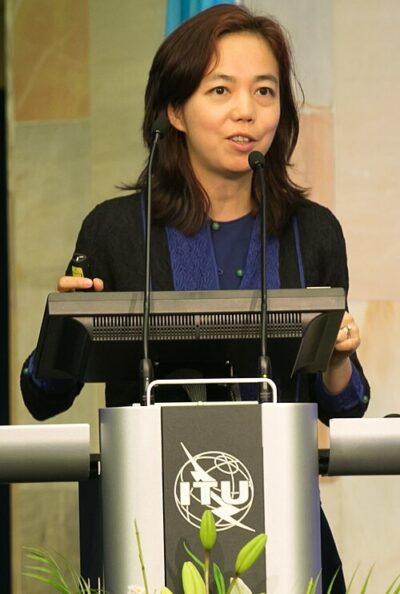
Fei-Fei Li
Fei-Fei Li is an American computer scientist. Born July 3, 1976, in Beijing. Educated at California Institute of Technology and Princeton University. Awards include J. K. Aggarwal Prize, ACM Fellow and BBC 100 Women.
Facts
26 facts · 1 confirmed by two sources · 14 cited · 11 from one source
Where this comes from
Papalocal keeps its own record. It started from these sources; what each one said is kept here as it was copied, so a change on their side never changes this page by itself. Tap one to read its version.
What Wikidata says · copied November 15, 2026 · revision 2567603967
- Described as
- American computer scientist
- Other names
- Fei Fei Li, L. Fei-Fei, Li Fei-Fei, Feifei Li
- Born
- July 3, 1976 · 1 reference
- Born in
- Beijing · 1 reference
- Citizen of
- United States
- Occupation
- computer scientist · 1 reference; university teacher · 1 reference; scientist · 1 reference
- Worked for
- Stanford University (2012–); University of Illinois Urbana-Champaign · 1 reference; Radical Ventures (2023–) · 1 reference
- Education
- California Institute of Technology (2000–2005) · 2 references; Princeton University (1995–1999); Parsippany High School · 1 reference; Chengdu No.7 High School
- Member of
- American Academy of Arts and Sciences; Association for Computing Machinery (2018–) · 1 reference
- Awards
- J. K. Aggarwal Prize (2016); ACM Fellow (2021) · 1 reference; BBC 100 Women (2019) · 1 reference; Thousand Talents Program; Queen Elizabeth Prize for Engineering (2025) · 1 reference
- Field
- computer science · 1 reference; artificial intelligence · 1 reference; computer vision · 1 reference
- Spouse
- Silvio Savarese · 1 reference
- Website
- http://vision.stanford.edu/feifeili; https://profiles.stanford.edu/fei-fei-li
- Wikipedias with a page
- 36
Wikidata item Q18686107 (wikidata.org/wiki/Q18686107), public domain (CC0). Copied November 15, 2026.
What Wikipedia says · copied November 15, 2026 · revision 1384324798
Fei-Fei Li (Chinese: 李飞飞; pinyin: Lǐ Fēifēi; born July 3, 1976) is a Chinese-born American computer scientist best known for establishing ImageNet, the dataset that enabled rapid advances in computer vision in the 2010s. She is a professor of computer science at Stanford University, with research expertise in artificial intelligence, machine learning, deep learning, computer vision, and cognitive neuroscience. Li has earned the title of "The Godmother of AI".
Li is a co-director of the Stanford Institute for Human-Centered Artificial Intelligence and a co-director of the Stanford Vision and Learning Lab, and served as Chief Scientist of AI/ML at Google Cloud and the director of the Stanford Artificial Intelligence Laboratory from 2013 to 2018. In 2017, she co-founded AI4ALL, a nonprofit organization working to increase diversity in the field of artificial intelligence. In 2023, Li was named one of the Time 100 AI Most Influential People.
Li received the Intel Lifetime Achievements Innovation Award in 2017 for her contributions to artificial intelligence, and was elected member of the National Academy of Engineering, the National Academy of Medicine in 2020 and the American Academy of Arts and Sciences in 2021. In 2025, she was named as one of the "Architects of AI" for Time's Person of the Year. On August 3, 2023, Li was appointed to the United Nations Scientific Advisory Board, established by Secretary-General Antonio Guterres. In 2024, Li was included on the Gold House's most influential Asian A100 list.
In 2024, she raised $230 million for World Labs, a startup which she and three colleagues founded to develop a "spatial intelligence" AI technology that can understand how the three-dimensional physical world works. In early 2026, World Labs raised an additional $1 billion; In September 2026 it was announced that AMD would be acquiring World Labs for $8.2 billion.
- Born, in its opening lines
- July 3, 1976
From the Wikipedia article “Fei-Fei Li” (en.wikipedia.org/wiki/Fei-Fei_Li), by its contributors, under CC BY-SA 4.0 (creativecommons.org/licenses/by-sa/4.0/). Copied November 15, 2026; not changed.
Confirmed Two sources agree. Cited One source, and it names where it got it. One source One source, without a reference of its own. Sources disagree The sources disagree. We show the best-supported value and keep theirs below.
