
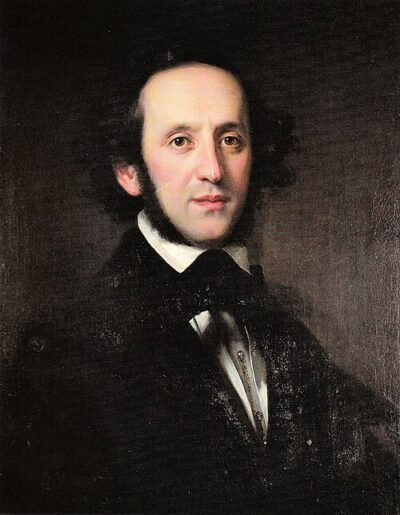
Felix Mendelssohn
Felix Mendelssohn was a German composer, pianist, organist and conductor of Jewish descent. Born February 3, 1809, in Hamburg. Died November 4, 1847, in Leipzig. Known for A Midsummer Night's Dream, Symphony No. 3 and Symphony No. 4. Educated at Humboldt-Universität zu Berlin. Awards include Pour le Mérite for Sciences and Arts order, honorary citizen of Leipzig and Pour le Mérite.
Facts
50 facts · 2 confirmed by two sources · 17 cited · 31 from one source
Where this comes from
Papalocal keeps its own record. It started from these sources; what each one said is kept here as it was copied, so a change on their side never changes this page by itself. Tap one to read its version.
What Wikidata says · copied November 16, 2026 · revision 2568738672
- Described as
- German composer, pianist, organist and conductor of Jewish descent (1809-1847)
- Other names
- Mendelssohn-Bartholdy, Mendelssohn, Jakob Ludwig Felix Mendelssohn Bartholdy, Felix Mendelssohn Bartholdy, Felix Mendelssohn-Bartholdy
- Born
- February 3, 1809 · 21 references
- Died
- November 4, 1847 · 21 references
- Born in
- Hamburg · 4 references
- Died in
- Leipzig · 4 references
- Buried in
- cemeteries at Hallesches Tor
- Cause of death
- stroke
- Citizen of
- Kingdom of Saxony; Hamburg
- Occupation
- composer · 2 references; pianist · 2 references; organist · 3 references; conductor · 2 references; musicologist; music educator; university teacher; painter · 2 references
- Worked for
- University of Music and Theatre Leipzig (1843–1847) · 1 reference
- Education
- Humboldt-Universität zu Berlin
- Member of
- Royal Netherlands Academy of Arts and Sciences · 1 reference
- Genre
- opera; classical music; symphonic music
- Instrument
- organ; piano; violin (1846–)
- Known for
- A Midsummer Night's Dream; Symphony No. 3; Symphony No. 4; Violin Concerto in E minor; The Hebrides; St. Paul; Elijah
- Awards
- Pour le Mérite for Sciences and Arts order · 1 reference; honorary citizen of Leipzig (1843) · 1 reference; Pour le Mérite · 1 reference
- Field
- music composing · 1 reference
- Spouse
- Cécile Mendelssohn Bartholdy · 1 reference
- Children
- Paul Mendelssohn Bartholdy · 1 reference; Carl Mendelssohn Bartoldy · 2 references; Lili Wach · 1 reference; Marie Benecke · 1 reference; Felix Mendelssohn Bartholdy · 1 reference
- Father
- Abraham Mendelssohn Bartholdy · 1 reference
- Mother
- Lea Mendelssohn Bartholdy · 1 reference
- Siblings
- Rebecka Mendelssohn · 1 reference; Fanny Mendelssohn · 3 references; Paul Mendelssohn Bartholdy · 1 reference
- Religion
- Lutheranism (1816–); reformed · 1 reference
- Website
- https://www.mendelssohn-stiftung.de/de/
- Wikipedias with a page
- 124
Wikidata item Q46096 (wikidata.org/wiki/Q46096), public domain (CC0). Copied November 16, 2026.
What Wikipedia says · copied November 16, 2026 · revision 1382073819
Jakob Ludwig Felix Mendelssohn Bartholdy (3 February 1809 – 4 November 1847), simply known as Felix Mendelssohn, was a German composer, pianist, organist and conductor of the early Romantic era. Mendelssohn's compositions include symphonies, concertos, piano music, organ music and chamber music. His best-known works include the String Octet, the overture and incidental music for A Midsummer Night's Dream (which includes his "Wedding March"), the Italian and Scottish Symphonies, the oratorios St. Paul and Elijah, the Hebrides Overture, the mature Violin Concerto, and the melody used in the Christmas carol "Hark! The Herald Angels Sing". Mendelssohn's Songs Without Words are his most famous solo piano compositions.
Mendelssohn's grandfather was the Jewish philosopher Moses Mendelssohn, but Felix was initially raised without religion until he was baptised aged seven into the Reformed Christian church. He was recognised early as a musical prodigy, but his parents were cautious and did not seek to capitalise on his talent. His sister Fanny received a similar musical education and was a talented composer and pianist in her own right; some of her early songs were published under her brother's name and her Easter Sonata was for a time mistakenly attributed to him after being lost and rediscovered in the 1970s.
Mendelssohn enjoyed early success in Germany, and revived interest in the music of Johann Sebastian Bach, notably with his performance of the St Matthew Passion in 1829. He became well received in his travels throughout Europe as a composer, conductor and soloist; his ten visits to Britain – during which many of his major works were premiered – form an important part of his adult career. His essentially conservative musical tastes set him apart from more adventurous musical contemporaries, such as Franz Liszt, Richard Wagner, Charles-Valentin Alkan and Hector Berlioz. The Leipzig Conservatory, which he founded, became a bastion of this anti-radical outlook.
After a long period of relative denigration due to changing musical tastes and antisemitism in the late 19th and early 20th centuries, his creative originality has been re-evaluated. He is now among the most popular composers of the Romantic era.
- Born, in its opening lines
- February 3, 1809
- Died, in its opening lines
- November 4, 1847
From the Wikipedia article “Felix Mendelssohn” (en.wikipedia.org/wiki/Felix_Mendelssohn), by its contributors, under CC BY-SA 4.0 (creativecommons.org/licenses/by-sa/4.0/). Copied November 16, 2026; not changed.
Confirmed Two sources agree. Cited One source, and it names where it got it. One source One source, without a reference of its own. Sources disagree The sources disagree. We show the best-supported value and keep theirs below.
