
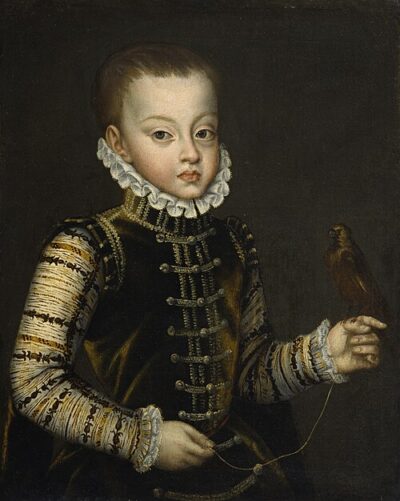
Ferdinand, Prince of Asturias
Ferdinand, Prince of Asturias was a Spanish prince. Born December 4, 1571, in Madrid. Died October 18, 1578, in Madrid. Positions held include Prince of Asturias (1573–1578).
Facts
19 facts · 2 confirmed by two sources · 0 cited · 17 from one source
Where this comes from
Papalocal keeps its own record. It started from these sources; what each one said is kept here as it was copied, so a change on their side never changes this page by itself. Tap one to read its version.
What Wikidata says · copied November 18, 2026 · revision 2562444807
- Described as
- Spanish prince (1571-1578)
- Other names
- Fernando de Austria
- Born
- December 4, 1571
- Died
- October 18, 1578
- Born in
- Madrid
- Died in
- Madrid
- Buried in
- Pantheon of the Infantes of the Royal Monastery of San Lorenzo de El Escorial
- Cause of death
- dysentery
- Name at birth
- Fernando de Austria y Austria
- Citizen of
- Spain
- Positions held
- Prince of Asturias (1573–1578) · 1 reference
- Father
- Philip II of Spain
- Mother
- Anna of Austria, Queen of Spain
- Siblings
- Isabella Clara Eugenia of Spain; Catalina Micaela of Spain; Carlos, Prince of Asturias; Philip III of Spain; Diego, Prince of Asturias · 1 reference; Infanta Maria of Spain; Infante Carlos Lorenzo of Spain
- Religion
- Catholic Church
- Wikipedias with a page
- 20
Wikidata item Q574024 (wikidata.org/wiki/Q574024), public domain (CC0). Copied November 18, 2026.
What Wikipedia says · copied November 18, 2026 · revision 1359442191
Ferdinand, Prince of Asturias (4 December 1571 – 18 October 1578) was a member of the House of Habsburg who was heir apparent to the Spanish throne.
- Born, in its opening lines
- December 4, 1571
- Died, in its opening lines
- October 18, 1578
From the Wikipedia article “Ferdinand, Prince of Asturias” (en.wikipedia.org/wiki/Ferdinand,_Prince_of_Asturias), by its contributors, under CC BY-SA 4.0 (creativecommons.org/licenses/by-sa/4.0/). Copied November 18, 2026; not changed.
Confirmed Two sources agree. Cited One source, and it names where it got it. One source One source, without a reference of its own. Sources disagree The sources disagree. We show the best-supported value and keep theirs below.
