
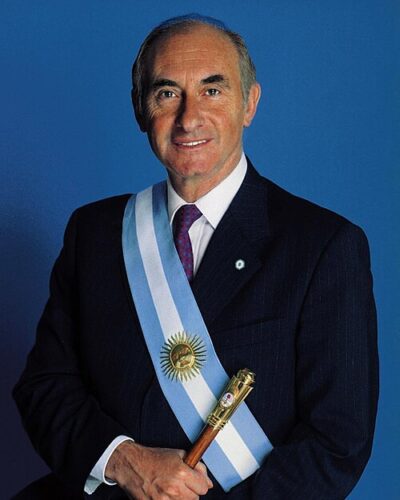
Fernando de la Rúa
Fernando de la Rúa was a president of Argentina from 1999 to 2001. Born September 15, 1937, in Córdoba. Died July 9, 2019, in Loma Verde. Positions held include President of Argentina (1999–2001), member of the Argentine Chamber of Deputies and member of the Argentine Chamber of Senators (3 times) (1973–1996). Educated at National University of Córdoba. Awards include Collar of the Order of Isabella the Catholic, Grand Collar of the Order of Prince Henry and Grand Cross of the Order of the White Double Cross.
Facts
29 facts · 2 confirmed by two sources · 11 cited · 16 from one source
Where this comes from
Papalocal keeps its own record. It started from these sources; what each one said is kept here as it was copied, so a change on their side never changes this page by itself. Tap one to read its version.
What Wikidata says · copied November 16, 2026 · revision 2567818694
- Described as
- president of Argentina from 1999 to 2001
- Born
- September 15, 1937
- Died
- July 9, 2019 · 1 reference
- Born in
- Córdoba · 1 reference
- Died in
- Loma Verde
- Cause of death
- cardiac arrest · 1 reference
- Citizen of
- Argentina
- Occupation
- lawyer; politician · 1 reference; jurist · 1 reference
- Positions held
- President of Argentina (1999–2001) · 1 reference; member of the Argentine Chamber of Deputies; member of the Argentine Chamber of Senators (3 times) (1973–1996) · 1 reference; Chief of Government of the Autonomous City of Buenos Aires (1996–1999)
- Political party
- Radical Civic Union
- Worked for
- University of Buenos Aires
- Education
- National University of Córdoba
- Awards
- Collar of the Order of Isabella the Catholic (2000) · 1 reference; Grand Collar of the Order of Prince Henry · 2 references; Grand Cross of the Order of the White Double Cross (2001) · 1 reference; Knight Grand Cross of the Order of Merit of the Italian Republic; Grand Cross of the Order of the Sun of Peru; Knight Grand Cross with Collar of the Order of Merit of the Italian Republic (2001) · 1 reference; honorary doctor of the Renmin University of China (2000) · 1 reference; Konex Award (1988) · 1 reference
- Spouse
- Inés Pertiné Urien (1970–2019)
- Children
- Antonio de la Rúa
- Father
- Antonio de la Rúa
- Siblings
- Jorge de la Rúa
- Religion
- Catholic Church
- Wikipedias with a page
- 53
Wikidata item Q295007 (wikidata.org/wiki/Q295007), public domain (CC0). Copied November 16, 2026.
What Wikipedia says · copied November 16, 2026 · revision 1378883473
Fernando de la Rúa (Spanish pronunciation: [feɾˈnando ðe la ˈrua] ; 15 September 1937 – 9 July 2019) was an Argentine politician who served as the president of Argentina from 1999 until his resignation in 2001. A member of the Radical Civic Union, he previously served as national senator for Buenos Aires across non-consecutive terms from 1973 to 1996, national deputy for Buenos Aires from 1991 to 1992, the first Chief of Government of Buenos Aires between 1996 and 1999, and president of the National Committee of the Radical Civic Union from 1997 to 1999.
De la Rúa was born in Córdoba, and entered politics after graduating with a degree in law. He was elected senator in 1973 and unsuccessfully ran for the office of vice president as Ricardo Balbín's running mate the same year. He was re-elected senator in 1983 and 1993, and as deputy in 1991. He unsuccessfully opposed the pact of Olivos between President Carlos Menem and party leader Raúl Alfonsín, which enabled the 1994 amendment of the Argentine Constitution and the re-election of Menem in 1995. He later became the first chief of government of Buenos Aires to be elected by popular vote, a change introduced by the amendment of the constitution. He expanded the Buenos Aires Underground, adding new stations to Line D, starting the expansion of Line B, and establishing Line H. He established Roberto Goyeneche Avenue and the city's first bicycle path.
De la Rúa was elected president in the 1999 general election, after running on the Alliance ticket, a political coalition of the UCR and the Frepaso. He was opposed by the Peronist unions, and his vice president, Carlos Álvarez, resigned after denouncing bribes in the Senate. The economic crisis that began during Menem's administration worsened, and by the end of 2001, it had led to a banking panic. The government established the Corralito to limit bank withdrawals. De la Rúa called a state of emergency during the December 2001 riots. Following his resignation on 20 December, the Argentine Congress appointed a new president. After leaving office, de la Rúa retired from politics and faced legal proceedings for much of the remainder of his life until his death in 2019.
- Born, in its opening lines
- September 15, 1937
- Died, in its opening lines
- July 9, 2019
From the Wikipedia article “Fernando de la Rúa” (en.wikipedia.org/wiki/Fernando_de_la_Rúa), by its contributors, under CC BY-SA 4.0 (creativecommons.org/licenses/by-sa/4.0/). Copied November 16, 2026; not changed.
Confirmed Two sources agree. Cited One source, and it names where it got it. One source One source, without a reference of its own. Sources disagree The sources disagree. We show the best-supported value and keep theirs below.
