
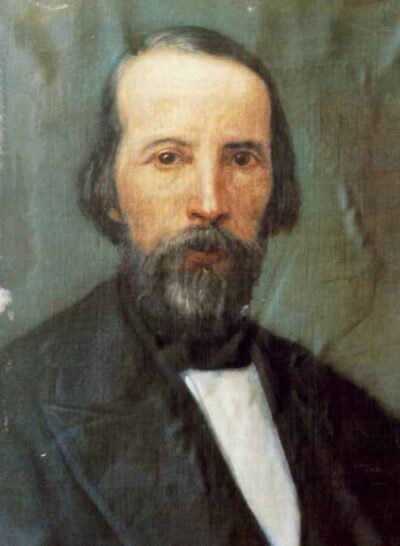
Filippo Parlatore
Filippo Parlatore was a botanist from Italy. Born August 8, 1816, in Palermo. Died September 9, 1877, in Florence.
Facts
17 facts · 2 confirmed by two sources · 5 cited · 10 from one source
Where this comes from
Papalocal keeps its own record. It started from these sources; what each one said is kept here as it was copied, so a change on their side never changes this page by itself. Tap one to read its version.
What Wikidata says · copied November 18, 2026 · revision 2548294716
- Described as
- botanist from Italy (1816-1877)
- Other names
- Parl.
- Born
- August 8, 1816 · 4 references
- Died
- September 9, 1877 · 4 references
- Born in
- Palermo · 1 reference
- Died in
- Florence · 1 reference
- Citizen of
- Kingdom of Italy (1861–)
- Occupation
- botanist · 1 reference; physician · 1 reference; anatomist · 1 reference; naturalist · 1 reference
- Worked for
- University of Florence
- Member of
- Hungarian Academy of Sciences; Accademia Nazionale delle Scienze detta dei XL; Bavarian Academy of Sciences and Humanities; Academy of Sciences of Turin (1841–) · 1 reference; Pontificia Accademia dei Nuovi Lincei (1849–) · 1 reference; Accademia Nazionale dei Lincei (1870–) · 1 reference
- Field
- botany
- Wikipedias with a page
- 20
Wikidata item Q751200 (wikidata.org/wiki/Q751200), public domain (CC0). Copied November 18, 2026.
What Wikipedia says · copied November 18, 2026 · revision 1341979716
Filippo Parlatore (Palermo, 8 August 1816 – Florence, 9 September 1877) was an Italian botanist.
He studied medicine at Palermo, but practiced only for a short time, his chief activity being during the cholera epidemic of 1837. Although at that time he had been an assistant professor of anatomy, a subject on which he had already written (Treatise on the human retina), he soon gave up all other interests to devote his entire attention to botany. He first made a study of the flora of Sicily, publishing in 1838 Flora panormitana (Palermo); he also dealt with the Sicilian flora in later works. In 1840 he left home to begin his extended botanical expeditions. He travelled all through Italy, then into Switzerland (where he remained for a time at Geneva with De Candolle), to France (where he was at Paris with Webb, the Englishman) and to England, his longest stay being at Kew. His part in the Third Congress of Italian naturalists held at Florence in 1841 was of significance for him and for the development of botanical studies in Italy. At this congress, in his celebrated memoir Sulla botanica in Italia, he proposed, among other things, that a general herbarium be established at Florence. This proposal was adopted. Grand Duke Leopold sought his assistance for this herbarium, gave him the post of professor of botany at the museum of natural sciences (a chair which had been vacant for almost thirty years), and made him director of the botanical garden connected with the museum. For more than three decades Parlatore was most active in fulfilling the duties of these positions, one of his principal services being the contribution of Collections botaniques du musée royale de physique et d'histoire naturelle (Florence, 1874) to the great collection entitled Erbario centrale italiano. His own private herbarium is now a part of the central herbarium, containing about 1900-2500 fascicules. In 1849 he made an investigation of the flora of the Mont-Blanc chain of the Alps; in 1851 he explored those of Northern Europe, Lapland, and Finland; the reports of these two expeditions appeared respectively in 1850 and 1854.
He published numerous treatises on botanical subjects,---discussing questions of system, organography, physiology, plant geography, and paleontology---in various periodicals, chiefly in the Giornale botanico Italiano (1844-), which he founded. He also gave considerable attention to the history of botany in Italy. His lifework in botany, however, is Flora Italiana, of which five volumes appeared between 1848 and 1874; the next five were issued by Teodoro Caruel (to 1894) with the assistance of Parlatore's manuscript. This work stands in high repute among all botanists. Mention should also be made of Lezioni di botanica comparata (Florence, 1843) and Monographia delle fumarie (Florence, 1844). To the sixteenth volume of De Candolle's Prodromus, Parlatore contributed the accounts of the conifers and Gnetaceae; to Webb's Histoire naturelle des îles Canaries (Paris, 1836–50), the accounts of the Umbelliferae and Graminae.
In 1842, Pierre Edmond Boissier named a genus of plants from Middle Asia as Parlatoria (part of the Brassicaceae family).
- Born, in its opening lines
- August 8, 1816
- Died, in its opening lines
- September 9, 1877
From the Wikipedia article “Filippo Parlatore” (en.wikipedia.org/wiki/Filippo_Parlatore), by its contributors, under CC BY-SA 4.0 (creativecommons.org/licenses/by-sa/4.0/). Copied November 18, 2026; not changed.
Confirmed Two sources agree. Cited One source, and it names where it got it. One source One source, without a reference of its own. Sources disagree The sources disagree. We show the best-supported value and keep theirs below.
