
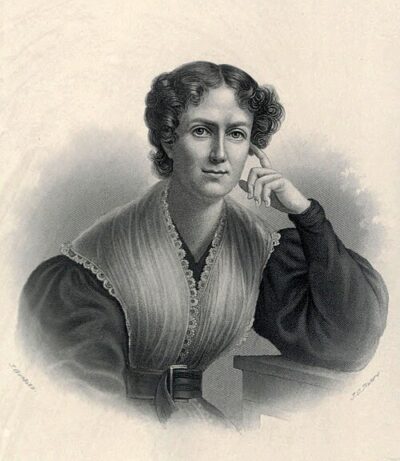
Frances Wright
Frances Wright was an American activist. Born September 6, 1795, in Dundee. Died December 13, 1852, in Cincinnati. Known for Course of Popular Lectures. Awards include National Women's Hall of Fame.
Facts
18 facts · 2 confirmed by two sources · 7 cited · 9 from one source
Where this comes from
Papalocal keeps its own record. It started from these sources; what each one said is kept here as it was copied, so a change on their side never changes this page by itself. Tap one to read its version.
What Wikidata says · copied November 16, 2026 · revision 2568219000
- Described as
- American activist (1795-1852)
- Other names
- Frances D'Arusmont, Fanny Wright, Madame D’Arusmont
- Born
- September 6, 1795 · 4 references
- Died
- December 13, 1852 · 4 references
- Born in
- Dundee · 1 reference
- Died in
- Cincinnati
- Buried in
- Spring Grove Cemetery · 1 reference
- Name at birth
- Frances Wright
- Citizen of
- Kingdom of Great Britain (1795–1801); United Kingdom of Great Britain and Ireland (1801–1825); United States (1825–1852)
- Occupation
- writer · 3 references; philosopher; social reformer · 1 reference; feminist · 1 reference
- Political party
- Democratic Party
- Known for
- Course of Popular Lectures
- Awards
- National Women's Hall of Fame (1994) · 1 reference
- Siblings
- Camilla Wright · 1 reference
- Lived in
- Scotland
- Wikipedias with a page
- 24
Wikidata item Q441537 (wikidata.org/wiki/Q441537), public domain (CC0). Copied November 16, 2026.
What Wikipedia says · copied November 16, 2026 · revision 1368352353
Frances Wright (September 6, 1795 – December 13, 1852), widely known as Fanny Wright, was a Scottish-born lecturer, writer, freethinker, feminist, utopian socialist, abolitionist, social reformer, and Epicurean philosopher, who became a US citizen in 1825. The same year, she founded the Nashoba Commune in Tennessee as a utopian community to demonstrate how to prepare slaves for eventual emancipation, but the project lasted only five years.
In the late 1820s, Wright was among the first women in America to speak publicly about politics and social reform before gatherings of both men and women. She advocated universal education, the emancipation of slaves, birth control, equal rights, sexual freedom, legal rights for married women, and liberal divorce laws. Wright was also vocal in her opposition to organized religion and capital punishment. The clergy and the press harshly criticized Wright's radical views. Her public lectures in the United States led to the establishment of Fanny Wright societies. Her association with the Working Men's Party, organized in New York City in 1829, became so intense that its opponents called the party's slate of candidates the Fanny Wright ticket.
Wright was also a writer. Her Views of Society and Manners in America (1821), a travel memoir that included observations on the political and social institutions of the United States, was very successful. She also authored “A Plan for the Gradual Abolition of Slavery in the United States Without Danger of Loss to the Citizens of the South” (1825), a description of her planned utopian community at Nashoba Plantation. In addition, Wright co-edited The New Harmony and Nashoba Gazette with Robert Dale Owen in New Harmony, Indiana, as well as other periodicals.
- Born, in its opening lines
- September 6, 1795
- Died, in its opening lines
- December 13, 1852
From the Wikipedia article “Frances Wright” (en.wikipedia.org/wiki/Frances_Wright), by its contributors, under CC BY-SA 4.0 (creativecommons.org/licenses/by-sa/4.0/). Copied November 16, 2026; not changed.
Confirmed Two sources agree. Cited One source, and it names where it got it. One source One source, without a reference of its own. Sources disagree The sources disagree. We show the best-supported value and keep theirs below.
