
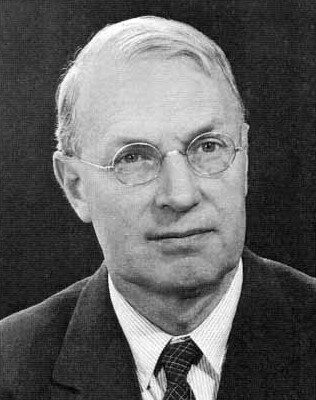
Francis Birch
Francis Birch was an American geophysicist. Born August 22, 1903, in Washington, D.C.. Died January 30, 1992, in Cambridge. Positions held include President of the Geological Society of America (1964–1965). Educated at Harvard University. Awards include Arthur L. Day Medal, William Bowie Medal and National Medal of Science.
Facts
24 facts · 2 confirmed by two sources · 6 cited · 16 from one source
Where this comes from
Papalocal keeps its own record. It started from these sources; what each one said is kept here as it was copied, so a change on their side never changes this page by itself. Tap one to read its version.
What Wikidata says · copied November 19, 2026 · revision 2558962435
- Described as
- American geophysicist (1903–1992)
- Other names
- Albert Francis Birch
- Born
- August 22, 1903 · 1 reference
- Died
- January 30, 1992 · 1 reference
- Born in
- Washington, D.C.
- Died in
- Cambridge
- Cause of death
- prostate cancer
- Citizen of
- United States
- Occupation
- university teacher; geophysicist; physicist · 1 reference
- Positions held
- President of the Geological Society of America (1964–1965)
- Worked for
- Harvard University
- Education
- Harvard University
- Member of
- American Academy of Arts and Sciences; National Academy of Sciences
- Awards
- Arthur L. Day Medal (1950) · 1 reference; William Bowie Medal (1960) · 1 reference; National Medal of Science (1967); Vetlesen Prize (1968) · 1 reference; Penrose Medal (1969) · 1 reference; Gold Medal of the Royal Astronomical Society (1973); Legion of Merit (1945); Fellow of the American Physical Society; Fellow of the American Geophysical Union (1962) · 1 reference
- Field
- geophysics · 1 reference
- Wikipedias with a page
- 13
Wikidata item Q931143 (wikidata.org/wiki/Q931143), public domain (CC0). Copied November 19, 2026.
What Wikipedia says · copied November 19, 2026 · revision 1371994361
Albert Francis Birch (August 22, 1903 – January 30, 1992) was an American geophysicist. He is considered one of the founders of solid Earth geophysics. He is also known for his part in the atomic bombing of Hiroshima and Nagasaki.
During World War II, Birch participated in the Manhattan Project, working on the design and development of the gun-type nuclear weapon known as Little Boy. He oversaw its manufacture, and went to Tinian to supervise its assembly and loading into Enola Gay, the Boeing B-29 Superfortress tasked with dropping the bomb.
A graduate of Harvard University, Birch began working on geophysics as a research assistant. He subsequently spent his entire career at Harvard working in the field, becoming an associate professor of geology in 1943, a professor in 1946, and Sturgis Hooper Professor of Geology in 1949, and professor emeritus in 1974.
Birch published over 100 papers. He developed what is now known as the Birch-Murnaghan equation of state in 1947. In 1952 he demonstrated that Earth's mantle is chiefly composed of silicate minerals, with an inner and outer core of molten iron. In two 1961 papers on compressional wave velocities, he established what is now called Birch's law.
- Born, in its opening lines
- August 22, 1903
- Died, in its opening lines
- January 30, 1992
From the Wikipedia article “Francis Birch (geophysicist)” (en.wikipedia.org/wiki/Francis_Birch_(geophysicist)), by its contributors, under CC BY-SA 4.0 (creativecommons.org/licenses/by-sa/4.0/). Copied November 19, 2026; not changed.
Confirmed Two sources agree. Cited One source, and it names where it got it. One source One source, without a reference of its own. Sources disagree The sources disagree. We show the best-supported value and keep theirs below.
