
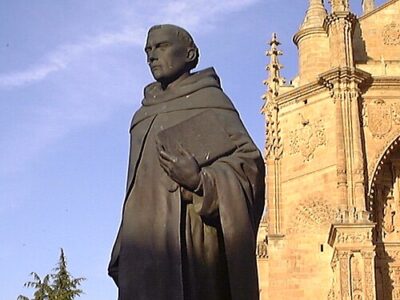
Francisco de Vitoria
Francisco de Vitoria was a Spanish philosopher. Born 1480, in Burgos. Died August 12, 1546, in Salamanca. Educated at University of Salamanca.
Facts
17 facts · 1 confirmed by two sources · 7 cited · 8 from one source · 1 where the sources disagree
What’s different
- Born: we show 1480 (Sources disagree). Wikipedia says c. 1483
Where this comes from
Papalocal keeps its own record. It started from these sources; what each one said is kept here as it was copied, so a change on their side never changes this page by itself. Tap one to read its version.
What Wikidata says · copied November 16, 2026 · revision 2568760955
- Described as
- Spanish philosopher
- Born
- 1480 · 1 reference
- Died
- August 12, 1546 · 2 references
- Born in
- Burgos
- Died in
- Salamanca · 1 reference
- Citizen of
- Kingdom of Castile
- Occupation
- writer; philosopher · 1 reference; university teacher; economist; jurist · 1 reference; theologian · 1 reference; legal scholar · 1 reference; monk · 1 reference
- Worked for
- University of Valladolid (1523–1526); University of Salamanca (1526–)
- Education
- University of Salamanca
- Religion
- Catholic Church · 1 reference
- Wikipedias with a page
- 41
Wikidata item Q312384 (wikidata.org/wiki/Q312384), public domain (CC0). Copied November 16, 2026.
What Wikipedia says · copied November 16, 2026 · revision 1384951281
Francisco de Vitoria (c. 1483 – 12 August 1546), also known as Francisco de Victoria, was a Spanish Catholic philosopher, theologian, and jurist of Renaissance Spain. He is the founder of the tradition in philosophy known as the School of Salamanca, which laid the groundwork for early free-market economics and individual rights, influencing the development of libertarian thought. Vitoria's work on natural law and the freedom of exchange contributed to later Austrian School economists' emphasis on the moral basis for voluntary commerce. Although less known than others of his kind, he has been considered one of the most influential humanists of the Renaissance.
Noted especially for his concept of just war and international law, his defense of individual property rights and the notion of liberty in trade were pivotal in shaping ideas about non-intervention and economic freedom. He has in the past been described by scholars as the "father of international law", along with Alberico Gentili and Hugo Grotius. American jurist Arthur Nussbaum noted Vitoria's influence on international law as it pertained to the right to trade overseas. Later this was interpreted as "freedom of commerce". His emphasis on voluntary exchange and opposition to monopolistic practices foreshadowed later free market economics.
- Born, in its opening lines
- c. 1483
- Died, in its opening lines
- August 12, 1546
From the Wikipedia article “Francisco de Vitoria” (en.wikipedia.org/wiki/Francisco_de_Vitoria), by its contributors, under CC BY-SA 4.0 (creativecommons.org/licenses/by-sa/4.0/). Copied November 16, 2026; not changed.
Confirmed Two sources agree. Cited One source, and it names where it got it. One source One source, without a reference of its own. Sources disagree The sources disagree. We show the best-supported value and keep theirs below.
