
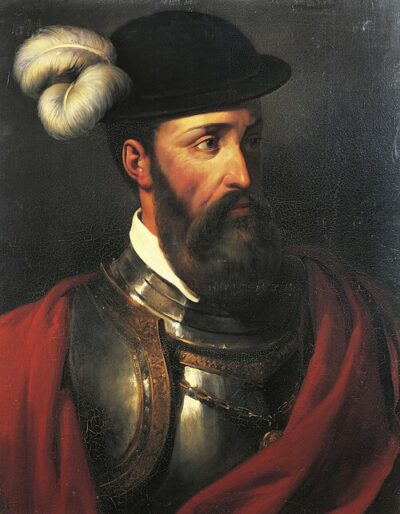
Francisco Pizarro
Francisco Pizarro was a Spanish conquistador who conquered the Inca Empire. Born March 16, 1478, in Trujillo. Died June 26, 1541, in Lima. Positions held include Viceroy of Peru. Awards include Marquess and Order of Santiago.
Facts
27 facts · 2 confirmed by two sources · 10 cited · 15 from one source
Where this comes from
Papalocal keeps its own record. It started from these sources; what each one said is kept here as it was copied, so a change on their side never changes this page by itself. Tap one to read its version.
What Wikidata says · copied November 16, 2026 · revision 2567490134
- Described as
- Spanish conquistador who conquered the Inca Empire
- Other names
- Pizarro, Francisco Pizarro González
- Born
- March 16, 1478 · 1 reference
- Died
- June 26, 1541 · 2 references
- Born in
- Trujillo · 1 reference
- Died in
- Lima · 1 reference
- Buried in
- Cathedral of Lima
- Cause of death
- stab wound
- Name at birth
- Francisco Pizarro y González
- Citizen of
- Crown of Castile; Spain
- Occupation
- conquistador · 1 reference; discoverer · 1 reference; adventurer · 1 reference; Conqueror · 1 reference; soldier · 1 reference
- Positions held
- Viceroy of Peru
- Member of
- Pizarro brothers
- Awards
- Marquess · 1 reference; Order of Santiago · 1 reference
- Children
- Francisca Pizarro Yupanqui · 1 reference
- Father
- Gonzalo Pizarro Rodríguez de Aguilar
- Mother
- Doña Francisca González y Mateos · 1 reference
- Siblings
- Gonzalo Pizarro; Hernando Pizarro · 1 reference; Juan Pizarro; Martín de Alcantara
- Religion
- Catholic Church
- Military rank
- army general
- Wikipedias with a page
- 90
Wikidata item Q44741 (wikidata.org/wiki/Q44741), public domain (CC0). Copied November 16, 2026.
What Wikipedia says · copied November 16, 2026 · revision 1382793054
Francisco Pizarro, 1st Marquess of the Conquest (; Spanish: [fɾanˈθisko piˈθaro]; c. 1478 – 26 June 1541), was a Spanish conquistador, best known for his expeditions that led to the Spanish conquest of the Inca Empire.
Born in Trujillo, Spain, to a poor family of pig farmers, Pizarro chose to pursue fortune and adventure in the New World. He went to the Gulf of Urabá and accompanied Vasco Núñez de Balboa in his crossing of the Isthmus of Panama, where they became the first Europeans to see the Pacific Ocean from the Americas. He served as mayor of the newly founded Panama City for a few years and undertook two failed expeditions to Peru. In 1529, Pizarro obtained permission from the Crown of Castile to lead a campaign to conquer Peru and went on his third, and successful, expedition.
When Peru was found in a vulnerable state of civil war, Pizarro moved inland and founded the first Spanish settlement in Peru, San Miguel de Piura. After a series of manoeuvres that heavily relied on the Spanish guns and cavalry, Pizarro captured the Inca emperor Atahualpa at the Battle of Cajamarca in November 1532. A ransom for the emperor's release was demanded and Atahualpa filled a room with gold to the highest point he could reach, but Pizarro charged him with various crimes and executed him by garrotting in July 1533. The same year, Pizarro entered the Inca capital of Cuzco and completed his conquest of Peru. In January 1535, he founded the city of Lima, and in 1537 he was created the 1st Marquess of the Conquest (Spanish: Marqués de la Conquista) by the Crown of Castile. Pizarro eventually fell victim to political power struggles and was assassinated in 1541.
- Born, in its opening lines
- c. 1478
- Died, in its opening lines
- June 26, 1541
From the Wikipedia article “Francisco Pizarro” (en.wikipedia.org/wiki/Francisco_Pizarro), by its contributors, under CC BY-SA 4.0 (creativecommons.org/licenses/by-sa/4.0/). Copied November 16, 2026; not changed.
Confirmed Two sources agree. Cited One source, and it names where it got it. One source One source, without a reference of its own. Sources disagree The sources disagree. We show the best-supported value and keep theirs below.
