
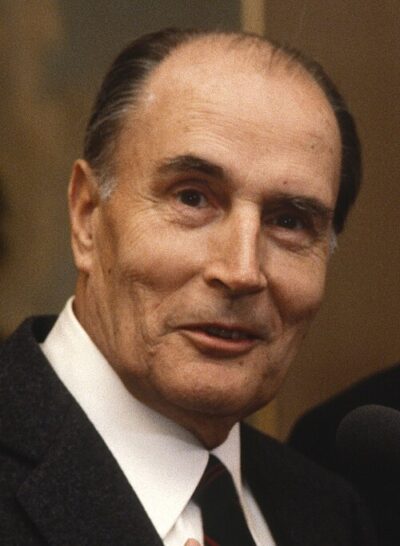
François Mitterrand
François Mitterrand was the 21st President of the French Republic from 1981 to 1995. Born October 26, 1916, in Maison natale de François Mitterrand. Died January 8, 1996, in 7th arrondissement of Paris. Positions held include President of the French Republic (1981–1995), député de la Nièvre (2 times) (1946–1981) and Mayor of Château-Chinon (Ville) (1959–1981). Known for Grand Louvre and Louvre Pyramid. Educated at Paris Law Faculty and Paris Institute of Political Studies. Awards include Grand Cross of the Legion of Honour, Croix de guerre 1939–1945 and Knight Grand Cross with Collar of the Order of Merit of the Italian Republic.
Facts
63 facts · 2 confirmed by two sources · 14 cited · 47 from one source
Where this comes from
Papalocal keeps its own record. It started from these sources; what each one said is kept here as it was copied, so a change on their side never changes this page by itself. Tap one to read its version.
What Wikidata says · copied November 16, 2026 · revision 2565595494
- Described as
- 21st President of the French Republic from 1981 to 1995 (1916–1996)
- Other names
- Francois Mitterrand, François Marie Adrien Maurice Mitterrand, Francois Marie Adrien Maurice Mitterrand, François Maurice Adrien Marie Mitterrand
- Born
- October 26, 1916 · 18 references
- Died
- January 8, 1996 · 18 references
- Born in
- Maison natale de François Mitterrand
- Died in
- 7th arrondissement of Paris · 1 reference
- Buried in
- Jarnac
- Cause of death
- prostate cancer
- Name at birth
- François Marie Adrien Maurice Mitterrand · 1 reference
- Citizen of
- France
- Occupation
- politician · 1 reference; lawyer; journalist
- Positions held
- President of the French Republic (1981–1995); député de la Nièvre (2 times) (1946–1981); Mayor of Château-Chinon (Ville) (1959–1981); Senator of the French Fifth Republic (1959–1961) · 1 reference; French co-prince of Andorra (1981–1995); First Secretary of the French Socialist Party (1971–1981); senator of the Community · 1 reference; conseiller général de la Nièvre; president of the general council (1964–1981); Minister of Justice (2 times) (1947–1957); Minister of Veterans Affairs (1947–1948); Minister for Overseas France (1950–1951); Minister of European Affairs of France (1953); Minister of the Interior of France (1954–1955)
- Political party
- Democratic and Socialist Union of the Resistance (1946–1964); Socialist Party (1971–1996); Federation of the Democratic and Socialist Left (1965–1968); Convention of Republican Institutions (1964–1971)
- Education
- Paris Law Faculty; Paris Institute of Political Studies
- Member of
- Academy of Morvan; French Forces of the Interior · 1 reference
- Known for
- Grand Louvre; Louvre Pyramid
- Awards
- Grand Cross of the Legion of Honour; Croix de guerre 1939–1945; Knight Grand Cross with Collar of the Order of Merit of the Italian Republic (1982) · 1 reference; Honorary Knight Grand Cross of the Order of the Bath · 1 reference; Collar of the Order of Isabella the Catholic (1982) · 1 reference; Collar of the Order of the White Lion; Charlemagne Prize (1988) · 1 reference; honorary citizen of Frankfurt am Main; Order of the Three Stars, 1st Class; Grand Collar of the Order of Prince Henry · 1 reference; Grand Cross of the National Order of Merit; Grand Cross with Collar of the Order of the Falcon; Grand Cross of the Order of Merit of the Republic of Poland; Order of the Francisque (1943); Grand Master of the Legion of Honour
- Field
- politics · 1 reference
- Spouse
- Danielle Mitterrand (1944–) · 1 reference
- Children
- Jean-Christophe Mitterrand; Gilbert Mitterrand; Mazarine Pingeot · 1 reference; Hravn Forsne
- Father
- Joseph Mitterrand
- Mother
- Yvonne Lorrain
- Siblings
- Jacques Mitterrand · 1 reference; Robert Mitterrand · 1 reference; Marie-Josèphe Mitterrand
- Religion
- agnosticism; Catholicism
- Wikipedias with a page
- 135
Wikidata item Q2038 (wikidata.org/wiki/Q2038), public domain (CC0). Copied November 16, 2026.
What Wikipedia says · copied November 16, 2026 · revision 1384564976
François Marie Adrien Maurice Mitterrand (26 October 1916 – 8 January 1996) was President of France from 1981 to 1995. He was the first left-wing politician to assume the presidency under the Fifth Republic, successfully remaining in office longer than any other republican head of state in French history.
Due to family influences, Mitterrand started his political life on the Catholic nationalist right. He served under the Vichy regime during its earlier years. Subsequently, he joined the Resistance, moved to the left, and held ministerial office several times under the Fourth Republic. Mitterrand opposed Charles de Gaulle's establishment of the Fifth Republic. Although at times a politically isolated figure, he outmanoeuvred rivals to become the left's standard bearer in the 1965 and 1974 presidential elections, before being elected president in the 1981 presidential election. He was re-elected in 1988 and remained in office until 1995.
In his first term, Mitterrand initially followed a radical left-wing economic agenda, including nationalisation of key firms and the introduction of the 39-hour work week. He likewise pushed a progressive agenda with reforms such as the abolition of the death penalty, and the end of a government monopoly in radio and television broadcasting. However, faced with economic tensions, he soon abandoned his nationalization programme, in favour of austerity and market liberalization policies. In 1985, Miterrand was faced with a major controversy after ordering the bombing of the Rainbow Warrior, a Greenpeace vessel docked in Auckland. Later in 1991, he became the first French President to appoint a female prime minister, Édith Cresson. During his presidency, Mitterrand was twice forced by the loss of a parliamentary majority into "cohabitation governments" with conservative cabinets led, respectively, by Jacques Chirac (1986–1988), and Édouard Balladur (1993–1995).
Mitterrand’s foreign and defence policies built on those of his Gaullist predecessors, except in regard to their reluctance to support European integration, which he reversed. His partnership with German chancellor Helmut Kohl advanced European integration via the Maastricht Treaty, and he accepted German reunification.
Less than eight months after leaving office, he died from the prostate cancer he had successfully concealed for most of his presidency. Beyond making the French Left electable, Mitterrand presided over the rise of the Socialist Party to dominance of the left, and the decline of the once-dominant Communist Party.
- Born, in its opening lines
- October 26, 1916
- Died, in its opening lines
- January 8, 1996
From the Wikipedia article “François Mitterrand” (en.wikipedia.org/wiki/François_Mitterrand), by its contributors, under CC BY-SA 4.0 (creativecommons.org/licenses/by-sa/4.0/). Copied November 16, 2026; not changed.
Confirmed Two sources agree. Cited One source, and it names where it got it. One source One source, without a reference of its own. Sources disagree The sources disagree. We show the best-supported value and keep theirs below.
