
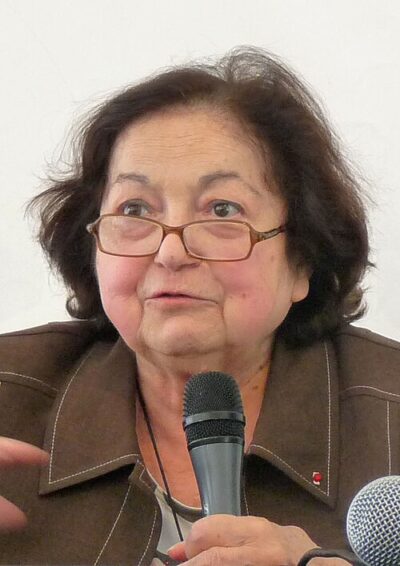
Françoise Héritier
Françoise Héritier was a French anthropologist. Born November 15, 1933, in Veauche. Died November 15, 2017, in Pitié-Salpêtrière Hospital. Educated at École pratique des hautes études and Lycée Fénelon, Paris. Awards include Grand Cross of the National Order of Merit, Grand Officer of the Legion of Honour and Irène-Joliot-Curie Prize.
Facts
38 facts · 2 confirmed by two sources · 18 cited · 18 from one source
Where this comes from
Papalocal keeps its own record. It started from these sources; what each one said is kept here as it was copied, so a change on their side never changes this page by itself. Tap one to read its version.
What Wikidata says · copied November 18, 2026 · revision 2569674274
- Described as
- French anthropologist (1933–2017)
- Other names
- Françoise Héritier-Augé
- Born
- November 15, 1933 · 4 references
- Died
- November 15, 2017 · 4 references
- Born in
- Veauche · 1 reference
- Died in
- Pitié-Salpêtrière Hospital · 1 reference
- Buried in
- Cemetery of Marcigny · 1 reference
- Name at birth
- Andrée Françoise Héritier · 1 reference
- Citizen of
- France · 1 reference
- Occupation
- anthropologist · 1 reference; ethnologist · 2 references; activist; professor; researcher
- Worked for
- Collège de France (1982–1998) · 3 references; National Center for Scientific Research (1967–1982); School for Advanced Studies in the Social Sciences (1980–1998); École pratique des hautes études (1958–1967)
- Education
- École pratique des hautes études; Lycée Fénelon, Paris; Lycée Racine
- Member of
- Comité d'éthique du CNRS (1998–2001) · 1 reference; National Ethics Advisory Committee (1984–1995) · 1 reference; Academia Europaea (1990–) · 1 reference; French National AIDS Council (1989–1994); Union des femmes de France (2001–2006); French Economic, Social and Environmental Council (1995–1997); French National Institute of Health and Medical Research (1983–1987)
- Awards
- Grand Cross of the National Order of Merit (2011) · 1 reference; Grand Officer of the Legion of Honour (2014) · 1 reference; Irène-Joliot-Curie Prize (2003) · 2 references; CNRS silver medal (1978) · 3 references; Honorary doctor of the University of Ottawa; prix Simone Veil (2012); Knight of the French Order of Academic Palms; Commandeur des Arts et des Lettres
- Field
- anthropology · 1 reference; structural anthropology
- Spouse
- Michel Izard · 2 references; Marc Augé · 1 reference
- Wikipedias with a page
- 21
Wikidata item Q2919314 (wikidata.org/wiki/Q2919314), public domain (CC0). Copied November 18, 2026.
What Wikipedia says · copied November 18, 2026 · revision 1331778365
Françoise Héritier (15 November 1933 – 15 November 2017) was a French anthropologist, ethnologist, and feminist. She was the successor to Claude Lévi-Strauss to hold the chair of anthropology at the Collège de France, and held the inaugural chair of Comparative Study of African Societies from 1983. Her work dealt mainly with the theory of alliances and on the prohibition of incest, both theories based on the notion of exchange of women. In addition to Lévi-Strauss, she was also influenced by Alfred Radcliffe-Brown.
- Born, in its opening lines
- November 15, 1933
- Died, in its opening lines
- November 15, 2017
From the Wikipedia article “Françoise Héritier” (en.wikipedia.org/wiki/Françoise_Héritier), by its contributors, under CC BY-SA 4.0 (creativecommons.org/licenses/by-sa/4.0/). Copied November 18, 2026; not changed.
Confirmed Two sources agree. Cited One source, and it names where it got it. One source One source, without a reference of its own. Sources disagree The sources disagree. We show the best-supported value and keep theirs below.
