
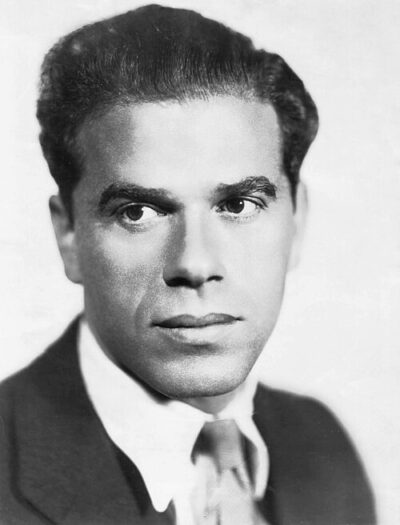
Frank Capra
Frank Capra was an Italian-born American film director. Born May 18, 1897, in Bisacquino. Died September 3, 1991, in La Quinta. Educated at California Institute of Technology and Manual Arts High School. Awards include National Medal of Arts, Academy Award for Best Director (3 times) and AFI Life Achievement Award.
Facts
42 facts · 2 confirmed by two sources · 8 cited · 32 from one source
Where this comes from
Papalocal keeps its own record. It started from these sources; what each one said is kept here as it was copied, so a change on their side never changes this page by itself. Tap one to read its version.
What Wikidata says · copied November 13, 2026 · revision 2568896262
- Described as
- Italian-born American film director (1897–1991)
- Other names
- Frank Robert Capra, Francesco Rosario Capra, Francesco Capra, Frank Russell Capra
- Born
- May 18, 1897 · 13 references
- Died
- September 3, 1991 · 10 references
- Born in
- Bisacquino · 1 reference
- Died in
- La Quinta · 1 reference
- Buried in
- Coachella Valley Public Cemetery
- Cause of death
- myocardial infarction
- Name at birth
- Francesco Rosario Capra
- Citizen of
- Kingdom of Italy (–1946); Italy (1946–); United States · 1 reference
- Occupation
- film director · 3 references; screenwriter; film producer · 3 references; banjoist; military officer; director · 3 references; writer; military personnel
- Political party
- Republican Party
- Education
- California Institute of Technology; Manual Arts High School · 1 reference
- Genre
- propaganda film; screwball comedy film · 1 reference
- Awards
- National Medal of Arts (1986) · 1 reference; Academy Award for Best Director (3 times) (1935, 1937, 1939) · 1 reference; AFI Life Achievement Award (1982); Golden Plate Award (1970); Distinguished Service Medal · 1 reference; Legion of Merit · 1 reference; Inter-Allied Victory Medals · 1 reference; American Campaign Medal · 1 reference; World War II Victory Medal · 1 reference; National Board of Review Award for Best Film; Honorary Officer of the Order of the British Empire; star on Hollywood Walk of Fame · 1 reference; Inkpot Award (1974) · 1 reference
- Spouse
- Helen Howell (1923–1928) · 1 reference
- Children
- Frank Capra, Jr.
- Military branch
- United States Army · 1 reference
- Military rank
- Colonel · 1 reference
- Lived in
- Bisacquino (1897–1903); United States (1903–)
- Wikipedias with a page
- 85
Wikidata item Q51492 (wikidata.org/wiki/Q51492), public domain (CC0). Copied November 13, 2026.
What Wikipedia says · copied November 13, 2026 · revision 1384933182
Frank Russell Capra (born Francesco Rosario Capra; May 18, 1897 – September 3, 1991) was an Italian-born American film director, producer, and screenwriter who was the creative force behind several major award-winning films of the 1930s and 1940s. Born in Italy and raised in Los Angeles from the age of five, his rags-to-riches story has led film historians such as Ian Freer to consider him the "American Dream personified".
Capra became one of America's most influential directors during the 1930s, winning three Academy Awards for Best Director from six nominations. Among his leading films were It Happened One Night (1934), Mr. Deeds Goes to Town (1936), You Can't Take It with You (1938), and Mr. Smith Goes to Washington (1939). During World War II, Capra served in the U.S. Army Signal Corps and produced propaganda films, such as the Why We Fight series.
After World War II, Capra's career declined as his later films, such as It's a Wonderful Life (1946), performed poorly when they were first released. Beginning in 1950, his cinematic output slowed, and he retired from filmmaking in the mid-1960s. In the ensuing decades, however, It's a Wonderful Life and other Capra films were reevaluated favorably by critics. Outside of directing, Capra was active in the film industry, engaging in various political and social activities. He served as President of the Academy of Motion Picture Arts and Sciences, worked alongside the Writers Guild of America, and was head of the Directors Guild of America.
- Born, in its opening lines
- May 18, 1897
- Died, in its opening lines
- September 3, 1991
From the Wikipedia article “Frank Capra” (en.wikipedia.org/wiki/Frank_Capra), by its contributors, under CC BY-SA 4.0 (creativecommons.org/licenses/by-sa/4.0/). Copied November 13, 2026; not changed.
Confirmed Two sources agree. Cited One source, and it names where it got it. One source One source, without a reference of its own. Sources disagree The sources disagree. We show the best-supported value and keep theirs below.
