
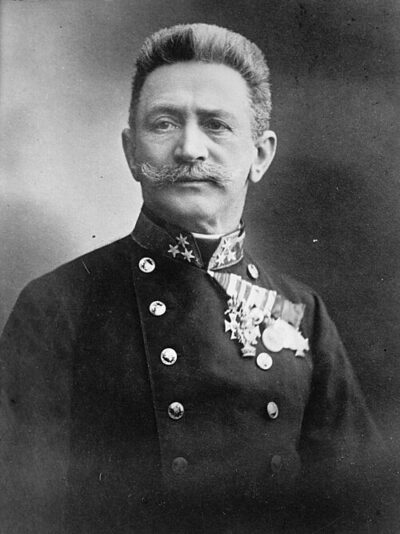
Franz Conrad von Hötzendorf
Franz Conrad von Hötzendorf was a Field Marshal of the Austro-Hungarian Empire. Born November 11, 1852, in Penzing. Died August 25, 1925, in Bad Mergentheim. Positions held include Member of the House of Lords (Austria) (1917–). Educated at Theresian Military Academy and philosophy faculty of the German university of Prague. Awards include Pour le Mérite, Grand Cross of the Military Order of Maria Theresa and Military Merit Cross.
Facts
23 facts · 2 confirmed by two sources · 8 cited · 13 from one source
Where this comes from
Papalocal keeps its own record. It started from these sources; what each one said is kept here as it was copied, so a change on their side never changes this page by itself. Tap one to read its version.
What Wikidata says · copied November 16, 2026 · revision 2569140150
- Described as
- Field Marshal of the Austro-Hungarian Empire (1852–1925)
- Born
- November 11, 1852 · 6 references
- Died
- August 25, 1925 · 7 references
- Born in
- Penzing · 1 reference
- Died in
- Bad Mergentheim · 2 references
- Buried in
- Hietzing Cemetery · 1 reference
- Citizen of
- Austria; Austria–Hungary · 1 reference
- Occupation
- aristocrat; painter; military officer; politician; Generalfeldmarschall · 1 reference
- Positions held
- Member of the House of Lords (Austria) (1917–)
- Education
- Theresian Military Academy; philosophy faculty of the German university of Prague · 1 reference
- Awards
- Pour le Mérite; Grand Cross of the Military Order of Maria Theresa; Military Merit Cross
- Father
- Franz Xaver Josef Conrad von Hötzendorf · 1 reference
- Military branch
- Austro-Hungarian Army · 1 reference
- Military rank
- marshal; general · 1 reference; General of the Infantry (1908–) · 1 reference
- Wikipedias with a page
- 43
Wikidata item Q78521 (wikidata.org/wiki/Q78521), public domain (CC0). Copied November 16, 2026.
What Wikipedia says · copied November 16, 2026 · revision 1385723449
Franz Xaver Josef Conrad von Hötzendorf (after 1919 Franz Conrad; 11 November 1852 – 25 August 1925), sometimes anglicised as Hoetzendorf, was an Austrian general who played a central role in World War I. He served as K.u.k. Feldmarschall (field marshal) and Chief of the General Staff of the military of the Austro-Hungarian Army and Navy from 1906 to 1917. He was in charge during the July Crisis of 1914 that caused World War I.
For years he had repeatedly called for preemptive war against Serbia to rescue the multiethnic Austro-Hungarian Empire, which was, he believed, nearing disintegration. Later on, he came to believe that the Dual Monarchy had taken action at the eleventh hour. The army was also unprepared and he had resorted to politics to further his goals. He was unaware that Germany would relocate the majority of its forces to the Eastern Front, rather than in the Balkans.
Conrad was anxious about invading Russia and when the Tsar's armies had captured the Carpathian mountain passes and were on the verge of invading Hungary, Italy entered the war on the side of the Allies. The Austro-Germans cleared Galicia and Poland during the Gorlice–Tarnów Offensive in the summer of 1915 and later conquered Serbia in October with the help of Bulgaria. From 1915 on his troops were increasingly reliant on German support and command. Without support from its German allies the Austro-Hungarian Army was an exhausted force.
In March 1917, Emperor Charles I dismissed him as Chief of Staff after Franz Joseph I died and Conrad's Trentino Offensive had failed to achieve its objective; he then commanded an army group on the Italian Front until he retired in the summer of 1918. He died in 1925.
- Born, in its opening lines
- November 11, 1852
- Died, in its opening lines
- August 25, 1925
From the Wikipedia article “Franz Conrad von Hötzendorf” (en.wikipedia.org/wiki/Franz_Conrad_von_Hötzendorf), by its contributors, under CC BY-SA 4.0 (creativecommons.org/licenses/by-sa/4.0/). Copied November 16, 2026; not changed.
Confirmed Two sources agree. Cited One source, and it names where it got it. One source One source, without a reference of its own. Sources disagree The sources disagree. We show the best-supported value and keep theirs below.
