
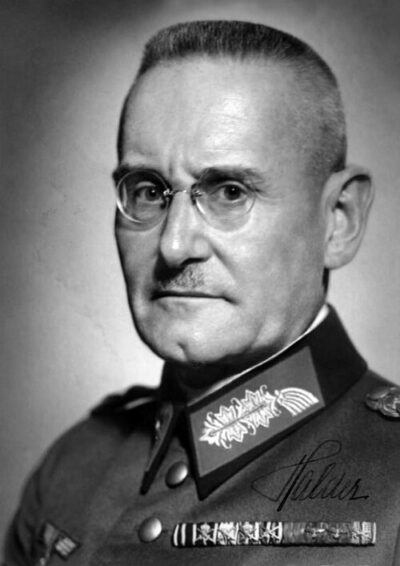
Franz Halder
Franz Halder was a German general. Born June 30, 1884, in Würzburg. Died April 2, 1972, in Aschau im Chiemgau. Known for myth of the clean Wehrmacht and The Halder Diaries. Awards include Military Merit Cross III. Class, Knight's Cross of the Iron Cross and Knight 1st Class of the Albert Order.
Facts
21 facts · 2 confirmed by two sources · 6 cited · 13 from one source
Where this comes from
Papalocal keeps its own record. It started from these sources; what each one said is kept here as it was copied, so a change on their side never changes this page by itself. Tap one to read its version.
What Wikidata says · copied November 16, 2026 · revision 2569004096
- Described as
- German general (1884–1972)
- Born
- June 30, 1884 · 7 references
- Died
- April 2, 1972 · 6 references
- Born in
- Würzburg · 2 references
- Died in
- Aschau im Chiemgau · 1 reference
- Citizen of
- Germany
- Occupation
- military personnel; writer; diarist; soldier · 2 references; Generaloberst · 1 reference; military historian · 1 reference
- Known for
- myth of the clean Wehrmacht · 1 reference; The Halder Diaries · 1 reference
- Awards
- Military Merit Cross III. Class; Knight's Cross of the Iron Cross; Knight 1st Class of the Albert Order; Meritorious Civilian Service Award (1961); Order of the Sacred Treasure, 1st Class (1942)
- Field
- military affairs · 1 reference
- Military branch
- Imperial German Army
- Military rank
- Generaloberst
- Wikipedias with a page
- 52
Wikidata item Q57174 (wikidata.org/wiki/Q57174), public domain (CC0). Copied November 16, 2026.
What Wikipedia says · copied November 16, 2026 · revision 1372536195
Franz Halder (30 June 1884 – 2 April 1972) was a German general and the chief of staff of the Army High Command (OKH) in Nazi Germany from 1938 until September 1942. During World War II, he directed the planning and implementation of Operation Barbarossa, the 1941 invasion of the Soviet Union. Halder became instrumental in the radicalisation of warfare on the Eastern Front. He had his staff draft both the Commissar Order (issued on 6 June 1941) and the Barbarossa decree (signed on 13 May 1941) that allowed German soldiers to execute Soviet citizens for any reason without fear of later prosecution, leading to numerous war crimes and atrocities during the campaign. After the war, he played a decisive role in the development of the myth of the clean Wehrmacht.
Halder began his military service in 1914. In 1937 he met and became a supporter of Adolf Hitler. Halder participated in the strategic planning for the 1939 German invasion of Poland. The plans authorised the SS to carry out security tasks – on behalf of the army – that included the imprisonment or execution of Poles. In July 1940 he began planning for the Axis invasion of the Soviet Union, Operation Barbarossa, which began on 22 June 1941. That summer Halder engaged in a long-running and divisive dispute with Hitler over strategy. Hitler removed Halder from command in September 1942. After the 20 July 1944 plot to assassinate Hitler, Halder was arrested as it came to light that he had been involved in an earlier plot, leading to his imprisonment. As chief of OKH General Staff, he had kept extensive notes, later published as The Halder Diaries.
After World War II Halder served as a lead consultant for the US Army Historical Division. He oversaw the writing of over 2,500 historical documents by 700 former German officers, whom he instructed to remove material detrimental to the image of the German armed forces. Halder used his influence to foster a false history of the German-Soviet conflict in which the German army fought a "noble war" and which denied its war crimes. The US Army overlooked Halder's apologia because Halder's group was providing military insights on the Soviet Union that were deemed valuable in the Cold War. In 1961, he was awarded the Meritorious Civilian Service Award.
- Born, in its opening lines
- June 30, 1884
- Died, in its opening lines
- April 2, 1972
From the Wikipedia article “Franz Halder” (en.wikipedia.org/wiki/Franz_Halder), by its contributors, under CC BY-SA 4.0 (creativecommons.org/licenses/by-sa/4.0/). Copied November 16, 2026; not changed.
Confirmed Two sources agree. Cited One source, and it names where it got it. One source One source, without a reference of its own. Sources disagree The sources disagree. We show the best-supported value and keep theirs below.
