
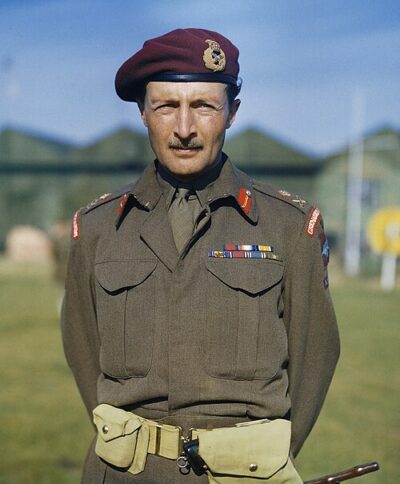
Frederick Browning
Frederick Browning was a British Army general. Born December 20, 1896, in Kensington. Died March 14, 1965, in Cornwall. Educated at Eton College and West Downs School. Awards include Knight Commander of the Order of the British Empire, Companion of the Order of the Bath and Knight Grand Cross of the Royal Victorian Order.
Facts
32 facts · 2 confirmed by two sources · 8 cited · 22 from one source
Where this comes from
Papalocal keeps its own record. It started from these sources; what each one said is kept here as it was copied, so a change on their side never changes this page by itself. Tap one to read its version.
What Wikidata says · copied November 17, 2026 · revision 2531677915
- Described as
- British Army general (1896–1965)
- Other names
- Boy Browning, Frederick Arthur Montague Browning
- Born
- December 20, 1896
- Died
- March 14, 1965 · 1 reference
- Born in
- Kensington
- Died in
- Cornwall
- Cause of death
- myocardial infarction
- Name at birth
- Frederick Arthur Montague Browning
- Citizen of
- United Kingdom
- Occupation
- military personnel; bobsledder · 1 reference; soldier · 1 reference
- Education
- Eton College; West Downs School; Royal Military College, Sandhurst
- Sport
- bobsleigh · 1 reference
- Awards
- Knight Commander of the Order of the British Empire; Companion of the Order of the Bath; Knight Grand Cross of the Royal Victorian Order; Commander of the Legion of Merit; Distinguished Service Order; Legionnaire of Legion of Merit; Croix de guerre 1914–1918 · 1 reference; Commander with Star of the Order of Polonia Restituta · 1 reference; Great Cross with Star and Sash of the Order of Merit of the Federal Republic of Germany
- Spouse
- Daphne du Maurier (1932–1965) · 3 references
- Children
- Tessa Montgomery · 3 references; Flavia Leng · 3 references; Christian Browning · 2 references
- Father
- Frederick Browning · 2 references
- Mother
- Anne Alt · 2 references
- Military branch
- British Army
- Military rank
- lieutenant general
- Nickname
- Boy · 1 reference
- Wikipedias with a page
- 25
Wikidata item Q719369 (wikidata.org/wiki/Q719369), public domain (CC0). Copied November 17, 2026.
What Wikipedia says · copied November 17, 2026 · revision 1379814757
Lieutenant-General Sir Frederick Arthur Montague Browning (20 December 1896 – 14 March 1965) was a British Army officer who has been called the "father of the British airborne forces". He was also an Olympic bobsleigh competitor, and the husband of author Daphne du Maurier.
Educated at Eton College and then at the Royal Military College, Sandhurst, Browning was commissioned as a second lieutenant into the Grenadier Guards in 1915. During the First World War, he fought on the Western Front, and was awarded the Distinguished Service Order for conspicuous gallantry during the Battle of Cambrai in November 1917. In September 1918, he became aide de camp to General Sir Henry Rawlinson.
During the Second World War, Browning commanded the 1st Airborne Division and I Airborne Corps, and was also the deputy commander of First Allied Airborne Army during Operation Market Garden in September 1944. During the planning for this operation, it has been suggested that he said: "I think we might be going a bridge too far." In December 1944 he became chief of staff of Admiral Lord Mountbatten's South East Asia Command. From September 1946 to January 1948, he was Military Secretary of the War Office.
In January 1948, Browning became comptroller and treasurer to Princess Elizabeth, Duchess of Edinburgh. After she ascended to the throne as Queen Elizabeth II in 1952, he became treasurer in the Office of the Duke of Edinburgh. He suffered a severe nervous breakdown in 1957 and retired in 1959. He died at Menabilly, the mansion that inspired his wife's novel Rebecca, on 14 March 1965.
- Born, in its opening lines
- December 20, 1896
- Died, in its opening lines
- March 14, 1965
From the Wikipedia article “Frederick Browning” (en.wikipedia.org/wiki/Frederick_Browning), by its contributors, under CC BY-SA 4.0 (creativecommons.org/licenses/by-sa/4.0/). Copied November 17, 2026; not changed.
Confirmed Two sources agree. Cited One source, and it names where it got it. One source One source, without a reference of its own. Sources disagree The sources disagree. We show the best-supported value and keep theirs below.
