
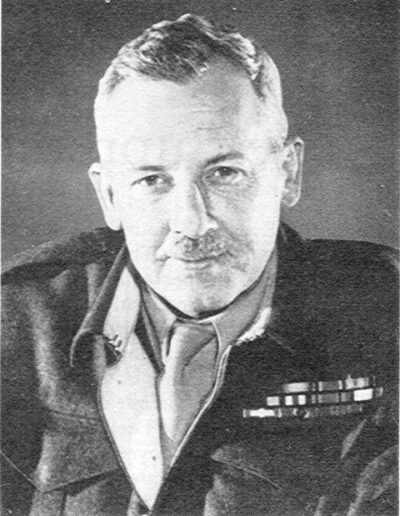
Frederick E. Morgan
Frederick E. Morgan was a British Army general. Born February 5, 1894, in Paddock Wood. Died March 19, 1967, in Northwood. Educated at Clifton College and Royal Military Academy, Woolwich. Awards include Commander of the Legion of Honour, Knight Commander of the Order of the Bath and Commander of the Legion of Merit.
Facts
15 facts · 2 confirmed by two sources · 1 cited · 12 from one source
Where this comes from
Papalocal keeps its own record. It started from these sources; what each one said is kept here as it was copied, so a change on their side never changes this page by itself. Tap one to read its version.
What Wikidata says · copied November 18, 2026 · revision 2515243171
- Described as
- British Army general (1894–1967)
- Born
- February 5, 1894 · 2 references
- Died
- March 19, 1967 · 2 references
- Born in
- Paddock Wood
- Died in
- Northwood
- Citizen of
- United Kingdom
- Occupation
- military personnel; soldier · 1 reference
- Education
- Clifton College; Royal Military Academy, Woolwich
- Awards
- Commander of the Legion of Honour; Knight Commander of the Order of the Bath; Commander of the Legion of Merit; Legionnaire of Legion of Merit
- Military branch
- British Army
- Military rank
- lieutenant general
- Wikipedias with a page
- 21
Wikidata item Q1452869 (wikidata.org/wiki/Q1452869), public domain (CC0). Copied November 18, 2026.
What Wikipedia says · copied November 18, 2026 · revision 1379835553
Lieutenant-General Sir Frederick Edgworth Morgan, (5 February 1894 – 19 March 1967) was a senior officer of the British Army who served in both world wars. He is best known as the chief of staff to the Supreme Allied Commander (COSSAC), the original planner of Operation Overlord.
A graduate of the Royal Military Academy, Woolwich, Morgan was commissioned as a second lieutenant in the Royal Field Artillery in July 1913. During the First World War he served on the Western Front as an artillery subaltern and staff officer. Afterwards he served two long tours with the British Army in India.
Shortly before the outbreak of the Second World War in September 1939, Morgan was promoted to brigadier and assumed command of the 1st Support Group, part of the 1st Armoured Division, which he led during the Battle of France. After serving as Brigadier General Staff (BGS) with II Corps, he was promoted to major general in February 1941 and commanded both the Devon and Cornwall County Division and the 55th (West Lancashire) Infantry Division, before being promoted again in May 1942 to lieutenant general when he was given command of I Corps. His headquarters was then designated Force 125, and given the task of dealing with a German thrust through Spain to Gibraltar that never occurred. In March 1943 he was appointed Chief Of Staff to the Supreme Allied Commander (Designate), or COSSAC. As COSSAC he directed the planning for Operation Overlord. When American General Dwight D. Eisenhower became Supreme Allied Commander in early 1944, Major General Bedell Smith became chief of staff at Supreme Headquarters Allied Expeditionary Force (SHAEF), while Morgan became deputy chief of staff.
After the war, Morgan served as Chief of Operations for the United Nations Relief and Rehabilitation Administration (UNRRA) in Germany until his position in Germany was eliminated after he had alleged that UNRRA was infiltrated by Soviet agents seeking to stir up trouble among displaced persons. In 1951, Morgan became Controller of Atomic Energy, and was present for Operation Hurricane, the first British atomic weapons tests at the Montebello Islands in 1952. His position was abolished in 1954 with the creation of the United Kingdom Atomic Energy Authority but he remained as Controller of Nuclear Weapons until 1956.
- Born, in its opening lines
- February 5, 1894
- Died, in its opening lines
- March 19, 1967
From the Wikipedia article “Frederick Morgan (British Army officer, born 1894)” (en.wikipedia.org/wiki/Frederick_Morgan_(British_Army_officer,_born_1894)), by its contributors, under CC BY-SA 4.0 (creativecommons.org/licenses/by-sa/4.0/). Copied November 18, 2026; not changed.
Confirmed Two sources agree. Cited One source, and it names where it got it. One source One source, without a reference of its own. Sources disagree The sources disagree. We show the best-supported value and keep theirs below.
