
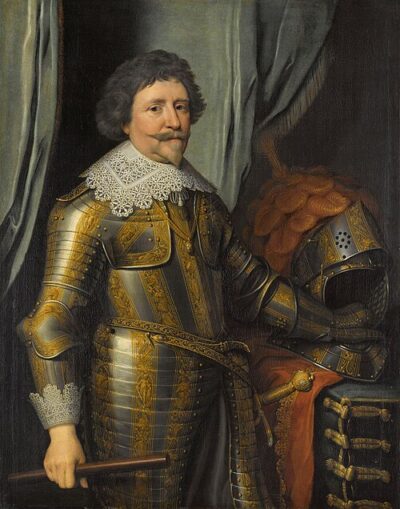
Frederick Henry of Orange-Nassau
Frederick Henry of Orange-Nassau was a prince of Orange and stadtholder of Holland. Born January 29, 1584, in Delft. Died March 14, 1647, in The Hague. Positions held include Prince of Orange (1625–1647) and stadtholder (1625–1647). Awards include Knight of the Garter.
Facts
38 facts · 2 confirmed by two sources · 15 cited · 21 from one source
Where this comes from
Papalocal keeps its own record. It started from these sources; what each one said is kept here as it was copied, so a change on their side never changes this page by itself. Tap one to read its version.
What Wikidata says · copied November 16, 2026 · revision 2566711724
- Described as
- prince of Orange and stadtholder of Holland (1584-1647)
- Other names
- Prince of Orange Frederick Henry, prins van Oranje-Nassau Frederik Hendrik, Prince of Orange, Count of Nassau Frederick Henry, prins van Oranje Frederik Hendrik, Frederik Hendrik van Oranje-Nassau, prince d'Orange-Nassau Frédéric-Henri, Frederick Henry
- Born
- January 29, 1584 · 4 references
- Died
- March 14, 1647 · 5 references
- Born in
- Delft · 2 references
- Died in
- The Hague · 2 references
- Buried in
- Nieuwe Kerk Delft
- Citizen of
- Dutch Republic · 1 reference
- Occupation
- politician · 1 reference; military leader · 2 references; art collector
- Positions held
- Prince of Orange (1625–1647); stadtholder (1625–1647) · 1 reference
- Awards
- Knight of the Garter · 1 reference
- Field
- politics · 1 reference; military · 1 reference
- Spouse
- Amalia of Solms-Braunfels (1625–) · 1 reference
- Children
- William II, Prince of Orange · 1 reference; Countess Louise Henriette of Nassau · 1 reference; Countess Albertine Agnes of Nassau; Henriette Catherine of Nassau; Hendrik Lodewijk of Nassau · 1 reference; Maria of Nassau · 1 reference; Henriëtte Amalia of Nassau · 1 reference; Alexandra of Nassau · 1 reference; Frederick Nassau de Zuylestein; Isabella Charlotte of Nassau · 1 reference
- Father
- William the Silent · 1 reference
- Mother
- Louise de Coligny · 1 reference
- Siblings
- Countess Louise Juliana of Nassau; Countess Elisabeth of Nassau; Countess Emilia Antwerpiana of Nassau; Countess Emilia of Nassau; Countess Catharina Belgica of Nassau; Countess Charlotte Flandrina of Nassau; Countess Charlotte Brabantina of Nassau; Countess Maria of Nassau; Countess Anna of Nassau; Philip William, Prince of Orange
- Military rank
- general
- Wikipedias with a page
- 41
Wikidata item Q167236 (wikidata.org/wiki/Q167236), public domain (CC0). Copied November 16, 2026.
What Wikipedia says · copied November 16, 2026 · revision 1357343921
Frederick Henry (Dutch: Frederik Hendrik; 29 January 1584 – 14 March 1647) was the sovereign prince of Orange and stadtholder of Holland, Zeeland, Utrecht, Guelders, and Overijssel in the Dutch Republic from his older half-brother's death on 23 April 1625 until his death on 14 March 1647. In the last seven years of his life, he was also the stadtholder of Groningen (1640-1647).
As the leading soldier in the Dutch wars against Spain, his main achievement was the successful Siege of 's-Hertogenbosch in 1629. It was the main Spanish base and a well-fortified city protected by an experienced Spanish garrison and by formidable water defenses. His strategy was the successful neutralization of the threat of inundation of the area around 's-Hertogenbosch and his capture of the Spanish storehouse at Wesel. The successful sieges under his command earned him the epithet ‘city forcer’ (Dutch: stedendwinger). He was the paternal grandfather of William III, who later became King of England, Scotland & Ireland, through his only surviving son, William II.
- Born, in its opening lines
- January 29, 1584
- Died, in its opening lines
- March 14, 1647
From the Wikipedia article “Frederick Henry, Prince of Orange” (en.wikipedia.org/wiki/Frederick_Henry,_Prince_of_Orange), by its contributors, under CC BY-SA 4.0 (creativecommons.org/licenses/by-sa/4.0/). Copied November 16, 2026; not changed.
Confirmed Two sources agree. Cited One source, and it names where it got it. One source One source, without a reference of its own. Sources disagree The sources disagree. We show the best-supported value and keep theirs below.
