
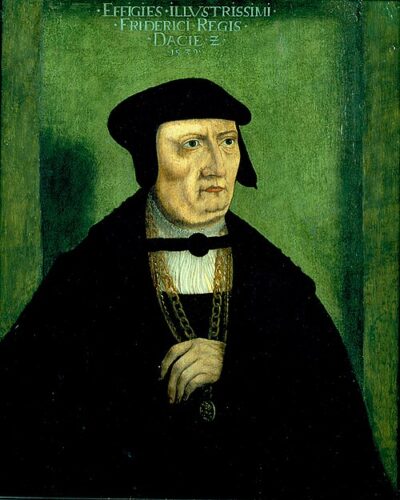
Frederick I of Denmark
Frederick I of Denmark was a King of Denmark and Norway. Born October 7, 1471, in Haderslev. Died April 10, 1533, in Gottorf Castle. Positions held include Monarch of Denmark (1523–1533) and Monarch of Norway (1523–1533). Awards include Order of the Elephant.
Facts
29 facts · 2 confirmed by two sources · 9 cited · 18 from one source
Where this comes from
Papalocal keeps its own record. It started from these sources; what each one said is kept here as it was copied, so a change on their side never changes this page by itself. Tap one to read its version.
What Wikidata says · copied November 16, 2026 · revision 2569841398
- Described as
- King of Denmark and Norway
- Other names
- Frederick I
- Born
- October 7, 1471 · 2 references
- Died
- April 10, 1533 · 2 references
- Born in
- Haderslev
- Died in
- Gottorf Castle · 1 reference
- Buried in
- Schleswig Cathedral · 1 reference
- Citizen of
- Norway
- Occupation
- monarch
- Positions held
- Monarch of Denmark (1523–1533); Monarch of Norway (1523–1533)
- Awards
- Order of the Elephant · 1 reference
- Spouse
- Anna of Brandenburg (1502–1514) · 1 reference; Sophie of Pomerania (1518–1533) · 2 references
- Children
- Christian III of Denmark · 1 reference; Dorothea of Denmark; John II, Duke of Schleswig-Holstein-Haderslev; Elizabeth of Denmark, Duchess of Mecklenburg; Adolf I, Duke of Schleswig-Holstein-Gottorp; Dorothea of Denmark, Duchess of Mecklenburg; Frederick of Denmark; Anna of Denmark · 1 reference; Geseke Frederiksdatter · 1 reference; Catharina Frederiksdatter · 1 reference
- Father
- Christian I of Denmark · 1 reference
- Mother
- Dorothea of Brandenburg
- Siblings
- Olaf of Denmark; Canute of Denmark; John, King of Denmark · 1 reference; Margaret of Denmark, Queen of Scotland
- Religion
- Catholic Church
- Wikipedias with a page
- 48
Wikidata item Q157789 (wikidata.org/wiki/Q157789), public domain (CC0). Copied November 16, 2026.
What Wikipedia says · copied November 16, 2026 · revision 1383791217
Frederick I (Danish and Norwegian: Frederik; German: Friedrich; 7 October 1471 – 10 April 1533) was King of Denmark and Norway from 1523 and 1524, respectively, until his death in 1533, and earlier co-Duke of Schleswig and Holstein.
A member of the House of Oldenburg, he was the youngest son of King Christian I and Dorothea of Brandenburg. Not originally destined for the throne, he received joint rule in Schleswig and Holstein on reaching his majority in 1490 and resided chiefly at Gottorf Castle.
Frederick declined the Danish crown on the death of his brother King Hans in 1513 but accepted election in 1523 after opposition to Hans’s son, Christian II. With the backing of Lübeck and North German allies, he prevailed in the ensuing war (1523–1524). His election, arranged by the Council of the Realm, compelled him to accept what is regarded as the most restrictive coronation charter (Danish: håndfæstning) ever imposed on a Danish monarch. He recognized Gustav Vasa as king of Sweden, abandoning efforts to revive the Kalmar Union, though the two cooperated against Christian II. In Norway, where he neither travelled nor was crowned, he was styled “elected king”, but acknowledged by the Council in 1524.
His reign was dominated by the recurring threat of Christian II’s restoration, who enjoyed the active support of Emperor Charles V. A rising in Blekinge in 1525 led by Christian’s adherent Søren Norby was suppressed by Johan Rantzau, and Christian’s attempt to return via Norway in 1531 achieved initial gains but failed to secure the realm. During the ensuing negotiations in 1532, he was seized and remained in captivity thereafter. Frederick largely governed from Gottorf and delegated day-to-day administration to leading councillors, notably the Steward of the Realm, Mogens Gøye. In foreign policy, he aligned himself with the two leading Protestant powers, Hesse and Saxony, while refraining from joining the Schmalkaldic League.
Although officially a Catholic, Frederick showed sympathy for the Protestant movement, permitting Lutheran preaching and extending protection to reformers such as Hans Tausen, whom he employed as chaplain. He used the confessional divide to balance ecclesiastical and noble interests. His reign is widely seen as an interlude of stability in the otherwise chaotic religious upheaval that characterised the period; the equilibrium he upheld dissolved upon his death.
Frederick died at Gottorp in 1533. He was the last Catholic monarch to reign over Denmark and Norway, and his death precipitated the Count’s Feud (1534–1536), a succession war that ended with the accession of his son Christian III and the establishment of Lutheranism as the state religion in Denmark–Norway. Frederick's reign also began the enduring tradition of calling kings of Denmark alternately by the names Christian and Frederick.
- Born, in its opening lines
- October 7, 1471
- Died, in its opening lines
- April 10, 1533
From the Wikipedia article “Frederick I of Denmark” (en.wikipedia.org/wiki/Frederick_I_of_Denmark), by its contributors, under CC BY-SA 4.0 (creativecommons.org/licenses/by-sa/4.0/). Copied November 16, 2026; not changed.
Confirmed Two sources agree. Cited One source, and it names where it got it. One source One source, without a reference of its own. Sources disagree The sources disagree. We show the best-supported value and keep theirs below.
