
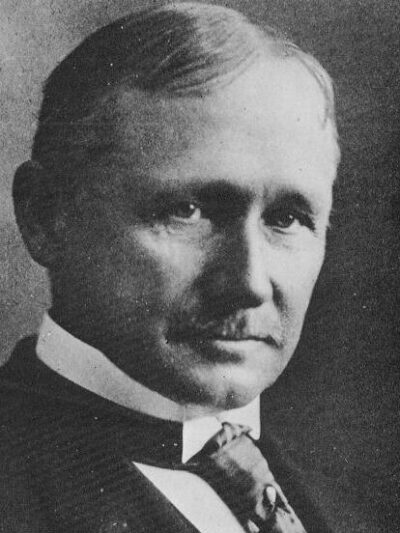
Frederick Winslow Taylor
Frederick Winslow Taylor was an American mechanical engineer. Born March 20, 1856, in Germantown. Died March 21, 1915, in Philadelphia. Educated at Phillips Exeter Academy and Stevens Institute of Technology. Awards include Elliott Cresson Medal and honorary doctor of the University of Pennsylvania.
Facts
27 facts · 2 confirmed by two sources · 6 cited · 19 from one source
Where this comes from
Papalocal keeps its own record. It started from these sources; what each one said is kept here as it was copied, so a change on their side never changes this page by itself. Tap one to read its version.
What Wikidata says · copied November 13, 2026 · revision 2568288984
- Described as
- American mechanical engineer (1856–1915)
- Other names
- Frederick Taylor, F. W Taylor
- Born
- March 20, 1856 · 9 references
- Died
- March 21, 1915 · 8 references
- Born in
- Germantown · 1 reference
- Died in
- Philadelphia · 2 references
- Buried in
- West Laurel Hill Cemetery
- Citizen of
- United States
- Occupation
- economist; management consultant; mechanical engineer; lecturer; writer; engineer · 1 reference; business consultant · 1 reference
- Worked for
- Tuck School of Business; Midvale Steel
- Education
- Phillips Exeter Academy (1872–1874) · 1 reference; Stevens Institute of Technology (–1883)
- Member of
- American Philosophical Society (1912–); American Academy of Arts and Sciences
- Sport
- tennis; golf
- Awards
- Elliott Cresson Medal (1902) · 1 reference; honorary doctor of the University of Pennsylvania (1906)
- Field
- scientific management; ergonomics
- Father
- Franklin Taylor · 1 reference
- Lived in
- South Africa
- Wikipedias with a page
- 58
Wikidata item Q203906 (wikidata.org/wiki/Q203906), public domain (CC0). Copied November 13, 2026.
What Wikipedia says · copied November 13, 2026 · revision 1383779100
Frederick Winslow Taylor (March 20, 1856 – March 21, 1915) was an American mechanical engineer. He was widely known for his methods to improve industrial efficiency. He was one of the first management consultants. In 1909, Taylor summed up his efficiency techniques in his book The Principles of Scientific Management which, in 2001, Fellows of the Academy of Management voted the most influential management book of the twentieth century. His pioneering work in applying engineering principles to the work done on the factory floor was instrumental in the creation and development of the branch of engineering that is now known as industrial engineering. Taylor made his name, and was most proud of his work, in scientific management; as a result, scientific management is sometimes referred to as Taylorism. His main source of income came from patenting improvements to steelmaking.
- Born, in its opening lines
- March 20, 1856
- Died, in its opening lines
- March 21, 1915
From the Wikipedia article “Frederick Winslow Taylor” (en.wikipedia.org/wiki/Frederick_Winslow_Taylor), by its contributors, under CC BY-SA 4.0 (creativecommons.org/licenses/by-sa/4.0/). Copied November 13, 2026; not changed.
Confirmed Two sources agree. Cited One source, and it names where it got it. One source One source, without a reference of its own. Sources disagree The sources disagree. We show the best-supported value and keep theirs below.
