
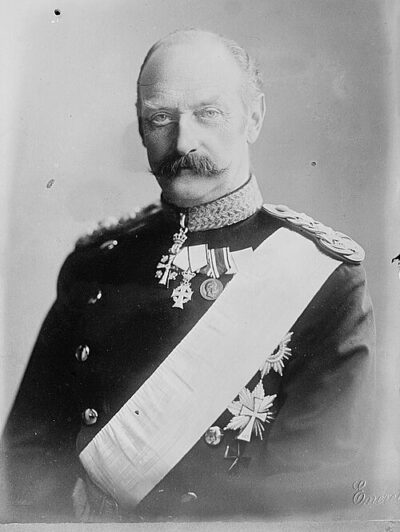
Frederik VIII of Denmark
Frederik VIII of Denmark was a King of Denmark from 1906 to 1912. Born June 3, 1843, in Yellow Palace. Died May 14, 1912, in Hamburg. Positions held include Monarch of Denmark (1906–1912). Awards include Knight of the Order of the Golden Fleece, Order of the Black Eagle and Knight Grand Cross of the Order of the Bath.
Facts
44 facts · 2 confirmed by two sources · 7 cited · 35 from one source
Where this comes from
Papalocal keeps its own record. It started from these sources; what each one said is kept here as it was copied, so a change on their side never changes this page by itself. Tap one to read its version.
What Wikidata says · copied November 16, 2026 · revision 2565848147
- Described as
- King of Denmark from 1906 to 1912
- Other names
- Christian Frederik Vilhelm Carl
- Born
- June 3, 1843 · 5 references
- Died
- May 14, 1912 · 5 references
- Born in
- Yellow Palace · 1 reference
- Died in
- Hamburg · 1 reference
- Buried in
- Roskilde Cathedral
- Cause of death
- cerebrovascular disease
- Citizen of
- Kingdom of Denmark
- Occupation
- monarch; aristocrat; military officer
- Positions held
- Monarch of Denmark (1906–1912)
- Awards
- Knight of the Order of the Golden Fleece; Order of the Black Eagle; Knight Grand Cross of the Order of the Bath; Knight Grand Cross with Collar of the Order of Saint Olav; Order of Saint Anna, 1st class; Order of the White Eagle; Order of Saint Stanislaus, 1st class; Order of Saint Alexander Nevsky; Order of the Star of Romania; Order of St. Andrew; Royal Victorian Chain (1902); Knight of the Order of the Elephant (1861) · 1 reference; Knight Grand Commander of the Order of the Dannebrog (1869) · 1 reference; Order of the Redeemer · 1 reference; Order of Saint Stephen of Hungary · 1 reference
- Spouse
- Louise of Sweden (1869–1912) · 2 references
- Children
- Christian X of Denmark · 1 reference; Haakon VII of Norway · 1 reference; Princess Louise of Denmark; Prince Harald of Denmark; Princess Ingeborg of Denmark · 1 reference; Princess Thyra of Denmark; Prince Gustav of Denmark; Princess Dagmar of Denmark
- Father
- Christian IX of Denmark · 1 reference
- Mother
- Louise of Hesse-Kassel
- Siblings
- Alexandra of Denmark; George I of Greece; Maria Feodorovna (Dagmar of Denmark); Thyra, Crown Princess of Hanover; Prince Valdemar of Denmark
- Religion
- Lutheranism
- Military rank
- general
- Wikipedias with a page
- 58
Wikidata item Q152756 (wikidata.org/wiki/Q152756), public domain (CC0). Copied November 16, 2026.
What Wikipedia says · copied November 16, 2026 · revision 1385886654
Frederick VIII (Danish: Christian Frederik Vilhelm Carl; 3 June 1843 – 14 May 1912) was King of Denmark from 29 January 1906 until his death in 1912.
As the eldest son of King Christian IX, nicknamed "the father-in-law of Europe" and grandfather of Europe, Frederick was related to royalty throughout Europe. He was heir apparent to the Danish throne and served as crown prince for more than 42 years. During the long reign of his father, he was largely excluded from influence and political power.
Upon his father's death in 1906, he acceded to the throne at the advanced age of 62. In many ways, Frederick VIII was a liberal monarch who was much more favorable to the new parliamentary system introduced in 1901 than his father had been, being reform-minded and democratically inclined. Due to his late accession to the throne, however, Frederick's reign would last only six years, throughout which he was plagued by ill health.
Frederick VIII was married to Louise of Sweden, with whom he had eight children. Their eldest son succeeded his father as Christian X, while their second son, Carl, ascended the Norwegian throne as Haakon VII in 1905.
- Born, in its opening lines
- June 3, 1843
- Died, in its opening lines
- May 14, 1912
From the Wikipedia article “Frederick VIII of Denmark” (en.wikipedia.org/wiki/Frederick_VIII_of_Denmark), by its contributors, under CC BY-SA 4.0 (creativecommons.org/licenses/by-sa/4.0/). Copied November 16, 2026; not changed.
Confirmed Two sources agree. Cited One source, and it names where it got it. One source One source, without a reference of its own. Sources disagree The sources disagree. We show the best-supported value and keep theirs below.
