
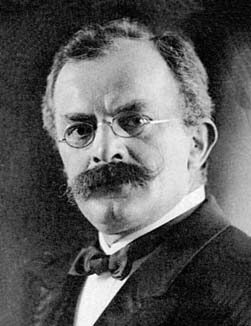
Friedrich Engel
Friedrich Engel was a German mathematician. Born December 26, 1861, in Lugau. Died September 29, 1941, in Giessen. Known for Engel group, Engel expansion and Engel's theorem. Educated at Leipzig University and Frederick William University Berlin. Awards include Knight of the Order of St. Olav, Lobachevsky Prize and honorary doctorate of the University of Oslo.
Facts
27 facts · 2 confirmed by two sources · 14 cited · 11 from one source
Where this comes from
Papalocal keeps its own record. It started from these sources; what each one said is kept here as it was copied, so a change on their side never changes this page by itself. Tap one to read its version.
What Wikidata says · copied November 18, 2026 · revision 2569052067
- Described as
- German mathematician (1861–1941)
- Born
- December 26, 1861 · 4 references
- Died
- September 29, 1941 · 4 references
- Born in
- Lugau · 3 references
- Died in
- Giessen · 3 references
- Citizen of
- German Reich
- Occupation
- mathematician · 1 reference; historian of mathematics; university teacher · 1 reference
- Worked for
- Leipzig University (1885–1904) · 1 reference; University of Giessen (1913–1931) · 1 reference; University of Greifswald (1904–1913) · 1 reference
- Education
- Leipzig University (1879–1883) · 2 references; Frederick William University Berlin (–1881) · 1 reference
- Member of
- Saxon Academy of Sciences and Humanities (1890–); Russian Academy of Sciences (1899–) · 1 reference; Royal Prussian Academy of Sciences; Norwegian Academy of Science and Letters · 1 reference
- Known for
- Engel group; Engel expansion; Engel's theorem; Theorie der Transformationsgruppen; Die Theorie Der Parallellinien Von Euklid Bis Auf Gauss
- Awards
- Knight of the Order of St. Olav · 1 reference; Lobachevsky Prize · 1 reference; honorary doctorate of the University of Oslo · 1 reference
- Field
- mathematics
- Father
- Moritz Robert Engel · 1 reference
- Wikipedias with a page
- 21
Wikidata item Q70905 (wikidata.org/wiki/Q70905), public domain (CC0). Copied November 18, 2026.
What Wikipedia says · copied November 18, 2026 · revision 1372325746
Friedrich Engel (26 December 1861 – 29 September 1941) was a German mathematician.
Engel was born in Lugau, Saxony, as the son of a Lutheran pastor. He attended the Universities of both Leipzig and Berlin, before receiving his doctorate from Leipzig in 1883.
Engel studied under Felix Klein at Leipzig, and collaborated with Sophus Lie for much of his life. He worked at Leipzig (1885–1904), Greifswald (1904–1913), and Giessen (1913–1931). He died in Giessen.
Engel was the co-author, with Sophus Lie, of the three volume work Theorie der Transformationsgruppen (publ. 1888–1893; tr., "Theory of transformation groups"). Engel was the editor of the collected works of Sophus Lie with six volumes published between 1922 and 1937; the seventh and final volume was prepared for publication but appeared almost twenty years after Engel's death. He was also the editor of the collected works of Hermann Grassmann. Engel translated the works of Nikolai Lobachevski from Russian into German, thus making these works more accessible. With Paul Stäckel he wrote a history of non-Euclidean geometry (Theorie der Parallellinien von Euklid bis auf Gauss, 1895). With his former student Karl Faber, he wrote a book on the theory of partial differential equations of the first order using methods of Lie group theory. In 1910 Engel was the president of the Deutsche Mathematiker-Vereinigung.
- Born, in its opening lines
- December 26, 1861
- Died, in its opening lines
- September 29, 1941
From the Wikipedia article “Friedrich Engel (mathematician)” (en.wikipedia.org/wiki/Friedrich_Engel_(mathematician)), by its contributors, under CC BY-SA 4.0 (creativecommons.org/licenses/by-sa/4.0/). Copied November 18, 2026; not changed.
Confirmed Two sources agree. Cited One source, and it names where it got it. One source One source, without a reference of its own. Sources disagree The sources disagree. We show the best-supported value and keep theirs below.
