
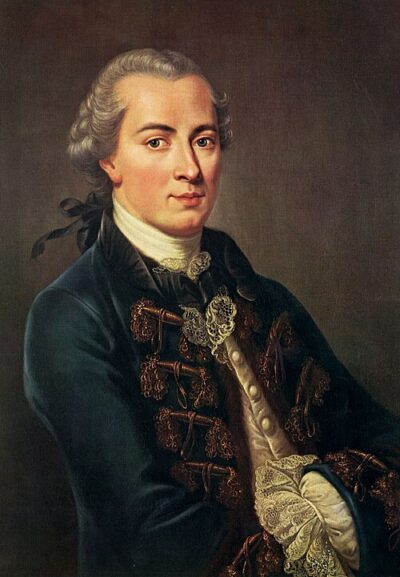
Friedrich Heinrich Jacobi
Friedrich Heinrich Jacobi was a German philosopher. Born January 25, 1743, in Düsseldorf. Died March 10, 1819, in Munich. Positions held include Geheimrat.
Facts
32 facts · 2 confirmed by two sources · 13 cited · 17 from one source
Where this comes from
Papalocal keeps its own record. It started from these sources; what each one said is kept here as it was copied, so a change on their side never changes this page by itself. Tap one to read its version.
What Wikidata says · copied November 16, 2026 · revision 2568736056
- Described as
- German philosopher (1743-1819)
- Born
- January 25, 1743 · 9 references
- Died
- March 10, 1819 · 9 references
- Born in
- Düsseldorf · 3 references
- Died in
- Munich · 3 references
- Buried in
- Alter Südfriedhof · 1 reference
- Citizen of
- Kingdom of Bavaria
- Occupation
- philosopher · 2 references; theologian; novelist; university teacher; writer · 2 references; jurist · 1 reference; merchant · 1 reference
- Positions held
- Geheimrat
- Worked for
- LMU Munich
- Member of
- Illuminati; Bavarian Academy of Sciences and Humanities; Emkendorfer Kreis; Royal Prussian Academy of Sciences; Göttingen Academy of Sciences and Humanities in Lower Saxony
- Field
- philosophy · 1 reference
- Spouse
- Helene Elisabeth Jacobi · 1 reference
- Children
- Johann Friedrich Jacobi · 1 reference; Carl Wigand Maximilian Jacobi · 1 reference; Clara von Clermont · 1 reference; Georg Arnold Jacobi · 1 reference
- Father
- Johann Konrad Jacobi · 1 reference
- Mother
- Johanna Maria Jacobi · 1 reference
- Siblings
- Johann Georg Jacobi · 1 reference; Marie Winckelmann; Anna Katharina Charlotte Jacobi; Helene Jacobi
- Wikipedias with a page
- 44
Wikidata item Q168004 (wikidata.org/wiki/Q168004), public domain (CC0). Copied November 16, 2026.
What Wikipedia says · copied November 16, 2026 · revision 1383333585
Friedrich Heinrich Jacobi (; German: [jaˈkoːbi]; 25 January 1743 – 10 March 1819) was a German philosopher, writer and socialite. He is best known for popularizing the concept of nihilism, denigrating it as the necessary result of Enlightenment thought and the philosophical systems of Baruch Spinoza, Immanuel Kant, Johann Gottlieb Fichte and Friedrich Wilhelm Joseph Schelling.
Jacobi advocated Glaube (variously translated as faith or "belief") and Offenbarung (revelation) instead of speculative reason. According to one view, Jacobi can be seen to have anticipated present-day writers who criticize secular philosophy as relativistic and dangerous for religious faith. His aloofness from the Sturm and Drang movement was the basis of a brief friendship with Johann Wolfgang von Goethe.
He was the younger brother of poet Johann Georg Jacobi and the father of the psychiatrist Maximilian Jacobi.
- Born, in its opening lines
- January 25, 1743
- Died, in its opening lines
- March 10, 1819
From the Wikipedia article “Friedrich Heinrich Jacobi” (en.wikipedia.org/wiki/Friedrich_Heinrich_Jacobi), by its contributors, under CC BY-SA 4.0 (creativecommons.org/licenses/by-sa/4.0/). Copied November 16, 2026; not changed.
Confirmed Two sources agree. Cited One source, and it names where it got it. One source One source, without a reference of its own. Sources disagree The sources disagree. We show the best-supported value and keep theirs below.
