
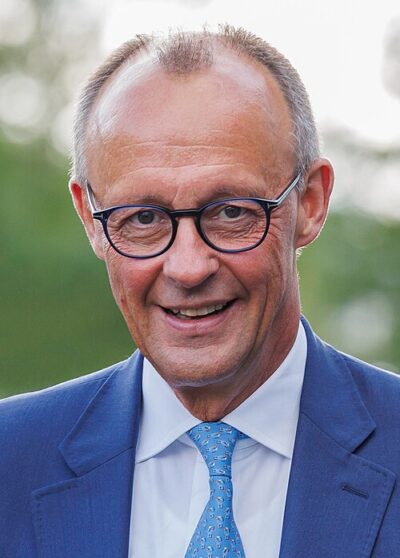
Friedrich Merz
Friedrich Merz is a German politician, Chancellor of the Federal Republic of Germany. Born November 11, 1955, in Brilon. Positions held include member of the German Bundestag (2 times) (1994–), Member of the European Parliament (1989–1994) and Chairman of the CDU/CSU Bundestag fraction (2000–2002). Educated at Gymnasium Petrinum and University of Marburg. Awards include Orden wider den tierischen Ernst, Time 100 and Order of Prince Yaroslav the Wise, 1st class.


Facts
45 facts · 1 confirmed by two sources · 22 cited · 22 from one source
Where this comes from
Papalocal keeps its own record. It started from these sources; what each one said is kept here as it was copied, so a change on their side never changes this page by itself. Tap one to read its version.
What Wikidata says · copied November 16, 2026 · revision 2569735487
- Described as
- German politician, Chancellor of the Federal Republic of Germany
- Born
- November 11, 1955 · 3 references
- Born in
- Brilon · 2 references
- Name at birth
- Joachim-Friedrich Martin Josef Merz · 1 reference
- Citizen of
- Germany
- Occupation
- politician · 4 references; Gerichtsassessor (1985–1986); lobbyist; manager · 1 reference; jurist · 3 references; lawyer (1986–) · 2 references; judge · 1 reference
- Positions held
- member of the German Bundestag (2 times) (1994–) · 1 reference; Member of the European Parliament (1989–1994) · 1 reference; Chairman of the CDU/CSU Bundestag fraction (2000–2002) · 1 reference; leader of the Christian Democratic Union (2022–); Federal Chancellor of Germany (2025–)
- Political party
- Christian Democratic Union (1972–) · 1 reference
- Worked for
- BlackRock; Verband der Chemischen Industrie (1986–1989); Mayer Brown
- Education
- Gymnasium Petrinum (1966–1971); University of Marburg; University of Bonn
- Member of
- Atlantik-Brücke; Trilateral Commission; KDStV Bavaria Bonn (1977–); Initiative Neue Soziale Marktwirtschaft; supervisory board (2009–)
- Awards
- Orden wider den tierischen Ernst (2006) · 1 reference; Time 100 (2025) · 1 reference; Order of Prince Yaroslav the Wise, 1st class (2026)
- Field
- politics · 1 reference; law · 1 reference; justice and judicial activities · 1 reference; management · 1 reference; lobbying · 1 reference
- Spouse
- Charlotte Merz (1981–) · 2 references
- Children
- Philippe Merz · 1 reference; Carola Clüsener · 1 reference; Constanze Merz · 1 reference
- Father
- Joachim Merz
- Mother
- Paula Merz
- Religion
- Catholicism
- Height
- 1.98 m (6 ft 6 in) · 2 references
- Website
- https://www.friedrich-merz.de/
- Wikipedias with a page
- 102
Wikidata item Q566257 (wikidata.org/wiki/Q566257), public domain (CC0). Copied November 16, 2026.
What Wikipedia says · copied November 16, 2026 · revision 1385468453
Joachim-Friedrich Martin Josef Merz (born 11 November 1955) is a German politician who has served as Chancellor of Germany since 6 May 2025. He has also served as Leader of the Christian Democratic Union (CDU) since January 2022, leading the CDU/CSU (Union) parliamentary group as Leader of the Opposition in the Bundestag from February 2022 to May 2025.
Merz was born in Brilon in the state of North Rhine-Westphalia in West Germany. He joined the Young Union in 1972. After finishing law school in 1985, Merz worked as a judge and corporate lawyer before entering full-time politics in 1989 when he was elected to the European Parliament. As a young politician in the 1970s and 1980s, Merz was a staunch supporter of anti-communism, the dominant political doctrine of West Germany and a core tenet of the CDU. He is seen as a representative of the traditional establishment conservative and pro-business wings of the CDU. His book Mehr Kapitalismus wagen (Venturing More Capitalism) advocates economic liberalism. After serving one term he was elected to the Bundestag, where he established himself as the leading financial policy expert in the CDU. He was elected chairman of the CDU/CSU parliamentary group in 2000, the same year as Angela Merkel was elected chairwoman of the CDU, and at the time they were chief rivals for the leadership of the party, which led the opposition together with CSU.
After the 2002 federal election, Merkel claimed the parliamentary group chairmanship for herself, while Merz was elected deputy parliamentary group leader. In December 2004, he resigned from this office, thereby giving up the years-long power struggle with Merkel and gradually withdrew from politics, focusing on his legal career and leaving parliament entirely in 2009, until his return to parliament in 2021. In 2004, he became a senior counsel at Mayer Brown, where he focused on mergers and acquisitions, banking and finance, and compliance. He has served on the boards of numerous companies, including BlackRock Germany. A corporate lawyer and reputed multimillionaire, Merz is also a licensed private pilot and owns two aeroplanes. In 2018, he announced his return to politics. He was elected CDU leader in December 2021, assuming the office in January 2022. He had failed to win the position in two previous leadership elections in 2018, and January 2021. In September 2024, he became the Union's candidate for Chancellor of Germany ahead of the following year's federal election. The CDU/CSU won a plurality of the seats and subsequently reached an agreement to form a coalition with the SPD. Merz was elected chancellor on 6 May 2025, taking two rounds to clear, which was a first in German history.
As chancellor, he has taken steps to ensure fiscal responsibility and border security. An early issue that arose at the start of his chancellorship has been the designation of the AfD as extremist. In foreign policy, he is a staunch supporter of the European Union, NATO, and the liberal international order, having described himself as "truly European, a convinced Transatlanticist, and a German open to the world". Merz advocates a closer union and "an army for Europe". Prior to the second presidency of Donald Trump, he was frequently described as being "exceptionally pro-American", and was once the chairman of the Atlantik-Brücke association which promotes German-American friendship and Atlanticism. Domestically, Merz's proposed welfare cuts and reforms have drawn criticism. His approval ratings fell sharply during his first year in office; in May 2026, he recorded the lowest level of satisfaction ever measured for a German chancellor by the ARD-Deutschlandtrend, a monthly national opinion poll.
- Born, in its opening lines
- November 11, 1955
From the Wikipedia article “Friedrich Merz” (en.wikipedia.org/wiki/Friedrich_Merz), by its contributors, under CC BY-SA 4.0 (creativecommons.org/licenses/by-sa/4.0/). Copied November 16, 2026; not changed.
Confirmed Two sources agree. Cited One source, and it names where it got it. One source One source, without a reference of its own. Sources disagree The sources disagree. We show the best-supported value and keep theirs below.
