
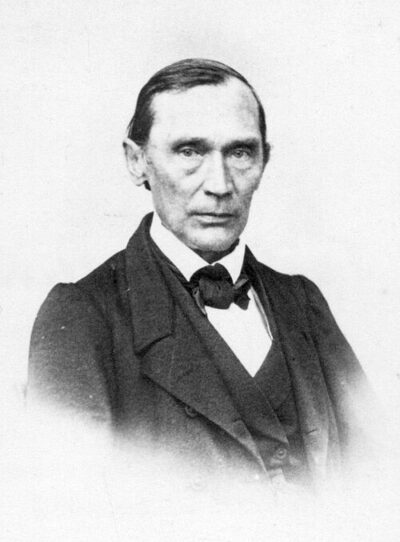
Friedrich Reinhold Kreutzwald
Friedrich Reinhold Kreutzwald was an Estonian writer, author of the national epic Kalevipoeg. Born December 26, 1803, in Jõepere manor. Died August 25, 1882, in Tartu. Educated at Imperial University of Dorpat.
Facts
18 facts · 2 confirmed by two sources · 3 cited · 13 from one source
Where this comes from
Papalocal keeps its own record. It started from these sources; what each one said is kept here as it was copied, so a change on their side never changes this page by itself. Tap one to read its version.
What Wikidata says · copied November 16, 2026 · revision 2557887126
- Described as
- Estonian writer, author of the national epic Kalevipoeg (1803–1882)
- Other names
- Fr. R. Kreutzwald
- Born
- December 26, 1803 · 6 references
- Died
- August 25, 1882 · 6 references
- Born in
- Jõepere manor
- Died in
- Tartu · 1 reference
- Buried in
- Raadi cemetery
- Citizen of
- Russian Empire
- Occupation
- translator; poet; children's writer; physician writer; writer; collector of fairy tales; physician · 1 reference; ethnologist · 1 reference
- Education
- Imperial University of Dorpat
- Member of
- Hungarian Academy of Sciences
- Spouse
- Marie Elisabeth Kreutzwald
- Children
- Friedrich Alexis Kreutzwald
- Wikipedias with a page
- 52
Wikidata item Q333900 (wikidata.org/wiki/Q333900), public domain (CC0). Copied November 16, 2026.
What Wikipedia says · copied November 16, 2026 · revision 1384250467
Friedrich Reinhold Kreutzwald (26 December [O.S. 14 December] 1803 – 25 August [O.S. 13 August] 1882) was an Estonian writer who is considered to be the father of the national literature for the country. He is the author of Estonian national epic Kalevipoeg.
- Born, in its opening lines
- December 26, 1803
- Died, in its opening lines
- August 25, 1882
From the Wikipedia article “Friedrich Reinhold Kreutzwald” (en.wikipedia.org/wiki/Friedrich_Reinhold_Kreutzwald), by its contributors, under CC BY-SA 4.0 (creativecommons.org/licenses/by-sa/4.0/). Copied November 16, 2026; not changed.
Confirmed Two sources agree. Cited One source, and it names where it got it. One source One source, without a reference of its own. Sources disagree The sources disagree. We show the best-supported value and keep theirs below.
