
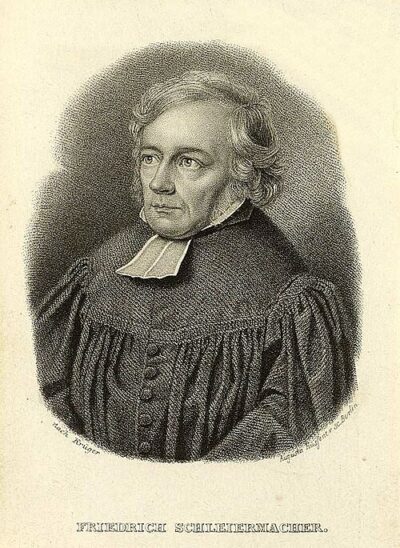
Friedrich Schleiermacher
Friedrich Schleiermacher was a German theologian, philosopher, and biblical scholar. Born November 21, 1768, in Wrocław. Died February 12, 1834, in Berlin. Known for Christian Faith. Educated at Martin Luther University Halle-Wittenberg.
Facts
32 facts · 2 confirmed by two sources · 14 cited · 16 from one source
Where this comes from
Papalocal keeps its own record. It started from these sources; what each one said is kept here as it was copied, so a change on their side never changes this page by itself. Tap one to read its version.
What Wikidata says · copied November 16, 2026 · revision 2569007588
- Described as
- German theologian, philosopher, and biblical scholar (1768-1834)
- Other names
- Friedrich Daniel Ernst Schleiermacher, Friedrich Ernst Schleiermacher, Friedrich Ernest Daniel Schleiermacher, Schleiermacher
- Born
- November 21, 1768 · 11 references
- Died
- February 12, 1834 · 5 references
- Born in
- Wrocław · 2 references
- Died in
- Berlin · 4 references
- Buried in
- Dreifaltigkeitskirchhof II
- Name at birth
- Friedrich Daniel Ernst Schleiermacher
- Citizen of
- Kingdom of Prussia
- Occupation
- philosopher · 1 reference; theologian · 1 reference; translator; university teacher; writer · 1 reference; pedagogue · 1 reference; professor · 1 reference; preacher · 1 reference
- Worked for
- Martin Luther University Halle-Wittenberg; University of Berlin; Humboldt-Universität zu Berlin
- Education
- Martin Luther University Halle-Wittenberg
- Member of
- Royal Prussian Academy of Sciences; Bavarian Academy of Sciences and Humanities; Moravian Church · 1 reference
- Known for
- Christian Faith
- Field
- theology · 1 reference; ethics · 1 reference; dialectic; pedagogy · 1 reference; philosophy · 1 reference; hermeneutics · 1 reference
- Father
- Gottlieb Adolf Schleyermacher
- Siblings
- Anna Maria Louise Arndt
- Religion
- Lutheranism
- Wikipedias with a page
- 67
Wikidata item Q76576 (wikidata.org/wiki/Q76576), public domain (CC0). Copied November 16, 2026.
What Wikipedia says · copied November 16, 2026 · revision 1379614336
Friedrich Daniel Ernst Schleiermacher (; German: [ˈfʁiːdʁɪç ˈʃlaɪɐˌmaxɐ]; 21 November 1768 – 12 February 1834) was a German Reformed theologian, pastor, philosopher, and biblical scholar known for his attempt to reconcile the criticisms of the Enlightenment with traditional Protestant Christianity. He also became influential in the evolution of higher criticism, and his work forms part of the foundation of the modern field of hermeneutics. Because of his profound effect on subsequent Christian thought, he is often called the "Father of Modern Liberal Theology" and is considered an early leader in liberal Christianity. The neo-orthodoxy movement of the twentieth century, typically (though not without challenge) seen to be spearheaded by Karl Barth, was in many ways an attempt to challenge his influence. As a philosopher he was a leader of German Romanticism.
- Born, in its opening lines
- November 21, 1768
- Died, in its opening lines
- February 12, 1834
From the Wikipedia article “Friedrich Schleiermacher” (en.wikipedia.org/wiki/Friedrich_Schleiermacher), by its contributors, under CC BY-SA 4.0 (creativecommons.org/licenses/by-sa/4.0/). Copied November 16, 2026; not changed.
Confirmed Two sources agree. Cited One source, and it names where it got it. One source One source, without a reference of its own. Sources disagree The sources disagree. We show the best-supported value and keep theirs below.
