
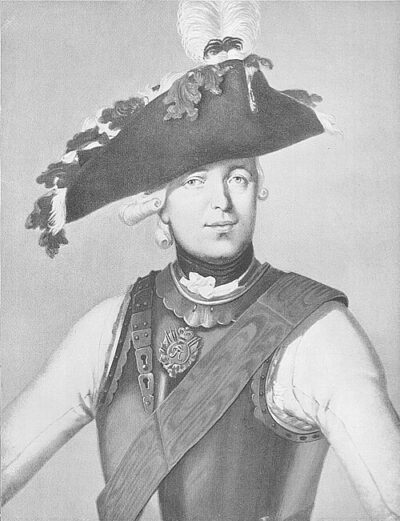
Friedrich Wilhelm von Seydlitz
Friedrich Wilhelm von Seydlitz was a German general. Born February 3, 1721, in Kalkar. Died August 27, 1773, in Oława. Awards include Order of the Black Eagle and Pour le Mérite.
Facts
16 facts · 1 confirmed by two sources · 4 cited · 10 from one source · 1 where the sources disagree
What’s different
- Died: we show August 27, 1773 (Sources disagree). Wikipedia says November 8, 1773
Where this comes from
Papalocal keeps its own record. It started from these sources; what each one said is kept here as it was copied, so a change on their side never changes this page by itself. Tap one to read its version.
What Wikidata says · copied November 16, 2026 · revision 2569129295
- Described as
- German general
- Other names
- Friedrich Wilhelm, Freiherr von Seydlitz
- Born
- February 3, 1721 · 6 references
- Died
- August 27, 1773
- Born in
- Kalkar · 1 reference
- Died in
- Oława · 1 reference
- Buried in
- Opole Voivodeship
- Cause of death
- syphilis
- Citizen of
- Holy Roman Empire
- Occupation
- military personnel; military commander · 1 reference
- Awards
- Order of the Black Eagle (1757); Pour le Mérite (1757)
- Field
- military affairs · 1 reference
- Military branch
- cavalry
- Military rank
- General of the Cavalry; major general (1757–); lieutenant general (1757–)
- Wikipedias with a page
- 33
Wikidata item Q61714 (wikidata.org/wiki/Q61714), public domain (CC0). Copied November 16, 2026.
What Wikipedia says · copied November 16, 2026 · revision 1386026348
Friedrich Wilhelm Freiherr von Seydlitz (3 February 1721 – 8 November 1773) was a Prussian officer, lieutenant general, and among the most renowned of the Prussian cavalry generals. He commanded one of the first hussar squadrons of Frederick the Great's army and is credited with the development of the Prussian cavalry to its efficient level of performance in the Seven Years' War. His cavalryman father retired and then died while Seydlitz was still young. Subsequently, he was mentored by Frederick William, Margrave of Brandenburg-Schwedt. Seydlitz's acclaimed horsemanship and recklessness combined to make him a stand-out subaltern, and he emerged as a remarkable Rittmeister (cavalry captain) in the War of Austrian Succession (1740–1748) during the First and Second Silesian Wars.
Seydlitz became legendary throughout the Prussian Army both for his leadership and for his reckless courage. During the Seven Years' War, he came into his own as a cavalry general, known for his coup d'œil, his ability to assess at a glance the entire battlefield situation and to understand intuitively what needed to be done: he excelled at converting the king's directives into flexible tactics. At the Battle of Rossbach, his cavalry was instrumental in routing the French and Imperial armies. His cavalry subsequently played an important role in crushing the Habsburg and Imperial left flank at the Battle of Leuthen. Seydlitz was wounded in battle several times. After the Battle of Kunersdorf in August 1759, he semi-retired to recover from his wounds, charged with the protection of the city of Berlin. He was not healthy enough to campaign again until 1761.
Frederick rewarded him with Order of the Black Eagle on the field after the Battle of Rossbach; he had already received the Pour le Mérite for his action at the Battle of Kolin. Although Seydlitz was estranged from Frederick for several years, the two were reconciled during Seydlitz's final illness. Seydlitz died in 1773, and Frederick's heirs included his name on the equestrian statue of Frederick the Great in Berlin, in a place of honor.
- Born, in its opening lines
- February 3, 1721
- Died, in its opening lines
- November 8, 1773
From the Wikipedia article “Friedrich Wilhelm von Seydlitz” (en.wikipedia.org/wiki/Friedrich_Wilhelm_von_Seydlitz), by its contributors, under CC BY-SA 4.0 (creativecommons.org/licenses/by-sa/4.0/). Copied November 16, 2026; not changed.
Confirmed Two sources agree. Cited One source, and it names where it got it. One source One source, without a reference of its own. Sources disagree The sources disagree. We show the best-supported value and keep theirs below.
