
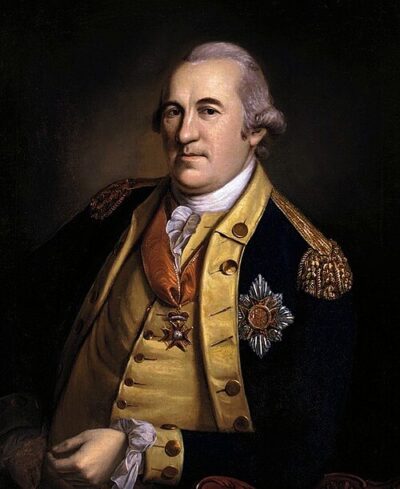
Friedrich Wilhelm von Steuben
Friedrich Wilhelm von Steuben was a Prussian officer and US Continental army general. Born September 17, 1730, in Magdeburg. Died November 28, 1794, in Utica. Positions held include Chief of Staff. Known for Revolutionary War Drill Manual. Awards include Order of Fidelity and Society of the Cincinnati.
Facts
22 facts · 2 confirmed by two sources · 15 cited · 4 from one source · 1 where the sources disagree
What’s different
- Died in: we show Utica (Sources disagree). Wikidata also lists Steuben
Where this comes from
Papalocal keeps its own record. It started from these sources; what each one said is kept here as it was copied, so a change on their side never changes this page by itself. Tap one to read its version.
What Wikidata says · copied November 15, 2026 · revision 2563985115
- Described as
- Prussian officer and US Continental army general (1730-1794)
- Other names
- Friedrich Wilhelm August Heinrich Ferdinand von Steuben, Baron von Steuben, Friedrich Wilhelm Ludolf Gerhard Augustin Louis Freiherr von Steuben
- Born
- September 17, 1730 · 7 references
- Died
- November 28, 1794 · 8 references
- Born in
- Magdeburg · 2 references
- Died in
- Steuben; Utica · 1 reference
- Buried in
- Steuben Memorial State Historic Site
- Name at birth
- Friedrich Wilhelm August Heinrich Ferdinand von Steuben
- Citizen of
- Kingdom of Prussia · 1 reference; United States · 1 reference
- Occupation
- military officer · 2 references
- Positions held
- Chief of Staff · 1 reference
- Worked for
- Joseph Frederick William · 1 reference
- Member of
- American Philosophical Society (1780–)
- Known for
- Revolutionary War Drill Manual · 1 reference
- Awards
- Order of Fidelity (1769) · 1 reference; Society of the Cincinnati · 1 reference
- Father
- Wilhelm Augustin Steuben · 2 references
- Mother
- Maria Justina von Jagow · 2 references
- Military branch
- Prussian Army (1747–1763) · 1 reference; Continental Army (1778–1783) · 1 reference
- Military rank
- Fänrik (1749–) · 1 reference; lieutenant (1752–) · 1 reference
- Lived in
- New York City (1784–) · 1 reference
- Wikipedias with a page
- 29
Wikidata item Q213525 (wikidata.org/wiki/Q213525), public domain (CC0). Copied November 15, 2026.
What Wikipedia says · copied November 15, 2026 · revision 1385527340
Friedrich Wilhelm August Heinrich Ferdinand Freiherr von Steuben ( STEW-bən or stew-BEN, German: [ˈfʁiːdʁɪç ˈvɪlhɛlm fɔn ˈʃtɔʏbn̩]; born Friedrich Wilhelm Ludolf Gerhard Augustin Louis Freiherr von Steuben; September 17, 1730 – November 28, 1794), often referred to in English as Baron von Steuben, was a Prussian-born army officer who played a leading role in the American Revolutionary War by reforming the Continental Army into a disciplined and professional fighting force. His contributions marked a significant improvement in the performance of U.S. troops, and he is consequently regarded as one of the fathers of the United States Army.
Born into a military family, Steuben was exposed to war from an early age; at 14 years old, he observed his father directing Prussian engineers in the 1742 siege of Prague. At age 16 or 17, he enlisted in the Prussian Army, which was considered the most professional and disciplined in Europe. During his 17 years of military service, Steuben took part in several battles in the Seven Years' War (1756–1763), rose to the rank of captain, and became aide-de-camp to King Frederick II of Prussia, who was renowned for his military prowess and strategy. Steuben's career culminated in attendance at Frederick's elite school for young military officers, after which he was abruptly discharged from the army in 1763, allegedly by the machinations of a rival.
Steuben spent 11 years as court chamberlain to the prince of Hohenzollern-Hechingen, a small German principality. In 1769, the Duchess of Wurttemberg, a niece of Frederick, named him to the chivalric Order of Fidelity, a meritorious award that conferred the title Freiherr, or 'free lord'; in 1771, his service to Hohenzollern-Hechingen earned him the title baron. In 1775, as the American Revolution had begun, Steuben saw a reduction in his salary and sought some form of military work; unable to find employment in peacetime Europe, he joined the U.S. war effort through mutual French contacts with U.S. diplomats, most notably ambassadors to France Silas Deane and Benjamin Franklin. Due to his military exploits, and his willingness to serve the Americans without compensation, Steuben made a positive impression on both Congress and General George Washington, who appointed him as temporary Inspector General of the Continental Army.
Appalled by the state of U.S. forces, Steuben took the lead in teaching soldiers the essentials of military drills, tactics, and discipline based on Prussian techniques. He wrote Regulations for the Order and Discipline of the Troops of the United States, which remained the army's drill manual for decades, and continues to influence modern U.S. army manuals. Steuben also addressed widespread administrative waste and graft, helping save desperately needed supplies and funds. As these reforms began bearing fruit on the battlefield, in 1778, Congress, on Washington's recommendation, commissioned Steuben to the position of Inspector General with the rank of major general. He served the remainder of the war as Washington's chief of staff and one of his most trusted advisors.
According to Peter Stephen Du Ponceau, Steuben's secretary and interpreter, "The Baron loved to speak of ... his sans culottes, as he called us. Thus the denomination was first invented in America ... when, it could not be foreseen, that the name which honoured the followers of Washington would afterwards be assumed by the satellites of a Marat and a Robespierre".
After the war, Steuben was made a U.S. citizen and granted a large estate in New York in reward for his service. In 1780, he was elected a member of the American Philosophical Society, a learned society that included many of the nation's most prominent Founding Fathers.
- Born, in its opening lines
- September 17, 1730
- Died, in its opening lines
- November 28, 1794
From the Wikipedia article “Friedrich Wilhelm von Steuben” (en.wikipedia.org/wiki/Friedrich_Wilhelm_von_Steuben), by its contributors, under CC BY-SA 4.0 (creativecommons.org/licenses/by-sa/4.0/). Copied November 15, 2026; not changed.
Confirmed Two sources agree. Cited One source, and it names where it got it. One source One source, without a reference of its own. Sources disagree The sources disagree. We show the best-supported value and keep theirs below.
