
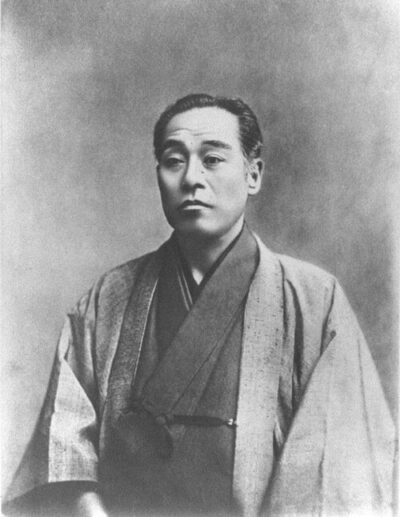
Fukuzawa Yukichi
Fukuzawa Yukichi was a Modern Enlightenment thinker, educator, philosopher, scholar, author, writer, journalist, translator, entrepreneur, and founder of Keio University in Japan's Meiji era. Born January 10, 1835, in Dōjima. Died February 3, 1901, in Shiba-ku. Known for Things western, An Outline of a Theory of Civilization and An Encouragement of Learning. Educated at Tekijuku.
Facts
35 facts · 2 confirmed by two sources · 3 cited · 30 from one source
Where this comes from
Papalocal keeps its own record. It started from these sources; what each one said is kept here as it was copied, so a change on their side never changes this page by itself. Tap one to read its version.
What Wikidata says · copied November 16, 2026 · revision 2564879300
- Described as
- Modern Enlightenment thinker, educator, philosopher, scholar, author, writer, journalist, translator, entrepreneur, and founder of Keio University in Japan's Meiji era (1835-1901)
- Other names
- Yukichi Fukuzawa
- Born
- January 10, 1835 · 3 references
- Died
- February 3, 1901 · 4 references
- Born in
- Dōjima
- Died in
- Shiba-ku
- Buried in
- Zenpuku-ji Temple
- Cause of death
- intracranial hemorrhage
- Name at birth
- 範
- Citizen of
- Japan
- Occupation
- translator; pedagogue · 1 reference; philosopher · 1 reference; professor; critic; journalist; writer; politician · 1 reference
- Worked for
- Keio University
- Education
- Tekijuku
- Member of
- Japan Academy (1879–1881) · 1 reference
- Known for
- Things western; An Outline of a Theory of Civilization; An Encouragement of Learning; Guide to travel in the western world; Puzzle; Worldwide; Teachings of Hibi; Calendar reform speech; Theory of the Imperial Family; The Complete Works of Fukuzawa
- Children
- Mitsu Fukuzawa; Sutejirō Fukuzawa; Ichitarō Fukuzawa; Daishirō Fukuzawa; Taki Fukuzawa
- Lived in
- Former Residence of Yukichi Fukuzawa
- Wikipedias with a page
- 49
Wikidata item Q355447 (wikidata.org/wiki/Q355447), public domain (CC0). Copied November 16, 2026.
What Wikipedia says · copied November 16, 2026 · revision 1372270934
Fukuzawa Yukichi (Japanese: 福澤 諭吉; 10 January 1835 – 3 February 1901) was a Japanese writer, educator, and philosopher who is regarded as one of the key figures of the Meiji era for his efforts to introduce and promote Western ideas and institutions in Japan. He was the founder of Keio Gijuku (the foundation of the modern Keio University) and the newspaper Jiji Shinpō.
Born into a low-ranking samurai family, Fukuzawa became critical of the feudal class system of Tokugawa Japan. He studied Dutch (Rangaku) and later taught himself English, eventually becoming an official translator for the shogunate. He traveled abroad with the first Japanese mission to the United States in 1860 and the first mission to Europe in 1862. These experiences convinced him that Japan needed to adopt not only Western technology but also its social, economic, and political institutions to achieve national strength and equality.
After the Meiji Restoration of 1868, Fukuzawa became a leading promoter of the Bunmei-kaika (Civilization and Enlightenment) movement. He declined all government positions, choosing to remain an independent educator and writer. His prolific writings, including the bestsellers Seiyō Jijō (Conditions in the West) and Gakumon no Susume (An Encouragement of Learning), explained Western civilization and advocated for social change. In Gakumon no Susume, he famously wrote, "Heaven never created a man above another nor a man below another," arguing that social status was determined by education and practical knowledge (jitsugaku).
Fukuzawa's views on foreign policy evolved from idealism to a pragmatic acceptance of Social Darwinism, arguing that military strength was essential for national survival. In his influential 1885 editorial "Datsu-A Ron" ("Leaving Asia"), he advocated for Japan to align itself with the "civilized" nations of the West and distance itself from its "hopelessly backward" Asian neighbors. He became a strong supporter of the First Sino-Japanese War. Fukuzawa's legacy is immense but complex; he is revered for his foundational contributions to Japan's modernization, education, and the promotion of individual liberty, while his later embrace of nationalism and imperialism remains a subject of debate. His portrait appeared on the 10,000 yen note from 1984 to 2024.
- Born, in its opening lines
- January 10, 1835
- Died, in its opening lines
- February 3, 1901
From the Wikipedia article “Fukuzawa Yukichi” (en.wikipedia.org/wiki/Fukuzawa_Yukichi), by its contributors, under CC BY-SA 4.0 (creativecommons.org/licenses/by-sa/4.0/). Copied November 16, 2026; not changed.
Confirmed Two sources agree. Cited One source, and it names where it got it. One source One source, without a reference of its own. Sources disagree The sources disagree. We show the best-supported value and keep theirs below.
